Why the manufacturing industry is likely to rethink.
The article about the necessary paradigm shift had triggered quite a response and I have therefore had various conversations about the future production of industrial goods over the last few days. While obvious paradigm shifts such as 3D printing are becoming foreseeable, others remain rather hidden. A few thoughts at a time when the production of even complex goods is becoming a commodity.
(Reading time: 5 minutes)
Digitized production
A lot is being written at the moment about the topic that is currently being referred to as Industry 4.0. The Internet of Things is said to play a role. Robots too. People will have less and less work. These are scenarios that are both threatening and tempting for a country like Germany. Threatening because at the moment no one can yet see clearly what the thousands of workers will one day be doing. Tempting because, as an industrialized nation, we have a supposedly perfect, but certainly good, starting position. At the moment, fear prevails. Understandably so, in my opinion.
Intelligent systems for super automation
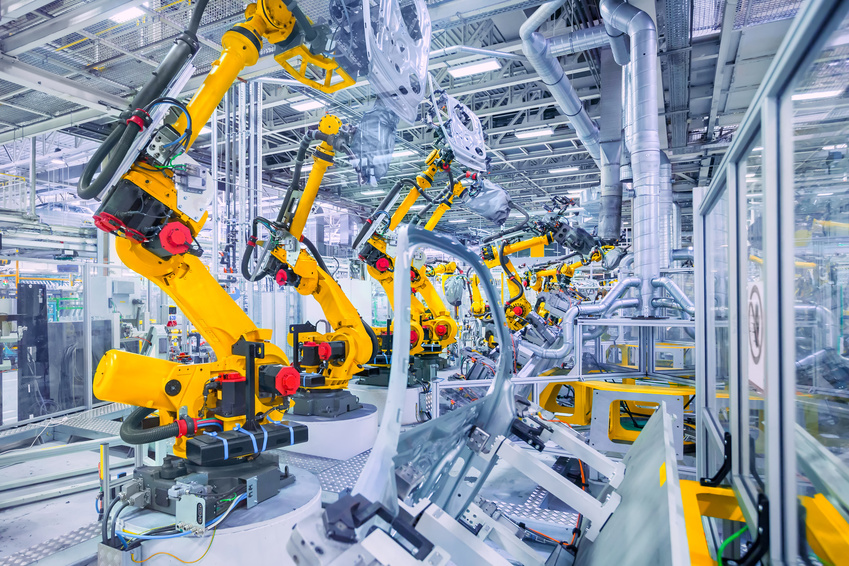
I think it is foreseeable that we will have super-automated production (watch out for the buzzword bingo alert) in the future.
While in many areas we are still striving for full automation, i.e. a production process that does not require human labor or intervention, I think the next step is super automation. Superautomation is full automation at a speed where human intervention would only slow down the process.
The concept is by no means new and there are already super-automated productions in various (simple) areas. The “new” thing is that we will see this in complex products in the future. Cars, for example.
This means that production speeds can be achieved that are unimaginable today. And production costs fall dramatically as a result.
Artificial intelligence
Artificial intelligence plays a significant role in this development. Today’s robots are comparatively rigid in production. Most of them are unable to react to even minor deviations. As soon as they are equipped with the appropriate artificial intelligence, they become considerably more flexible and can be used for complex tasks.
Paradigm shift: a holistically designed, software-based factory
However, the real turning point in the manufacturing industry lies in the paradigm shift away from actual production towards the construction, maintenance and ongoing further development of a holistic, software-based production machine. This is a new and unfamiliar way of looking at production.
So I believe that in future, production people should concentrate on building a holistic machine that can manufacture complex products in a super-automated way.
This machine is basically the entire factory – not individual robots or a production line. An entire factory that functions under a holistic concept and is completely software-controlled and learns accordingly. In this context, IoT is only a (necessary) basic technology.
I certainly didn’t invent the concept, this paradigm shift. There are already some engineering protagonists who are moving in this direction. One person who has taken up the discussion in recent months, probably out of necessity, is Tesla’s CEO Elon Musk. He says:
“We realized that the true problem, the true difficulty, and where the greatest potential is – is building the machine that makes the machine. In other words, it’s building the factory. I’m really thinking of the factory like a product.”
Of course Musk has to think about this (and say something about it). After all, he promised half the world that he would deliver the Model 3 in the shortest possible time. An undertaking that does not seem possible according to conventional procedures. And the production managers of German car manufacturers will have laughed up their sleeves when Musk even shortened the planned delivery dates. Nobody can be that stupid. The next few months will show whether the “machine-makes-the-machines” concept will work.
Upheaval for an armada of sub-industries
The investments in such new production concepts are huge and risky. You only do something like this on a large scale because you have to. Tesla, as we all know, has to if it wants to live to see the next decade.
The integration of production processes is also resulting in major changes for suppliers, who are already struggling. This is because a just-in-time production concept with many suppliers, some of whom are geographically distant, has only made economic sense in recent years. Physically, however, decentralized production is generally more complex. If production can now be super-cheap and integrated, it soon no longer makes sense to source parts externally.
This results in vertical integration on the production side, which offers the manufacturer enormous advantages. It reduces dependencies, secures the characteristic sovereignty of the products and makes it possible to fundamentally increase the speed, think in terms of the time span from raw material to end product.
To make matters worse, investments in such integrated production machines are difficult for the often medium-sized suppliers to afford. On the other hand, such a change does not happen overnight. We have time.
That’s how much time it will take for a manufacturer to make a breakthrough with its new production concept. I expect this to happen in the next 10 years. Tesla could be that manufacturer, but I think it’s rather unlikely that we’ll see that any time soon. What is more likely with Tesla’s Model 3 is a mix of extremely efficient production with the shortest possible lead times – coupled with significant delivery delays.
What do all these people do then?
I am regularly inundated with questions about what all the workers are going to do. How this will turn out socially. To be honest, I have no idea.
And with good reason: no one can reliably predict today what complex new products we will have in the future. And what jobs they will demand.
However, I assume that we will again have products that are so complex that it makes no economic sense to produce them in a super-automated way. On the one hand, because we won’t be ready with the technology as we are today with cars, or on the other hand because the smaller quantities don’t allow investment in super automation.
The difficult thing about this thought experiment is that we cannot imagine future jobs because the products for which they are needed do not yet exist. Or would you have thought in 1996 that there would be hundreds of user experience designers in Germany in 2016?
Artikel auf Social Media teilen: