Disruption in the automotive industry: Renault, the forgotten winner.
The Paris Auto Show 2016 is in full swing and one gets the impression that never before has an automotive event been so focused on electromobility. The German press was jubilant. They saw pioneering concepts from Porsche, VW and Daimler. However, the real winner in European electromobility is not celebrating. It is already one step ahead.
(Reading time: x minutes)
Allez les Bleus!
I was socialized with Renault, so to speak. And let me tell you, I never really liked the car. Whenever we had to change the family car, I always hoped that we might get a German car. German cars, it seemed to me, were in a different league in terms of quality. Whenever something broke down on the Renault, this feeling was reinforced. Later, when I bought my first car, I bought a BMW and yes, that was a different world.
When I once asked my father why he always drove a Renault, he replied: “Because they’re always doing new and innovative things”. I couldn’t make much sense of that at the time. Of course, the car used a woman’s voice to tell you when the oil level was too low, you could roll down the windows with the remote control and most Renaults had all sorts of things that you couldn’t find in a Passat back then. But oh well.
Price/performance
However, Renault’s price/performance ratio was always pretty good, especially when it came to repairs. And I really needed it back then: once, as a 13-year-old, I wanted to reverse the car out of the garage in neutral, as I often did, but forgot to pull the door shut. I can still see the image of my father cursing as he drove to the garage, holding the badly damaged door shut with his left hand because it wouldn’t close. A few years later, I rear-ended his fairly new Renault in a queue of traffic. Both times the costs were kept within reasonable limits. I couldn’t say the same about BMW later on.
Try & Error
As a consumer, it seems to me that Renault has always created and tried out new things. Some of them were a complete success. For example, the first private van in Europe – the Renault Espace. Others not so much.
Tesla killer
At the Autoshow, we saw German manufacturers announcing new strategies and concepts in a grandiloquent manner. And there is often subliminal talk of a Tesla killer. Of a car that will outdo the Tesla models.
If you look closely, the newly presented cars are comparable to models that are already available from Tesla today. However, the German manufacturers only want to be able to deliver from 2019. This is quite ironic, because at the beginning of the year there were voices from the German automotive industry accusing Tesla of presenting a car with the Model 3 that was not even available yet.
However, the success of the Model 3, which is purely virtual for the time being, was definitely one of the main drivers for the established manufacturers. Because they can do the math: If Tesla manages to grab a relevant market share in the premium segment, then they will also be able to do so in the mid-range segment. The fact that 400k reservations are just the beginning is just as well known in Germany as it is in the USA. Something has to happen now, otherwise the tide may turn.
With all the media focus on Tesla, it was completely forgotten where the real competitors are, as was evident at the Paris Auto Show 16. This is all the more bitter as Tesla was never interested in beating any car manufacturer.
Because if there is any competition for the German car manufacturers, it is Renault-Nissan.
The really uncomfortable question
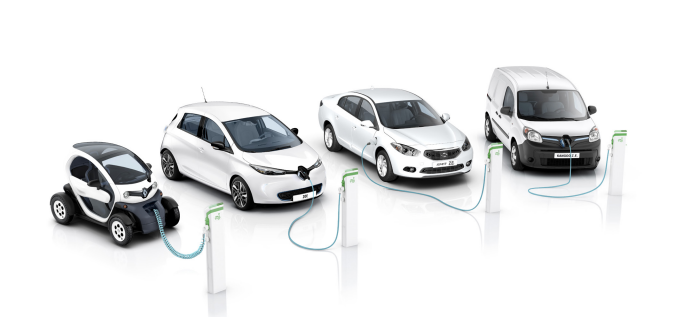
The really uncomfortable question for German car manufacturers is why Renault-Nissan has now become the world market leader in electric cars. Every third electric car in Germany comes from Renault. Every second electric car worldwide comes from Renault-Nissan.
And so it is that while VW and Daimler are presenting the future, this future is already on the Renault stand. A car with a real 300km (400km NEDC) range at a price of around 22k EUR. Available to order and deliver today.
What can Renault and Nissan do that the German manufacturers obviously can’t?
If you look closely, it is no wonder that a start-up manages to bring a new, physically superior technology to the market with a lot of luck, chutzpah and passion, even if this statement is not intended to diminish Tesla’s achievement: The ability to start on the white sheet is the one huge advantage of any start-up. It makes things possible and unleashes forces that you can only dream of in established companies.
That’s why this question is so uncomfortable: What can Renault and Nissan do that the German manufacturers can’t? If I were a shareholder, I would ask this question.
More relaxed, more serene
As if that wasn’t ironic enough, Renault-Nissan boss Carlos Ghosn also declared in his presentation that “diesel is not dead yet” and that Renault-Nissan would indeed continue to develop SUV models with diesel engines.
It is clear that Renault-Nissan, and this is probably also thanks to Ghosn, is approaching the issue of technological change in a much more serene and calm manner than the German manufacturers. Renault-Nissan invested in the new drive technology at a very early stage and did not pursue any absolute “either-or” strategies. This, and here we come full circle, goes hand in hand with the playful innovation that Renault has always displayed. It seems as if Renault-Nissan is simply more open to new technology and has less “not-invented-here” syndromes to contend with.
A path that has currently made them the clear market leader with enormous growth rates. And things are looking pretty good for them when it comes to electromobility.
And they have also done some things right that the German manufacturers still don’t seem to have understood. For example, that electric cars must not look like Batmobiles if they want to be bought. Or that large-scale neon blue is not a color that belongs on an electric car, not even in LED. The Renault Zoe, on the other hand, is simply a decent car. People who don’t know the model don’t even realize that it’s an electric car. It is completely obvious that futuristic design escapades are totally counterproductive. And yet VW, BMW and Daimler keep making the same mistake.
Learnings
Even though it may seem like I’ve become a car nut, that’s not the case at all. What fascinates me about this topic is that an entire industry is being turned upside down before our very eyes and it was quite foreseeable that this would happen. You just have to look closely.
And it is fascinating to see how the individual players develop strategies and how strengths become weaknesses and vice versa.
If you are an entrepreneur or decision-maker, you can learn a great deal from these examples at the moment and apply them to your industry. Because many other industries will go through the process that the automotive industry is currently going through in the future. Most of them sooner than they would like.
Artikel auf Social Media teilen: