
No stone is left unturned in mobility.
In November 2018, I had the opportunity to give a presentation on digitalization in mobility at the “ioki Mobility Network Symposium” in Berlin. It was a great event that brought many different stakeholders from the mobility industry together and engaged them in discussion. As one of the few people from outside the industry, I was able to present my outside perspective as a person involved in digitalization. Here are a few thoughts on the mobility of tomorrow.
(Reading time 5 minutes)
In the discussion about the mobility of tomorrow, I think it is important to address a few basic principles.
Mobility cannot be prevented
We often hear from people in the mobility industry that consumers should be influenced in their behavior. More people should use public transport, fewer people should fly or drive. People should travel less. I think that’s an impossible approach. After all, people are explorers. We are fundamentally mobile and driven by an inner need. Fighting against this is as futile as it is wrong.
First and foremost, people are “explorers”. Secondly, they are lazy.
I am of the opinion that changes in mobility behavior can only be achieved through proportionally better offers. This can be achieved by improving one offer or making the other worse. Consumers generally do not understand artificial deterioration.
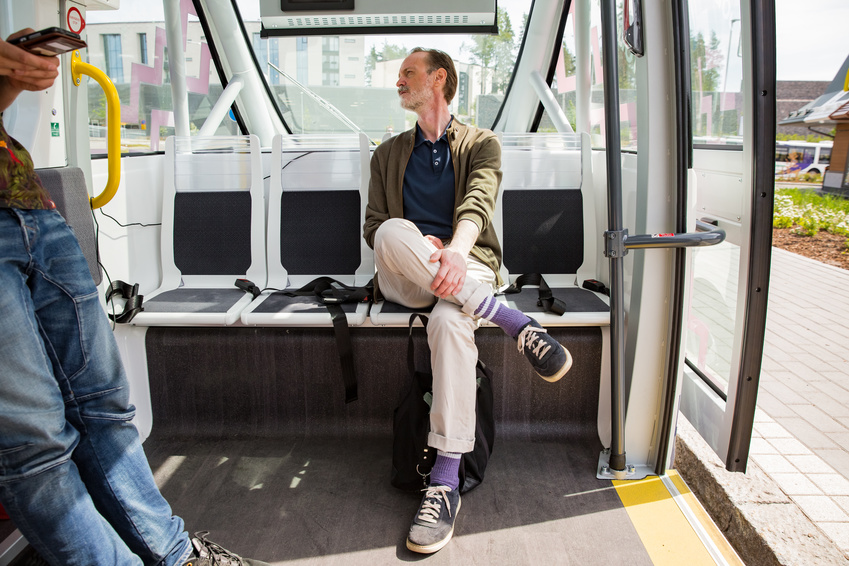
You can see the effect very clearly, for example, in people who have spent half their lives commuting to work in the city by car and are then so burdened over time by the increased traffic jams and delays that public transport is now the better option for them. I believe that people always do what is easiest for them. If you want to change social behavior, it’s a good idea to start there.
Mobility is of inestimable social value
However, we should not prevent mobility in principle, as mobility always means a change of perspective and getting to know new circumstances. This creates differentiation and perspective and this is invaluable, especially for our pampered Western societies. If we want to understand our world and be understood, we have to go out into it.
Mobility is never environmentally friendly
Germany and Switzerland in particular are good at trying to solve problems “holistically”. That is, if I may say so, quite nonsense. We come from this noisy, sooty, inefficient mobility system and now we want a perfect, completely sustainable and comprehensive solution. A not insignificant proportion of people even believe that it is better to stay with the status quo than to “only” make incremental improvements. This effect can be observed particularly well, for example, in the discussion about the switch to electric drives.
Mobility is never environmentally friendly. It is only more or less harmful to the environment. Whenever molecules are transported around, this is fundamentally disadvantageous for the existing ecosystem. We should not pretend that this can be changed. Instead, we should realize the incremental improvements in “every nook and cranny”.
Everything is a “turnaround” today – the mobility turnaround does not have a high probability
In the mobility debate, people keep talking about the mobility turnaround. As I mingled with people before the lecture and had a drink, I heard the phrase “everything must be a turnaround today” from the next table.
And quite a few people imagine the change to a new form of mobility as a kind of abrupt, controlled, collective action. I don’t think this idea is entirely wrong. After all, the sector is highly regulated and you might think that you only need to influence it politically to bring about change. That is certainly possible. But not on a scale that would allow a turnaround in transportation. Mobility as a whole is too fragmented. Too many interests are represented at the table.
Autonomous driving as the basis for a mobility revolution
I think it is much more likely that we will have a true mobility revolution, driven by the fact that we will have autonomous vehicles. In my opinion, mobility experts often make the mistake of neglecting autonomous driving “as a distant potential development”, so to speak.
We are also subject to the classic, intuitive misjudgement with regard to this topic: we overestimate the short-term possibilities of autonomous driving, while completely underestimating the long-term possibilities.
It is often said that autonomous driving will take a very long time before it is suitable for everyday use. The talk is always of 15 to 30 years. And for this reason, it is probably not so relevant to think about it at the moment. This is an astonishing statement in that mobility projects always have very long terms. The planning of BER alone took around 15 years before construction began. The Gotthard Base Tunnel took 23 years from exploration to completion.
So 15 to 30 years is a comparatively short time in the world of transportation. Even if this does happen, the change will come relatively soon by the standards of the mobility world. However, I think there is a high probability that the first providers will have autonomous vehicles available in civilized areas within 5-7 years.
Landslide
The chances that the autonomous vehicle will trigger a veritable landslide in mobility are extremely high. The reason for this is quite simple: it can save enormous costs. There are two main reasons for this.
Elimination of operating personnel
Autonomous vehicles require fundamentally fewer people to keep them in operation. One of the biggest cost blocks in transportation is simply eliminated.
Higher allocation of investment costs to the mobility service
Autonomous vehicles can also be kept on the road almost permanently, which means that the investment costs can be spread over more kilometers. This makes the individual kilometer considerably cheaper.
Enormous cost-saving potential is the driver par excellence for being able to launch new innovations quickly in an industry. The fact that autonomous vehicles will also be digitally built vehicles also has an accelerating effect. This means that completely new services that are much more convenient for the customer are also possible. This is an explosive mix.
Everyone in the transport industry is affected by the new opportunities
When talking to people in the mobility industry, I often sense that they are hesitant about the impact that autonomous driving will have on public transport. Autonomous vehicles will be of crucial importance for public transport in particular, as they will make it possible to switch from rigid timetables to a rolling, planned journey system. Imagine if all vehicles were small passenger buses that basically stopped at any point in a city. Depending on the volume of demand. Journeys are combined – not just passenger journeys, but also deliveries of small consignments of goods, for example.
And maybe you’re thinking: “Well, it’ll take ages and it’s difficult until something like this comes along.” However, I believe that these concepts will spread like wildfire. On the one hand, there are enough players who are just waiting for it. Like Uber, for example, which is basically one huge bet on the autonomous vehicle.
As soon as such an offering is launched, it will be so much better than what we have today that people will literally jump at it.
Mobility as a service
In my opinion, the discussion about “Mobility as a Service” is therefore going in the right direction. The key question here is whether a provider will succeed in establishing itself as a platform for cross-modal mobility. From today’s perspective, the chances are not bad, especially for the big tech companies. Google can already do quite a lot in this respect. It’s also quite conceivable that Amazon will clean up the field from the other side, so to speak, from goods logistics. I have already mentioned Uber in this context.
The main focus will be on establishing a standard to combine mobility services from as many different systems as possible (not just technically speaking). In the mobility scene, this is referred to as “mobility roaming” in reference to mobile telephony. The idea is that whoever sets the standard dominates the market. That may be the case, but in my opinion it doesn’t necessarily have to be.
What is perhaps not yet so obvious is that other players, above all Tesla, can also play a major role. If the plans of Elon Musk and his people work out to some extent, in ten years they will own or have direct access to technology for autonomous driving, a large fleet of autonomous vehicles (Tesla), their own energy production and storage (Tesla), their own global satellite-based data network (SpaceX), their own technology and capacity for the cost-effective construction of tunnel infrastructure (Boring Company) and corresponding new technology for high-speed transportation (Hyperloop). Even if not all plans become reality or come too late, it is an impressive mix of components that could have a major impact on the future of mobility.
Basically, however, I think that the field is still open. As we have seen in other sectors, the cards are slowly but surely being reshuffled.
In my opinion, those who try to be radically innovative and have the courage (courage in an entrepreneurial context can be read as “risky investments”) to turn these innovations into fundamentally better products are rewarded.
I think the game for the future of mobility is only just beginning.
Artikel auf Social Media teilen: