The “Digital Transformation Model”
Two years ago, I used a simple graphic to explain the digital transformation. To my surprise, it was quickly very well received. The model was taken up by many industry colleagues, sometimes used in presentations and referenced in articles. And it brought me hundreds of contacts and conversations with interesting people. Time for a professional remake.
Reading time: 3 minutes
Why remake?
Two things have always bothered me about the original article. For one thing, the rather, well, stupid name of the original article (Digital Transformation – it’s about adaptation, stupid!) and the inferior “quick & dirty” graphics, which to make matters worse also contained a mouse pointer “forgotten” by the screenshot (which also shamelessly shows the level of laziness – I didn’t even want to cut pictures).
However, the mouse pointer has always been the source of all kinds of amusing stories. Because it is not usually immediately recognizable. When I discovered the graphic somewhere, I sometimes jokingly asked if it was a screenshot of my blog. The confusion was correspondingly great. Because, in fact, people copied it (which I think is perfectly okay). Now enough of the stories – let’s get down to business.
The “Digital Transformation Model”
Digital transformation is the buzzword of the hour at C-level and among marketing staff. I keep noticing that there are a lot of people who use the term but don’t seem to really know what it actually means. Well, it’s quite simple: it’s about the adaptation of technology by customers/individuals and companies.
If a technology is available, it will be used sooner or later.
The essential part of this is when a technology is used by customers on a broad scale and how companies react to it. At its core, this is what digital transformation is all about:
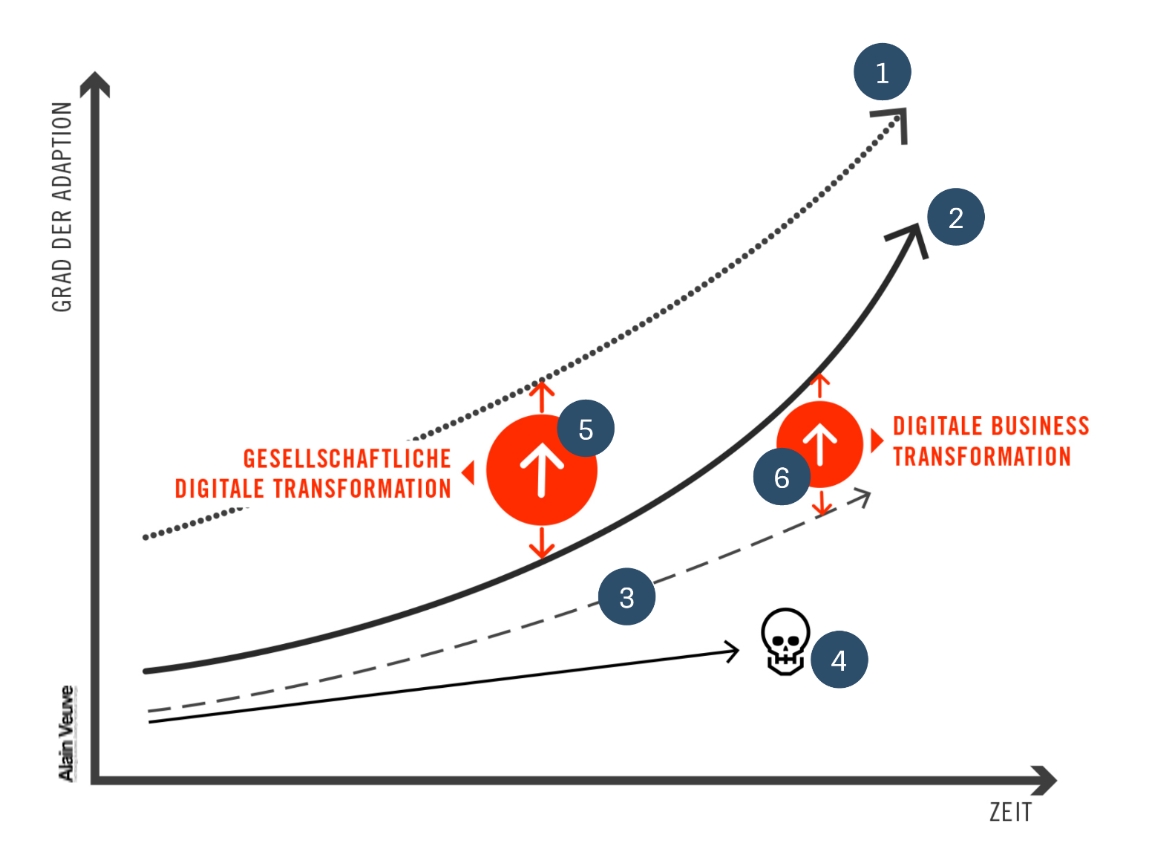
1. technological development
This straight line shows the course of technological development. It goes without saying that technological development is always ahead of adaptation by users and companies.
2. adaptation of the technology by customers
This curve shows the adaptation of the technology by society or (because we are talking in a business context here) by customers. It is typical that when a new technology appears, customers are initially hesitant to use it. Once a critical mass of users has been reached, use usually spreads “by leaps and bounds”. This is simply because we humans are much more likely to do something that our fellow human beings do.
3. adaptation curve of the average company
In simplified terms, this curve shows the degree of adaptation of the average company. It traditionally lags behind social adaptation. If the adaptation behavior of users changes very quickly, as is now the case in the digital revolution, companies are taken by surprise and fall behind. This is what has happened in the digital sector over the last 10 to 15 years.
4. adaptation curve of the doomed companies
Typically, there are always companies that fail to adapt to the new market environment. There can be various reasons for this, such as a lack of market analysis, a lack of willingness to change, a lack of change management and even a stoic “it’s-always-been-this-way-we’ve-always-done-it-this-way” attitude. A quick look back over a person’s lifetime shows that there has never been a time when a market environment has not changed rapidly. These companies will not be able to adapt and will sooner or later disappear from the market.
5. social, digital transformation
The convergence of the user’s technology adaptation curve with the technology provided can be described as a social, digital transformation. This is what we can observe in ourselves every day. It is how and when we use new technology. I know you have dozens of examples in your daily life. If not, please send me an e-mail. I’m curious to see if we really can’t find anything. Change is not always obvious.
6. digital business transformation
The convergence of the technology adaptation curve of companies with that of users can be described as digital business transformation. Companies must change their communication, their products and their business model to meet the new needs of users/customers. The fact that the focus is on the user and their behavior – and not on the available technology – is absolutely crucial.
If the company focuses on the technology that is already available, it will overwhelm the users/customers and simply not find the critical mass to operate the service economically. There are numerous examples of this. For example, an internationally active premium manufacturer that I was able to advise for several years. At the turn of the millennium, an eCommerce offering was created there for a large sum, which unfortunately never achieved the desired sales and therefore became an internal debacle. If you look at the adaptation and acceptance of eCommerce at that time, it quickly becomes clear that there was not yet a great need to be able to order online. The company had created an offering that was ahead of the social adaptation of the technology.
In the case of my client, this experience led to a kind of traumatic obstacle that continues to have an effect to this day. While huge sums are being invested in conventional stores, the digital sector is being frittered away on a shoestring budget. The company runs the risk of misjudging the development of user needs for a second time.
Infographic
The above model explains the interaction between technological development, the adaptation of technology by customers and the reaction of companies to it. In principle, it applies to all technologies. What is particularly striking about digital technology is the speed with which it has entered our society. Most companies were and are surprised by this and fall behind, which they now have to overcome in a special effort.
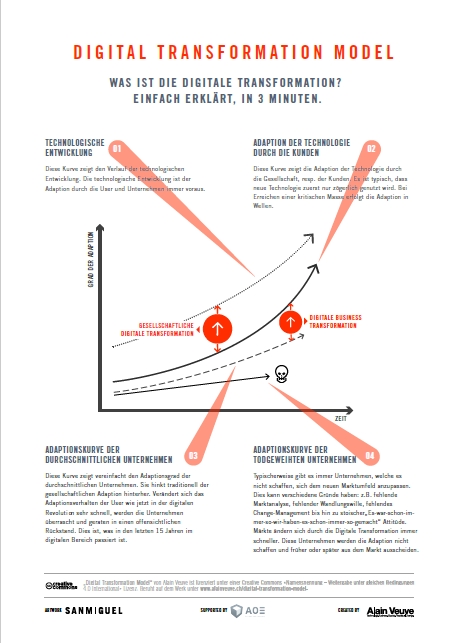 Infographic: Digital Transformation Model
A short summary of the Digital Transformation Model can be downloaded here. All material may be copied, shared and adapted. The only request: reference or link back to alainveuve.ch
Artikel auf Social Media teilen: