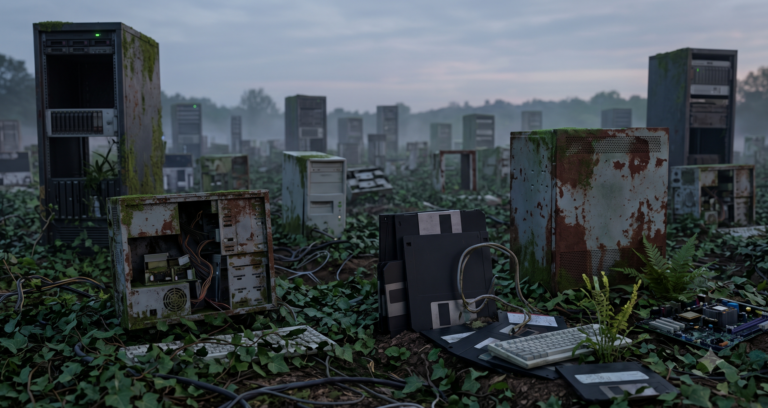
The ERP needs a fix. It is broken.
I’m sure you know the situation: your CEO wants customer process XY to finally be digitized, an agency has been flown in and designed a great app and everyone is in good spirits that you can move forward quickly and agilely. Until someone asks how they intend to continue designing the process in ERP. Suddenly, things become incredibly complicated. What started out great and with momentum is soon just another colorless project that seems to go on forever. Good ideas die the “ERP death” in large companies today – not always, but surprisingly often. A reappraisal of why ERP needs to be rethought and rebuilt and why this is important for us all.
(Reading time: 5 minutes)
Death by ERP
I have experienced this effect around 40 times in the last 10 years. What was intended to be great and could actually be implemented quite simply is unintentionally hindered, slowed down or completely prevented by a monolithic, business-critical system. And leaves behind frustrated employees, employees who actually want to help the company move forward.
The whole thing sometimes leads to strange consequences, as people get creative; instead of an ERP integration, isolated and/or parallel solutions are set up. Paradoxically, many of these constructs are also much cheaper than a solution via ERP integration.
So what is actually there to give companies a competitive edge is increasingly becoming a brake on digitalization. If you look at the situation from a distance, it makes sense: the time in which ERP was established as a concept was a completely different one. The concept of one-dimensional “Enterprise Resource Planning” – it fits less and less into a time in which companies have to be fast and therefore agile.

ERP is broken
And that’s why ERP as an instrument is simply a bit “broken” today. You can ask any CIO, I have yet to find one who doesn’t think ERP systems are simply overpriced and too rigid. Of course, this is not something that would be announced on the conference stage or in the interview panel – because nobody loses their job if they choose IBM, Oracle or SAP. However, when the curtain comes down, the dramas surrounding ERP migrations and the like are reported quite openly.
Another fundamental problem is that processes are often developed separately from the operational control of people and machines. This results in a dizzying amount of knowledge transfer and correction costs, which also keeps a whole armada of middle management people artificially “busy”. We have generally accepted this waste of time as natural work. And as if that weren’t strange enough, we are also constantly optimizing this work. There’s nothing worse than optimizing things that shouldn’t be here in the first place. This old engineering truism seems to be completely unconscious in the management context of large companies.
Time for a new system
I think it’s time we started working on a new system for corporate management. Let’s think again from the beginning: the aim is to generate as much output as possible with as few resources as possible.
There are resources that ultimately contribute directly to the output and those that have to be brought in to correctly allocate the other resources in terms of time, space and intensity. These overhead resources need to be reduced as much as possible. We can do this by creating a holistic system for the independent allocation of these resources.
The first key point is that process design is directly linked to implementation. A designed process should lead directly to executable code. “No-code” sends its regards.
A second key point is that processes should change and improve in a self-learning way. The tiresome, endless work of process optimization is complex, usually too complex for people. I have so often experienced bad improvements in this area – insidious, difficult issues that only become apparent when the damage has long since been done. Previously achieved efficiency gains are often “optimized to nothing”.
The future present is determined by a man-machine complex
What is often overlooked is that we have been working hand in hand with machines for a long time. In the business sector, there is sometimes too much manic striving for full automation and from a technical point of view this is usually very exciting, but the reality is that in almost all cases human-machine systems are superior to pure machine systems.
This is due to the fact that machines are still not as proficient as humans in many disciplines of a job. However, we are on the journey towards a transition to a situation where many of the tasks known today as work can be better performed by machines. On this journey, the man-machine combination achieves the best economic results. Doing everything manually is just as wrong as wanting to automate everything. At least as long as technology cannot keep up with people.
Two things are relevant in conclusion: The lean allocation of tasks between humans and machines is extremely important to reduce the consumption of “overhead resources/costs”. The second important point is that the transition from human labor to machine labor can take place as continuously as possible and with as few upheavals as possible in order to continuously reduce the consumption of “transformation resources/costs”.
“The ERP of the future must be a system that fundamentally supports companies in their efforts to adapt to new realities quickly and cost-effectively.”
Specifically now?
Specifically, this must be a system that treats machine and human units (don’t be confused by the somewhat strange name) equally. Each of these units has a corresponding skill profile, a kind of repository of proven skills.
Starting from the desired end result, processes are mentally decompiled in the system into individual “intermediate deliverables” and the combination of these intermediate steps form what we understand today as processes. The system now compares the skill requirements with the various skill profiles and assigns individual tasks to the units. This allocation of tasks to units must be self-learning and autonomous. The allocation should also attempt to actually parallelize as many tasks as possible that are only performed “pseudo-serially”. A step is “pseudo-serial” (you don’t have to google it, it’s made up) if all steps in the entire process chain are serial, although only a few actually require seriality physically. This is surprisingly often the case in production systems, simply because it is more expensive today to manage allocation complexity than to serialize the production process. A system supported by artificial intelligence can resolve this complexity.
It should also be irrelevant where a unit is located spatially or in relation to its domain. Various units can be easily integrated via an API and added or removed as required. For the units, including the human ones, this results in a simple list of tasks to be completed without having to worry about what has priority where and how.
Human-machine interface
In my opinion, a key component is a user interface that can capture human interactions in a standardized API. Think of it as a single API for all the applications on the planet. I am already aware that this is insane. Simplifying the transition from human to machine work leads back to the core of the ERP via a standardized interface. This makes it easy to change. The transformation costs are virtually eliminated.
Striving for radical improvement
That all sounds pretty crazy at first. Especially in comparison to your ERP project, which you may have at the moment, where it is perhaps a matter of introducing some new payment slip and half a soccer team is employed for 3 months for this. But let me be very clear, we must also strive for radical improvements in the area of business software. The higher you aim, the higher you hit. Improving what we have is of comparatively little use – we need to create new approaches.
Productive work vs. creative work
You will now be thinking, this is a dark world, we humans are referred to as units and degraded to robots that are told exactly what to do.
We already live in this world, you will probably literally have a superior. You’re just doing it all incredibly inefficiently and you’ll turn away from your day’s work every now and then in frustration.
It is important, and I think this is where many people make a mistake, not to confuse productive work with creative work. Productive work can only ever be structured and optimized; anything else unnecessarily increases the costs of the “product”. Creative work, on the other hand, is usually difficult or impossible to raise in costs. The result of creative work must always be a gain in knowledge (incidentally, this is also the case in the field of art in the broadest sense). Methods that are successful in productive work cannot, by definition, be successful in creative work.
Just because we do work in an unstructured, uncoordinated way or in individual, non-industrialized steps does not make it creative work. Rather, it is simply poorly organized productive work.
The future of human labor lies in creative work, and I believe that the more we allow production work to be done by machines, the more we will be able to tackle the really big creative challenges of the future. If the potential is released, the potential is only really recognized, so to speak. In my experience, this creative work is what fulfills people spiritually – you can already see that in your children. Creative work keeps them busy – with productive activities, the attention span is usually short.
The future
The question is how quickly we can make progress with this. In my opinion, the question is of overriding importance. Half the world runs on ERP systems that slow us down. An ERP of the future must accelerate us, beyond borders, beyond units and cultures. We need to work much better together.
(Triggered? DM me.)
Artikel auf Social Media teilen: