Why you should do community management instead of marketing today!
The marketing concepts used today are still largely based on knowledge from before the internet. Although more modern and up-to-date models are taught today, the marketing managers at work today usually have no real idea. Of course, this does not stop them per se from doing as many things as possible on the Internet or in social media. Unfortunately, however, very often with extremely modest success. But it wouldn’t be that difficult: once you understand that you have a community. And not a “sales base”.
(Reading time: 6 minutes)
Dinosaur concepts
When I was studying marketing about 10 years ago, I was taught by an older gentleman. As a marketing manager, he had successfully launched various products in the shower gel sector (for our Swiss: shower gel). Among others, “Dusch-Das” (who still knows it).
For him, marketing was mainly about managing the budget via the 4Ps. That’s a huge oversimplification, but it was really mostly about which channels to use to sell the products, how much money to invest in which measures and, statistically speaking, what returns you can expect. That was a great thing, because there was often a very clear right or wrong (in the exams). Something I had never experienced in my marketing practice. Online marketing was not mentioned at all, even at my vehement suggestion. Word-of-mouth got half an hour. In 4 full semesters.
Now you will say “Well, my good man, that was 10 years ago and yes, that was a long time ago”. But I have some colleagues who, like me, are now approaching their late 30s and have just such a CMO job. Unfortunately, they still think more or less along these lines. They run “campaigns”, want to create “brand awareness”. Create a “brand world”. I silently think to myself more often than I would like “Oh kids, as long as you’re not Gucci, you don’t have to work on the brand world”. Why? Because I think the time for such thought patterns has passed. Quite simply because we have arrived in the age of networks. Hello World!
The age of networks
For me, the most important role is played by the customer experience (at this point, I would once again recommend the book“Conversational Capital – How to create stuff people love to talk about” by Sid Lee, the absolute CX thought leaders in my view) and, above all, word-of-mouth ( WOM ). This has always had a significant effect on the success of efforts, but has traditionally been kept quiet. The reason is simple: WOM was not really tangible in the analog world because it took place in secret. Among friends, at the regulars’ table, on Sundays after church. It would be even nicer if something so diffuse were responsible for the success of marketing and advertising.
Today, however, we live in a different world. In a world of networks, of social networks. And WOM is more important than ever for all marketing activities. The good thing today is that WOM can be measured. Followers, shares, likes, etc. are all characteristics that reflect these mechanics within WOM. This is not an exact and certainly not a complete science. And I don’t think it should be.
Complexity of the networks
I believe that we are still a long way from understanding and grasping social networks in detail. This has to do with the fact that these are complex, dynamic systems and we do not (cannot) systematically include all relevant factors when considering them. For example, whether a “piece of content marketing” (sic!) is often read and shared depends on a variety of factors and constellations. Technical and content-related constellations that we know well and “soft facts” that we often forget. Simple examples. The “attention competition”, the weather, different share routes, tipping points.
“Communication”, “PR” and “advertising media” in a world of networks? Oh dear.
It’s not much use trying to “do the doctorate” in detail on a complex, opaque topic like social media. Even if that’s what you might be sold from time to time. After all, the hype of the moment is content marketing. Tomorrow it will be something else again. We in the digital industry are excellent at repainting the pig we chase down the alley every now and then.
However, a real paradigm shift in marketing would be to view customers and the entire surrounding system as a community of interest. And to see your own company as a facilitator in this community.
“You make a real paradigm shift when you start to view your customers as a community.
”
Because community management is something completely different from the unidirectional customer relationships practiced today. And no, dear marketing people, if the customer calls the call center to complain or fills out one of those endlessly long surveys just to win an iPad at the end, then that is not bidirectional communication.
The joke here is that it is no longer so much about communication from the company to the customer/prospect or vice versa. No, communities are about communication between the community members themselves. This is not so easy to grasp after 70 years of “MarCom”. My approach is as follows:
The community approach to marketing
As I’m sure many people know, I’ve spent a lot of the last few years in the TYPO3 community (and am still very active) and have learned there how such communities work. Not learned in the sense that I now have it all figured out. Oh no! Rather in the sense that certain types of community members can be categorized. I use the concept of “community onion” for this purpose:
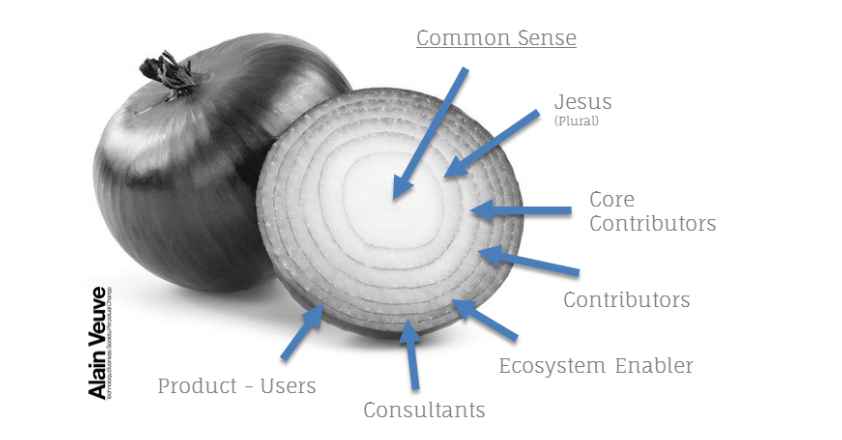
The basic idea behind this approach is that there is a common denominator at the center of the entire ecosystem. A belief is an abstract value, a kind of fundamental conviction. Using Tesla as an example, this would be the conviction that we need sustainable energy generation. You can also take any company. It is the lowest common denominator of the entire community, so to speak.
Different types of community members form around this:
- Jesus
The Jesuses (plural) are those community members who devote themselves unconditionally to the cause. As a rule, these are only 2-5 people, even in large communities. Ideally, the CEO of a company is the first representative of this category. He influences everyone else to a great extent. By the way, I called this category Jesus because these community representatives would allow themselves to be nailed to the cross for the cause of the community and the community members identify with these people to a large extent. - Core Contributors
The core contributors shape the debates in the community and help to find more community members and “harden” existing ones. - Contributors
Contributors are the milder version of core contributors. They are very interested in the cause, but do not (yet) see it as part of their life’s purpose. - Ecosystem enablers
Ecosystem enablers are individuals or usually companies that enable a commercial case to be made. They either promote the products, the common sense or the environment in general. If you sell products indirectly, sales partners are the typical ecosystem enablers. Traditional media also play a fundamental role in this category. At least some of the time. - Consultants
Consultants are product users who recommend the product and tell their peers about it in detail on request. They are not necessarily proactive, but are extremely sympathetic to the cause. - Product users
This category of members has almost no connection to Common Sense and simply uses the product because it has advantages for them.
Moving inwards – closer to the common sense
The more members move from the outermost ring to the center, the more intensive the network effects of the community become. This means that customers become increasingly loyal and become ambassadors for your cause. This then manifests itself in extreme forms such as fanboyism, which causes grown-up people to spend a night outside a store just to buy a new product. The people are so fed up that they push the company on their own.
The more people have this close connection to common-sense, the more new people get deeper into the “Onion”. As a result, they are quicker to talk about the product and/or the cause with people who are not involved. In this context, for example, the admittedly somewhat flat joke about vegans is circulating: “How do you notice that a vegan is present at a cocktail party? -> He’ll tell you”.
This is precisely the effect that such a community has on outsiders. The members are involved accordingly and acquire new customers almost independently. And because this type of acquisition, from familiar to familiar, is one of the most efficient things people can do in this field, it spreads like wildfire. There is not enough airtime and billboards to reach these scales.
Role of the company
The role of the company is no longer to do “MarCom”, but to ensure that this migration towards common sense is as easy as possible for everyone.
Important: Under no circumstances can you push and shove the members. You can only get rid of annoying things and give the consultants and contributors an environment in which they are motivated to continue doing their “work”. You can also call them influencers if you prefer. That was too new-fangled for me.
Platform for exchange
What you can do as a company is to show your story and your “common sense”. Make it possible to leak things, to meet in real life. But please do this as authentically and directly as possible. There must be a feeling that everyone in the community is accessible to everyone. And it’s best to make sure that this is actually the case.
Social media is everything, because only a few companies have done community management so far
Social media allows us to communicate with the community at an unprecedented speed and scope. That is what is really new. In simple terms, the core is the age-old social mechanism of word-of-mouth propaganda. Simply that today it has less to do with word of mouth. It’s much more like pointing-finger-to-pointing-finger propaganda.
Artikel auf Social Media teilen: