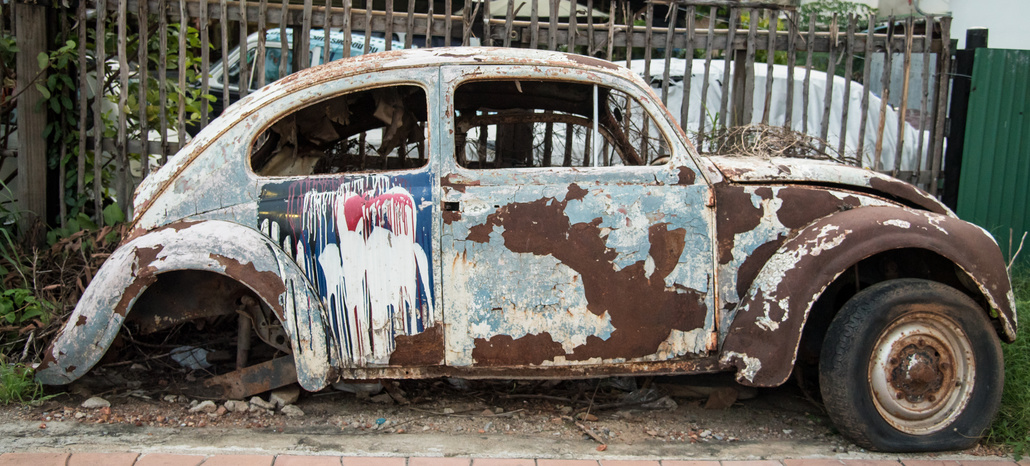
VW is now more of a “people’s car” than we would all like.
I have a VW Multivan Diesel as my family car. It’s a great, large car that can comfortably transport our 3 children, the parents-in-law, their dog and all kinds of luggage across the country at once. It’s actually the perfect family car. And not a car you would want to give away. Nevertheless, I’ve decided to sell it soon because I don’t like losing money. Unfortunately, it is more likely than ever that I will lose money. Because the problems surrounding and at VW are immense. But most people don’t really realize that.
(Reading time: 10 minutes)
99 Problems – but Tesla ain’t one
As a responsible writer, you don’t write articles like this just like that. It was preceded by reading well over a hundred reports and assessments on the subject. And there have been enough moments in the last few months when I have mentally discarded this article. Quite simply because it is very difficult to assess the situation at VW in a differentiated and objective manner. I still doubt whether I can do that with this article.
It is always easy to pick on a company that has committed various transgressions. And this was also done at VW, albeit comparatively moderately. However, there was no major outrage in the media. VW is too important for Germany, indeed for Europe. This article is not intended to be a VW “bashing”.
Initially, I wanted to make a detailed list of all the problems, complaints, claims and legal cases. But that’s not going to happen. This list would be so long and extensive that I simply couldn’t fit it in properly on alainveuve.com. So I will confine myself to outlining problem areas. Far from any claim to completeness.
Technical problems with fraudulent diesel engines
The technical challenges with the engines revolve around fuel consumption, of course, exhaust emissions, performance and the long-term durability of the (overhauled) engines. Many people express doubts as to why it would now suddenly be possible to meet the promised performance data and emissions regulations with a software upgrade and comparatively minor modifications. I believe that such a fix is technically feasible, because the original problem was not necessarily a technical one, but an economic one.
It was simply cheaper to cheat than to push ahead with development in such a way that all requirements could be met. Now that money is no longer an issue, this development has been made up for. I believe, and I’m no specialist in this area, that these problems can be solved technically – at least that seems logical to me.
Consumer complaints
Compiling an overview of the thousands of lawsuits is an incredible amount of work. We know that a settlement of around EUR 13 billion has been reached in the USA for certain engine models. Some of this money will be used to buy cars back from consumers, pay compensation and carry out repairs. The other part of the money will be used to compensate for the environmental damage. The bottom line is that each customer receives around USD 5,000 in compensation, in whatever form.
Why this became possible at all has to do with the American possibility of organizing class actions. In the VW case, a certain Michael Hausfeld is in charge of such class actions. After the American settlement, he immediately demanded a worldwide settlement from VW for all 11 million affected customers. His logic is quite plausible:
“VW cannot cheat European consumers and escape accountability. Europeans are no less worthy of justice than their American counterparts. VW has concluded its package of payments to its U.S. consumers. At the same time, it is facing a similar responsibility to its European victims who have every right to expect equal redress…..(….)….Thereis no justification for VW favoring restitution to Americans over Europeans. Global misconduct must have global consequences for all on an equitable basis.
”
Such a lawsuit or settlement, which would mean an additional 42 billion in compensation payments for VW in Europe alone, would be the certain death sentence for the VW Group as we know it today. Fortunately for VW, the legal situation in Europe is different. Although milder forms of class actions are possible in individual countries such as Holland, the laws are far less harsh and angular.
Of course, that doesn’t stop Hausfeld, who has successfully taken on many large corporations over the last 30 years, from trying anyway. And he also tackles the painful areas away from the actual complaints. His request to VW to explain whether a guarantee would be given for the retrofits puts VW in an extremely stupid position. Because neither is good for VW.
Investor lawsuits
Another, albeit far less significant, battleground is the lawsuits filed by investors. The states of Hesse, Bayer and Baden-Württemberg have filed lawsuits, the Swiss AHV pension fund and probably a long list of other institutions have filed lawsuits (the statute of limitations has already expired). Their accusation is of a stock corporation law nature. Put simply, VW did not provide enough information early enough and therefore hoarded insider information, so to speak, which then caused damage to investors. It is quite likely that these lawsuits will be successful. However, the claims are in the low millions. In terms of image, however, they are a super disaster.
Disaster management
Another huge risk in my opinion is the current management. CEO Müller got himself into hot water right from the start with, there’s no other way to put it, completely stupid statements in American interviews. Later on, when “the place was on fire”, so to speak, there was a public discussion about retaining bonuses for the top management and even in September, Müller announced wholeheartedly that the diesel scandal had de facto been overcome and that the company was no longer a driven company. And a few days ago, he repeated that VW wanted to “become the world’s leading provider of sustainable mobility”. That’s a bit like the seriously injured man sitting in a wheelchair and announcing that he wants to become the next Usain Bolt. You can only smile mildly.
Of course, there are always two sides to what you communicate as company management and what you actually think about your company in secret. We can only hope that Müller really sees the true situation, problems and challenges and is actually working on them with his people.
The huge problem: being invested in diesel
The biggest problem, however, is that VW has really married itself to the diesel over the last 15 years. This diesel is the tanker on which almost everything from VW is freighted. And this tanker is slowly but surely sinking.
We can see that this is the case from the fact that particulate matter pollution in cities is becoming less and less acceptable. In a ruling by the Düsseldorf Administrative Court that is almost unsurpassable in its explosive force, the district government is obliged to actually comply with the applicable environmental laws. The court has also just specified how this is to be done: Inner cities are to be banned from diesel vehicles.
This is an international trend that has been boiling up for years and I believe there is a tipping point in this development. As soon as we see this in some cities, this measure will rapidly spread to other cities. It’s already sending a signal to consumers: “Don’t buy diesel anymore”. Because if that happens, I don’t want to have any more diesel in my garage. Because the value is likely to collapse dramatically from one day to the next.
This is particularly tragic for VW, as diesel was (or is) a central strategy of the Group. Officially, the company is now repeating, almost like a prayer wheel, that electric cars are the future. But there is nothing, absolutely nothing, on offer that could be offered to customers today as a replacement. If I want to buy an electric car today, I will most likely end up with Renault or Nissan. VW has been making the same promises over and over again for years. I remember that the electric Multivan was presented back in 2013. Study after study was presented, showcase, concepts, promises made.
But for me as a consumer, there is nothing to buy. If I don’t want a diesel, then it will just be a petrol car from VW. I believe that due to the general development in the diesel sector, VW will simply lack good alternative products in the short term. That’s not so obvious at the moment, but I’ll be happy to be quoted in two years’ time.
Too big to fail, luckily
One reason why the general public is relatively unconcerned about VW is because they don’t see the sheer volume of serious problems this company has. On the other hand, it is probably also because everyone knows that politicians will not let VW fall so quickly. With over 600,000 employees, VW is “too big to fail”. In Switzerland, we have had relevant, albeit somewhat dubious, experience with this concept.
The first test for this rope team of politics and the private sector for the benefit of all will come in the next few weeks. The Bundestag’s emissions investigation committee has requested an expert opinion from Darmstadt University of Applied Sciences on the legal interpretation of the legal situation / practice by the Federal Motor Transport Authority (KBA). The essence of the report is that the KBA had established in practice that almost all manufacturers used so-called shut-off devices in their diesel engines at low temperatures. These mechanisms, known as “thermal windows”, are technically necessary for “engine protection”. In its practice, the KBA invokes a so-called legal exception because, in its opinion, it was technically impossible to do otherwise.
However, the expert opinion comes to a completely different conclusion. This is because the legislator has made it clear that there can be no justification for this exception (the thermal window). The report literally states: “However, if the manufacturer has nevertheless installed the defeat device, he is placing a vehicle on the market outside the type approval”
In addition, the manufacturers should have already disclosed these thermal windows during type approval. In conclusion, the report states: “Both – the applicant and the KBA – are acting in breach of legal requirements. A type approval nevertheless granted for an engine system with a defeat device is unlawful from the outset.”
Of course, this is now an expert opinion and the committee can do whatever it wants with it. There is much to suggest that it will not follow it. For good political and social reasons. But it is very special. Anyone who, for example, does not have approved rims fitted to their car must more or less immediately abandon the car if they are caught. In the case of a much more serious, broad-based offense, the issue can and will be swept under the carpet. The fact that this does not end up turning into an even bigger scandal is due to concern for the 600,000 employees. And, on balance, probably rightly so. Somehow.
Not out of the woods
Anyone who thinks that “too big to fail” can protect VW from all harm and ruin is mistaken. Because the protective hand is only held over VW temporarily. If they continue to come up with home-made problems in addition to the general, enormous challenges (keyword autonomous driving) of the market, things will get tighter and tighter for VW.
The perfidious problem is that VW has to cut costs in order to be able to continue investing in new developments and thus remain competitive. Unfortunately, this can only be done by making redundancies, as has already been announced. With every employee less on the payroll, VW becomes less worthy of protection for politicians. That is extremely dangerous.
I therefore see the probability that VW will remain in the current constellation for the next 5 years at around 40%. It is much more likely that individual brands will have to be sold and the market share will fundamentally decrease.
Mismanagement
And despite all the mild comments, we have to be clear. What we have seen at VW over the last 10 years is quite simply mismanagement as it is written in the book. On the one hand, the company has strategically failed to position itself in such a way that it could lead new developments (which for me do not necessarily have to mean electromobility). On the other hand, they have caused the biggest case of fraud in European economic history. There is nothing to gloss over.
The many loyal and hard-working employees and customers are footing the bill for this. As a customer, I don’t want to have to pay too. That’s why I’m selling the Multivan, which is actually a great car. Before it’s only worth a quarter and I have to park it in the suburbs when I want to go into the city center.
Artikel auf Social Media teilen: