“Game changer” autonomization.
Automation was a big topic long before digitalization, but it has now really picked up speed again. All companies want to automate. The demand is huge. What is being forgotten is that the next step, autonomization, is just around the corner and will be a game changer. Especially for the software industry.
(Reading time 5 minutes)
Autonomization vs. automation
Many people can’t tell the difference between automation and autonomization. It’s simple: an automated system can process previously defined processes without human intervention. If a deviation from the standard process or a completely new requirement occurs during processing, the system stops and requires a human to clarify the situation.
Autonomous systems, on the other hand, are designed to carry out various types of work and processes in a specialist area independently, i.e. autonomously. The system does not need humans.
“Game changer”
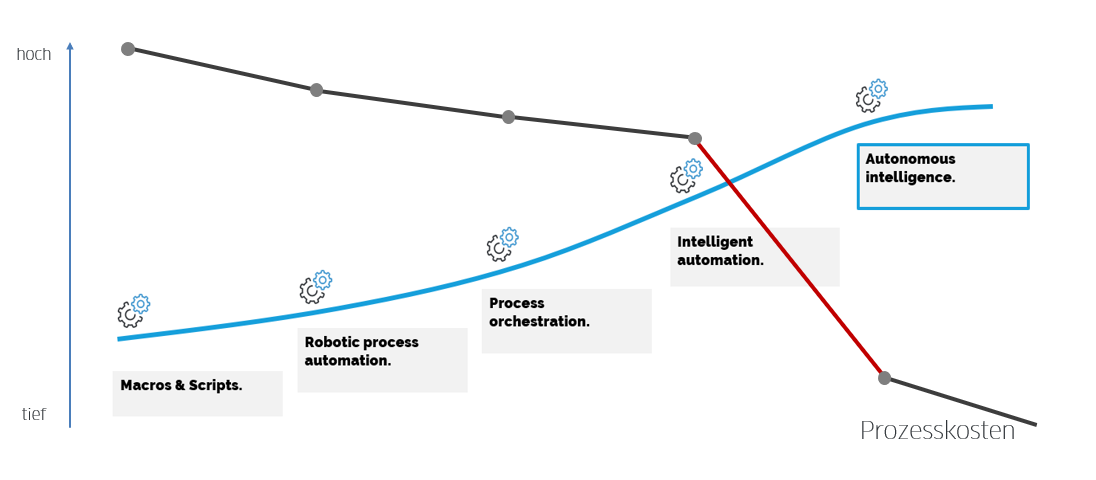
Autonomous systems are “game changers”, as they radically reduce costs from processes. At Parashift, we have developed an engine that already delivers 100% correct results for data extraction and posting of accounting documents. Compared to automated systems, for example for invoice processing, which have sophisticated exception management, companies using this service have the advantage that they no longer need any employees at all to correct and validate the data. This reduces the process cost curve.
Building autonomous systems is a marathon.
While the advantages of autonomous systems are obvious, building autonomous systems is extremely time-consuming. This is mainly due to the fact that sooner or later the machine has to find the best possible solution for every situation (in accordance with all the practices and rules of the specialist area). Trying to deal with this complexity with a set of rules is impossible by definition. It will never work. This is probably the reason why the idea that “accounting cannot be autonomized” persists in the accounting industry.
We solve this problem by continuously developing our own machine learning platform, which learns from a gigantic amount of processing data. It is not enough just to have accounting documents, for example. The interaction data from qualified human processing is of greater value. We are currently training the platform specifically for the accounting case. However, the process and the technology behind it could basically be used for almost any form of autonomous completion of qualified work.
In its infancy
Since the task is complicated and usually extremely time-consuming to solve, autonomous systems are extremely rare. And I am of the opinion that systems that do not learn independently and/or cannot apply this acquired knowledge independently in the context of new cases are not truly autonomous systems. They are more likely to be perfectly and broadly automated mechanisms. It is only a matter of time before a new requirement arises in such a scenario that the system is unable to process. Translated into business terms, this means that at some point it will no longer be possible to reduce overall processing costs.
Autonomous systems are like children
I also see time and again how even very innovative people from IT are stuck in a conventional understanding of software. Autonomous systems are not software projects that you start, develop and then deliver result xy.
Rather, these systems are like a child that you first bring into the world and that can learn relatively little at the beginning. You feed it, start to teach it more and more complicated things, encourage and challenge it, set limits and spur it on. This is a completely different approach to software development. By definition, a project like this has no end. We are trying to establish this philosophy more and more in our team.
From tool to service provision partner
However, autonomous systems have what it takes to turn the software industry and the world of work upside down. Because autonomous systems are changing the role of software.
While software today is a tool to make work faster, easier, cheaper and better, autonomous software takes over the work completely. To stay with accounting: While today accounting systems are used to let people do accounting, future autonomous systems will do the accounting on their own. We are much closer to this point than people generally think. We are working on it at full speed.
When software controls real things
Logically, autonomous systems have a particularly big impact when they start to control objects in our daily lives. The most discussed example at the moment is certainly the autonomous vehicle. I think the combination of autonomous software and physical things/machines will bring about undreamt-of new possibilities at a rate that we cannot even imagine yet.
At the very beginning
We are at the very beginning and I don’t know many people who are familiar with or deal with general concepts for the autonomization of software systems. This probably has to do with the fact that the sum of challenges and the level of complexity are overwhelming at first. However, the more you look into it, the more you realize that there are relatively simple approaches to many of these challenges that work well. What was extremely difficult for us as a start-up was to build a business model around the ongoing development of the platform that helps to recoup and ultimately offset the development costs.
After a period of extreme uncertainty and searching for possibilities, we now believe we have found an economic model that can generally be used to develop complex autonomous systems. This does not mean that it will be easier to achieve the technological goal. But, as we all know, there are no shortcuts to places that are worth going to.
Artikel auf Social Media teilen: