Why “Everything as a Service” is the order of the day.
What began as “something as a service” in the software sector is now increasingly finding its way into areas in which we could not have imagined using products on a subscription basis just a few years ago. There are many indications that we are at the beginning of a paradigm shift in the consumption model.
(Reading time 4 minutes)
Underlying drivers
There are two fundamental changes that explain why we are paying for more and more products based on usage:
On the one hand, the cost of money has fallen considerably (1), making it much easier to finance product use. Secondly, technological progress (2) ensures that the overhead costs for enabling this small-scale use are also falling rapidly (4). It has always been possible to organize this small-scale use manually – literally with paper and pencil. However, the costs for this made the model so expensive that it was no longer competitive.
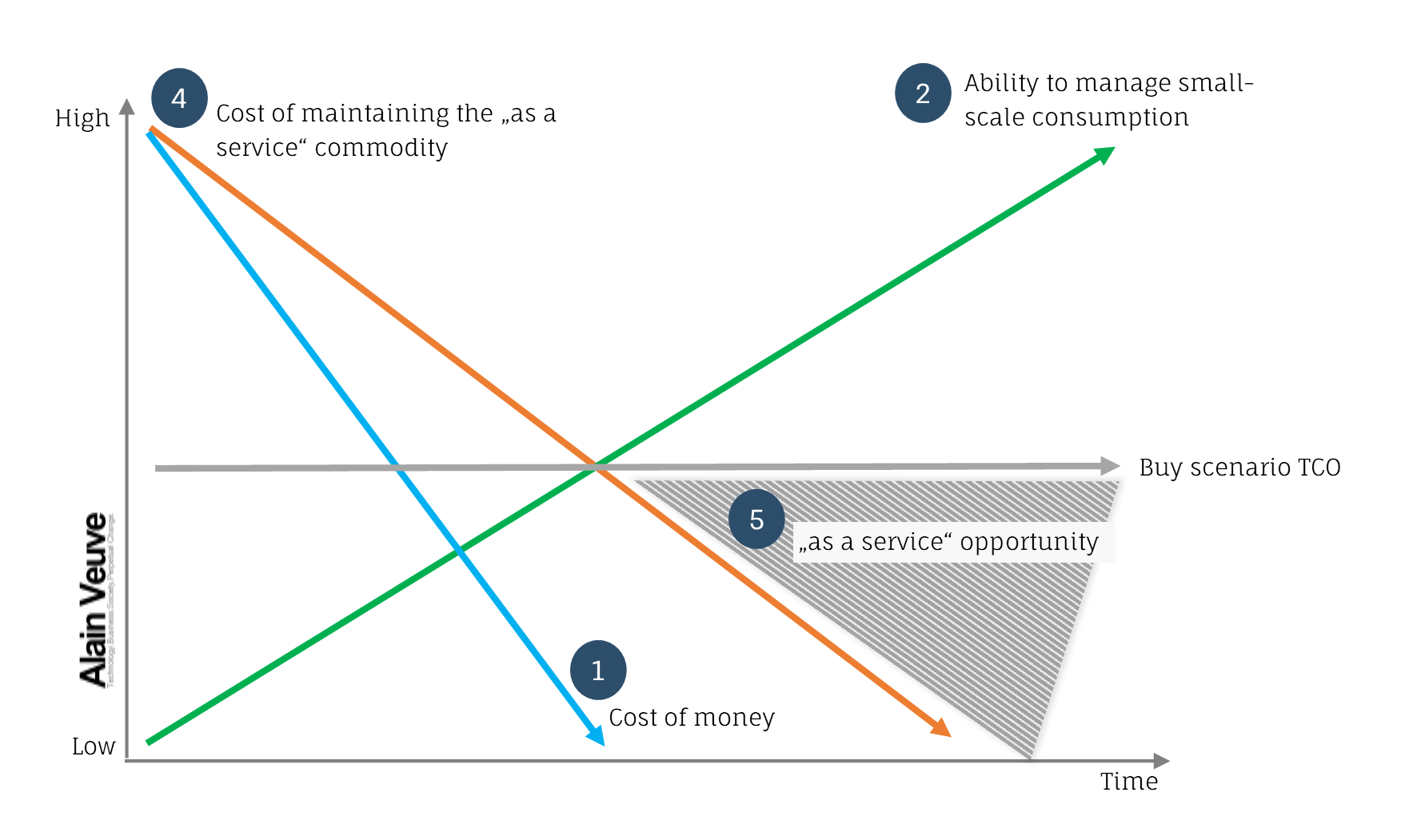
This results in an “efficiency window” (5) compared to the ownership model. The total costs fall in the “as a service” model primarily because the amortization can be better distributed over the actual use.
One example of this is the “car as a service” model. As the cars are continuously allocated to those people who really want the car, the bottom line is that the costs are lower than in a “buy/own/sell model”, where the “wrong allocation” is patiently bridged until it is such a bad fit that the car is sold and a more ideal one is bought.
This change is then associated with considerable costs (inconvenience!) for the consumer, as he rarely makes this change.
Fueling factors
In addition, various factors are fueling the trend towards timeshare subscriptions. I think one important such factor is that people today pay much less attention to ownership and more to possession. Whereas after the war it was considered desirable to save money and keep items in one’s possession for the long term, today it is much more important to use them in a way that is appropriate to the situation.
You can observe this beautifully when you buy a house; my grandparents built a house to last far beyond their lifetime. It was symbolically intended that future generations would use it one day (and then no longer have to worry about buying it). Today, this has changed. Many families who build or buy a house today are well aware that they will only use it for one stage of their lives and that they will move into a small apartment when, for example, the children have left home. Using something for a period of time or for a specific situation without making a fundamental commitment is more opportune than ever.
Cash is king
Another important element is that the majority of people cannot really distinguish between costs and cash-out. Even among people who have the relevant business training, I see time and again that they generally prefer the option where less cash has to be used at once.
Of course, this also has to do with the fact that saving per se is no longer a virtue and many people do not even have the means to buy. From this perspective, the “as a service” model allows consumers to afford things that were previously almost unattainable (not even leasing).
Old model vs. new model
In any case, the “as a service” model has almost unbeatable advantages in the market compared to traditional purchase models. We are already very far advanced with this development in the software sector and I expect it to find its way into more and more areas of our economy.
We can see, for example, that the “Car as a Service” model is very popular and promising – not least just a few years after representatives of the car industry declared that people would never want to order something like a car on the Internet.
And there is a high probability that this business model will spread to many other areas. Furniture stores want to offer furniture by subscription, bicycles can be purchased by subscription, apartments can be rented (not to be confused with renting) – there seems to be no area in which the model could not be applied sooner or later.
So if you want to start a business today, please consider very carefully whether an “as a service” model might be the right one. Today, it is probably still a risk and a special success factor in equal measure. In a few years’ time, however, it could be the standard model per se.
Artikel auf Social Media teilen: