
The looming iPhone moment for the automotive industry?
Tesla is like Micheal Jackson. There is hardly anyone who doesn’t know him and doesn’t have an opinion about him. Tesla polarizes. A story straight out of a picture book – David against Goliath. Not many people thought Tesla would last this long. And no other car brand has had such a strong influence on the automotive industry in recent years. And there are good reasons to believe that the biggest upheavals triggered by Tesla are yet to come.
(Reading time: 6 minutes)
Relevant market share in the corresponding segment
What many people, especially here in Germany, don’t realize is how successful Tesla has been so far, even in terms of unit sales. This is because Tesla is doing very well in most of the relevant markets, but not in Germany. The Model S is a car that has really broken into its market in the USA or Switzerland, for example.
The Model S sold 29,421 units in the USA last year. No other manufacturer sold more vehicles in the luxury class.
If we look at Switzerland, the picture is even starker. The Model S was sold 1,299 times there last year. Here, too, no other manufacturer sold more vehicles in the luxury class. On the contrary. Sales of the BMW 6 and 7 Series, Audi A7 and A8 and Mercedes S-Class together amounted to 1,527 units. In other words, only 228 more than Tesla with the Model S alone.
What favors this development in purely statistical terms is that the “large luxury SUV” segment has grown strongly in recent years and this has had a correspondingly negative impact on the statistics for traditional manufacturers, as buyers have switched from sedans to SUVs.
However, it is no longer possible to speak of a niche existence by any stretch of the imagination. Tesla also plays a significant role in the “large luxury sedan” segment in many other countries.
Model 3 is coming
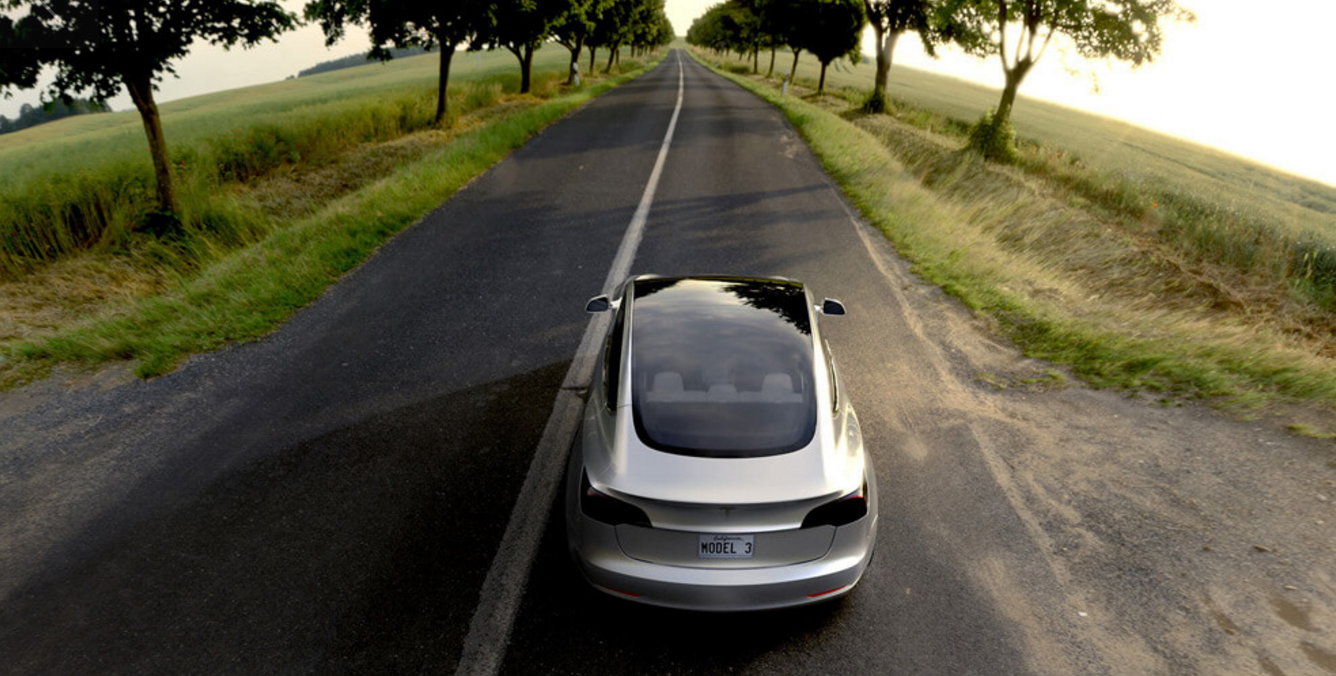
The Model 3, the smaller mass-market model with a base price of around US$ 35,000, is due to be launched on the market in a few months. A year ago, when the new model was announced, not many people even in the Tesla community believed this would happen. In the meantime, however, there are increasing signs that Model 3 will indeed start mass production and be delivered this year. A few of these signs are:
Rising Model S prices
The prices of the Model S have risen sharply in recent months. This is certainly due to the fact that Tesla is now a strong brand and can therefore generate good demand and is therefore willing and able to push through higher prices.
On the one hand, however, the strategy of building electric cars with very high acceleration was undoubtedly a success. At first glance, this seems like a pointless, almost stupid undertaking. In fact, however, it was very clever, because it meant that electric cars became cool with the wider public and were taken out of the renunciation/eco corner – an essential prerequisite for being able to achieve something in the mass market.
On the other hand, this performance also justifies much higher prices. If you want the production car with the fastest acceleration today, you can’t go past Tesla. And at prices that are relatively affordable. If you can even talk about cheap in these price ranges. And of course that doesn’t make a Tesla a circuit sports car. For everyday driving, however, there really isn’t much faster acceleration available at the moment.
Deletion of the “bridge models”
After the introduction of Model 3, the models with a smaller battery (60/60D) were reintroduced as a “bridging offer”, so to speak. This was primarily to make it easier for people who had reserved a Model 3 and had a sufficient budget to make the switch in terms of cost. This has worked so far. The fact that this model is now being discontinued again suggests that this space will soon be filled by better-equipped Model 3s.
Start of production
The first pre-production models are on the road and are being tested. Obviously, Tesla has changed the traditional production process to save a lot of time. In addition, the car is apparently radically geared towards the simplest possible production. The debacle with the Model X should not be repeated.
The iPhone moment
Therefore, I think it is quite possible that the Model 3 will already be available for order and configuration at the next promised presentation, or at least very soon.
And if Tesla manages to achieve anywhere near what they did in the luxury class with the Model 3, this would mean that they would sell around 100,000 cars in the USA, around 9,000 cars in Switzerland and around 11,000 cars in Germany. This means they would dominate the upper middle class in Switzerland and the USA, where the BMW 3 and 4 Series, Audi A4 and Mercedes C-Class have become the best-selling models. The Model 3 would sell better than any of these models.
Of course, the mid-range is not the same as the luxury class. In the upper class, many people were initially much more willing to embark on such an experiment with a new manufacturer and a new technology. However, there are at least three reasons to believe that Tesla’s success will be repeated in the mid-range segment:
The Tesla brand
The Tesla brand has become enormously strong in recent years. On the one hand, there are surveys on this. On the other hand, the inevitable focus on the premium segment has led to Tesla being perceived as a status symbol. We know this from BMW, Mercedes and Audi. People from the middle class buy their smaller cars because of the brand. Even if there are objectively better offers from less prestigious brands. This effect will also play out for the Model 3.
Zeitgeist – Brand: Tesla is the only brand in the automotive sector to offer a consistently digital product. This reflects the spirit of the times. We live in the age of technology chic. Nothing fits better in the automotive sector than Tesla.
Business model change
It is quite possible that Tesla will soon also offer a car subscription. This means that all costs are included for a fixed amount per month and come from a single source. The first pilot projects have already been launched by Tesla and other manufacturers and players in the digital sector are also experimenting with this. The introduction of such a pay-as-you-go model at the same time as the Model 3 would have a resounding effect, as it would significantly lower the barriers to entry for new buyers.
Rather, the fact that financing such a business model is very costly speaks against it, and if there is one thing Tesla as a company cannot use, it is the pre-financing of its own sales. Of course, there is a lot of money in the market and enough investors are waiting for opportunities, but one can also imagine that the risk premium for such a financing transaction is rather high.
However, I believe that this is exactly the model that will prevail in the long term. Especially when we move towards autonomous driving, I actually only see advantages.
Costs
So far, Tesla has always been perceived as very expensive and this is of course true in terms of the high purchase price in relation to mid-range cars. In terms of running costs, however, the Model X and Model S beat their competitors hands down. Mainly because no gasoline has to be purchased and maintenance and service are virtually eliminated.
What many people do not yet understand is that electromobility will prevail mainly because of the costs. This is because the cost of batteries has fallen by around 80% in the last 6 years and is currently estimated at $190 per kWh for Tesla. With the start of production of the new batteries in the Gigafactory, Tesla expects a further reduction of around 35%, which will bring them to less than $125 per kWh.
It is generally assumed that at prices of around 100 dollars per kWh, cars can be built in all classes that are as expensive or cheaper than models with conventional technology. However, this development is by no means at an end. On the contrary. It is only just beginning, both in terms of new battery technology and economy of scale. Tesla is particularly well positioned here to multiply precisely these economies of scale with the energy business.
A rude awakening
Even if I wouldn’t wish it on the traditional automotive industry in the slightest, I think we’re in for a rude awakening over the next few months. There is a very good chance that Tesla’s Model 3 will make a breakthrough in the upper mid-range segment, which is particularly important for German manufacturers. Not in Germany, of course, which has very special conditions, but in the rest of the world.
I find it striking how many people in Switzerland tell me they would buy a Tesla in a heartbeat if the car was cheaper. Many people who don’t have much to do with digital. The Model 3 opens up a huge new group of buyers. The fact that Tesla is the first choice in the ever-growing segment of “digital professionals” is increasingly reinforcing this.
What is particularly bitter about the situation for the traditional manufacturers is that there is not much they can do about it. They have fallen behind in terms of battery prices and volumes and the gap is widening by the day. They are also coming under increasing pressure on their own technological front with the diesel scandal and, in particular, the stricter limits. And it looks like their current strategy of building many more hybrids will not work. After all, a hybrid is an electric car in a combustion engine. This only makes the whole thing more expensive in terms of manufacturing costs and maintenance.
It is still far from “checkmate”. Tesla is still far too unreliable in many respects. And the cars still need to be much better, for example in terms of interior design. But if you take a step back, you have to realize that the situation for Tesla has improved significantly compared to 12 months ago.
Checkmate
And there are more clouds in the sky for the traditional manufacturers. Tesla is once again struggling with the basics in terms of autonomous driving, as it is replacing its previous technology provider Mobileye with in-house developments and the new autopilot, although promised, is unfortunately not yet really usable.
However, this should not obscure the fact that Tesla is collecting and already has a lot of data on this development. And it is quite possible that while the traditional manufacturers are still trying to catch up on the cost and quantity lead in batteries and the charging network in 2-3 years, Tesla already has an operational fleet of self-driving cars on the road.
All these developments already have a “checkmate” character. On the other hand, you shouldn’t think that nothing can happen to Tesla. A few stupid mistakes and a chain of circumstances and Tesla is dead. However, hoping for this is not a good strategy for traditional manufacturers. So far, this “wait and see” has not worked out. On the contrary. It is becoming increasingly uncomfortable.
Artikel auf Social Media teilen: