And yet the digital sector is digitizing.
My article entitled “Disruption in every sector: When developers become superfluous” in T3N has triggered numerous comments and responses. And never before have I received so many direct e-mail responses to an article. Obviously many people felt addressed and obviously the topic is a red rag. But I am no stranger to these reactions. On the contrary. I consider them to be exemplary in processes of change.
(Reading time: 6 minutes)
Reflection
A good colleague said to me last week that the article was written too “sloppy” and that this kind of subliminal aggressiveness was partly responsible for the many quite negative comments. That may well be the case. On the other hand, I always write like that. For example, in an article that is decidedly pro-developer. (I’m generally very pro developer!) The somewhat exaggerated headline naturally had its effect. So far so good.
I think it’s about something else. It’s about intellectual vested interests, because the article basically says nothing other than; “Watch out friends, sooner or later our industry will face exactly the same challenges as everyone else”. I maintain that people in the digital industry know much better than the average person what that means.
They know that “software is eating the world” because we are part of this movement. Marc Andreesen mentions technical progress as follows:
Six decades into the computer revolution, four decades since the invention of the microprocessor, and two decades into the rise of the modern Internet, all of the technology required to transform industries through software finally works and can be widely delivered at global scale.
I know very few people in our industry who are not convinced that technological progress will accelerate in the future. So the question is, where will we be in 20 years’ time? What opportunities will we have then?
Experts Exchange has put together an exciting infographic on the development of computing power from 1956 to 2015.

So if the development of computing speed has multiplied by a trillion over the last 6 decades, where will we be in 20 years’ time? That’s right, we will have digital possibilities beyond our current imagination. So we will have the tools to break completely new ground. Even in software development.
Paradigm shift
Industry disruption always involves a paradigm shift. This means that the players who disrupt industries do not follow the same path as the existing industry. Instead, they use the new technological and social opportunities in a new way. The only thing they have in common with the “old” industry is the customer problem they are solving.
Take Airbnb, for example, which is considered a disruptor in the hotel industry. Is it a hotel chain? Has Airbnb digitized the hotel industry? No, of course not.
Airbnb has solved the customer problem of cheap accommodation worldwide with the help of new technology. I mention Airbnb here because many people really do know it.
Digitize existing thinking?
Very few of the decision-makers I deal with on a daily basis understand these fundamental processes. They are all firmly anchored in their business.
André in his comment on the article:
“So the question arises as to why IBM, for example, has not yet come up with a solution, why there are no code generators. “
It is precisely because of this inability to change paradigms that the issue has not yet been addressed. Large, established companies are practically never able to implement real paradigm shifts. Firstly, because they lack the mental ability to change paradigms. Please do not confuse this with intelligence. Secondly, because investments in such paradigm shifts simply cannot be justified in a construct such as a listed company.
However, this does not mean that they are not justified. If we go back in history, we see the same pattern: individual entrepreneurs and businesspeople venture into the market with a paradigm shift and are rewarded by being put in an economic position to make a lot of money in a short space of time. This money is reinvested, imitators and niche providers emerge and an industry is created.
And yes, this also applies to the software industry
To think that these mechanisms will stop at the software industry is naive. At the moment, the costs of solving the complexity are simply still too high. The following simplified diagram shows the dependencies:
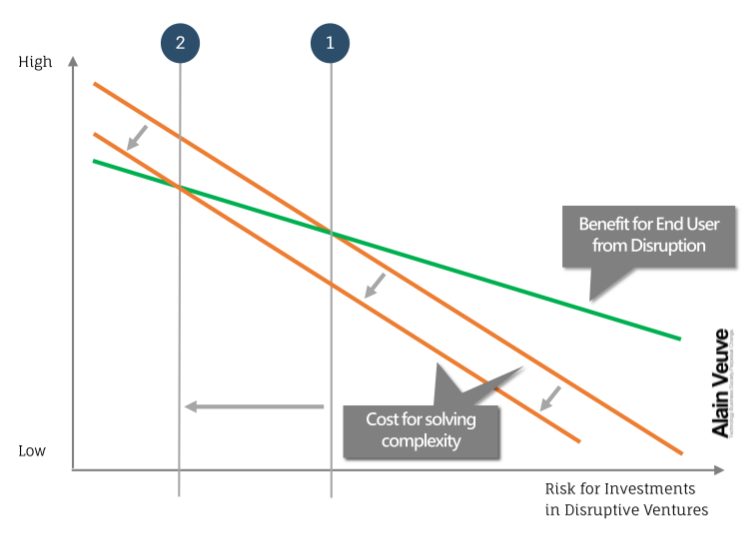
The greatly improved technology indirectly lowers the price to solve the complexity of a task. This reduces the risk of not being successful with an investment in a disruptive venture. Ergo, there will be more investments and sooner or later such an investment will pay off because the venture was able to solve the fundamental problem.
Applied to the software industry, the problem that needs to be solved is not the automation of software development and certainly not the replacement of developers.
The problem that needs to be solved is to be able to provide customers with greatly improved software that is available more quickly and more closely tailored to their needs at a fraction of today’s costs. In order to achieve this, from a process perspective, anything goes.
For this reason, the argument that today’s software production is too complexly structured to be digitized is also pointless, although in my opinion it is actually correct. But it is simply very unlikely that we will still be producing software in 30 years’ time in the same way and with the same process as we do today. And please yes, any kind of software.
Reactions to change
As already mentioned, I consider the reactions to the change I have envisioned to be natural, if not downright exemplary. I encounter precisely these patterns again and again in companies that are dealing with digital transformation. I categorize them as follows, albeit not exhaustively:
Incompetence subordination
I often observe that employees who question the tried and tested and/or suggest very unconventional approaches are quickly labeled as incompetent or inexperienced. This is particularly effective in larger groups, where it takes a lot of courage to expose the fact that there are other good ways to solve a problem besides best practice.
Referring to “reality
This type of reaction refers to the current reality in an industry or company. Sentences like: “The idea is not bad in itself, but in practice it looks very different”. If you ask, you get a description of the current situation. It’s only logical that the new ideas don’t fit in.
Social argument
I also often hear that employees or the company will not go along with this. I think that’s completely wrong. Society drives and is driven by technological progress and the associated paradigm shifts. Employees in companies are usually the ones who suffer. I don’t like that, but to a certain extent it is a historical concept of progress. However, developments over the last 300 years have shown that the victims are getting smaller and smaller. Quite simply because mankind is getting better and better as a result of technological progress.
Hidden consent
I have actually received 7 emails from people who have either already developed such solutions or are in the process of doing so. And who thanked me or encouraged me to keep working on the topic. I often experience this in my consulting work with companies. After particularly heated workshops, where I question a lot of things, it’s common for employees to call or email me and say thank you that someone is now talking about it and addressing it.
Only the level of abstraction is changed
Christopher contradicts me in his last comment so far, but I don’t see it as a contradiction per se :-). Rather, I think he hits the point pretty accurately. In order to make software production and further development more effective, the level of abstraction must be changed. And I also agree with him that people who bring the qualities of the “developer” to the process will probably be needed for even longer.
But I don’t think it’s just about naming the roles. I think it’s more about the definition of roles within an industry. And the number of people who fill a role. That is precisely what defines the architecture and design of an industry.
And ultimately, it is precisely these structures that will be caught cold by disruption. We still have it in our hands to tackle such structural changes at a very early stage. But the clock is ticking. The field is becoming more interesting for investors every day.
Artikel auf Social Media teilen: