Please no more Unicorns.
Last week I was able to spend an interesting day at hub15. On a side stage, there was a panel entitled “How do we get more European Unicorns?”, which had a lot to say about the state of the European start-up scene. An assessment.
(Reading time 4 minutes)
We are not America
First of all, yes, of course we need more start-ups on the European continent, more VCs, more opportunities for people who want to achieve something. But we are fundamentally missing the point if we continue to try to do this American-style. The reason for this is simple: we are not America.
In his book “Zero to one”, Peter Thiel has presented a plausible model of the fundamental differences:
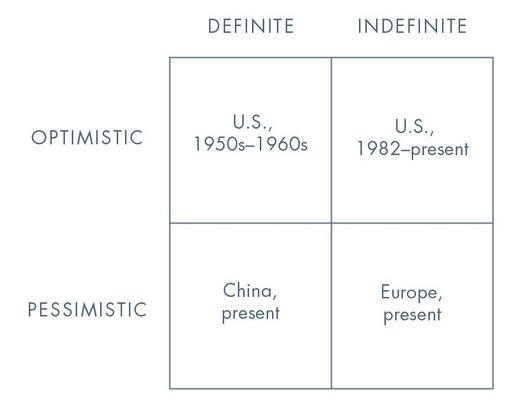
“The definite optimist has a concrete plan for the future and strongly believes in that future being better than today. The indefinite optimist is bullish on the future but lacks any design and plan for how to make such a future possible. The definite pessimist has a specific vision for the future but believes that future to be bleak. The indefinite pessimist has a bearish view on the future but no idea what to do about it.”
His statement is that start-ups and venture capitalists are “definite optimists”. In other words, they believe in tomorrow and also have a plan for how they can make this better future a reality.
European start-ups are no different. But they operate in a context and environment that could not be more different. After all, every start-up has to be competitive (read “make a profit”) in the existing economy sooner or later.
And unconventional companies in Europe in particular have a harder time. Simply because a different psychological climate prevails here. And look at it this way: 200 years ago, people from all over the world set off into the “new, uncertain” world and shaped the USA.
Could it be that a lot of the risk-taking “characters” simply left Europe back then? I know it’s a little far-fetched, but you have to admit, those roots in the US must have some effect even on their society today.
Finding your own way
This comparison of the VC markets and start-ups over here and over there is nothing more than a numbers game. It does nothing except depress us in Europe with a few figures. But there is also no point in simply issuing battle cries à la more risk, more unicorns. Because nothing much is happening.
But what can we do here in Europe? Significantly, the two founders named it quite clearly in the panel at hub15: The sheer administrative madness, the many regulations are a major annoyance and obstacle. On the one hand, the EU is promoting the digital single market (“we now have the digital, single market”), while on the other hand, overregulation is simply rampant.
In many cases, this is regulation that was created more to protect existing industries than consumers. This is extremely dangerous because it increases the damage that is caused if an industry is then subject to disruption (read “goes down”) anyway. This protectionism increases social damage in the long term.
Confusing Founding with Incorporating
And then this Andrus Ansip, with whom the EU is not exactly doing itself any favors as an envoy, tells us how easy it is to set up a company in Estonia in 15 minutes. And he makes the number one rookie mistake: he confuses setting up a company with establishing a legal entity.
Honestly, the second is not a really big problem almost anywhere in the western world. But getting help, advice and assessment when setting up a business is quite difficult. And, apart from a few isolated offers, it is also not available as a service from state institutions. But that would help a lot to get more people out on the street who are willing to start a business.
And then these Unicorns
Later, Verena Hubertz says that some of the companies’ valuations are a bit “crazy” and poses the rhetorical question of why companies such as Uber or Airbnb are worth more than their traditional industry competitors. And thus reveals the fundamental misunderstanding regarding unicorns.
Unicorns are only very rarely worth >1 billion. They are only technically valued in this way by a small circle of investors. It’s amazing how few people are aware of this. Apparently, even quite bright people, especially in the digital sector, are not immune to the attraction of big numbers.
Funding and valuation
The financing of a start-up with large capital requirements usually takes place via various financing rounds. In each round, one or more investors participate in an injection of capital into the company. To ensure that the ownership structure is maintained or deliberately shifted, a private valuation is prepared. This is not a traditional company valuation, but a relatively simple mathematical calculation or matter of negotiation. The basic amount, i.e. the “100%”, is increased, so to speak. The part of the pie that is now missing is filled in with a pool of options. fundersandfounders.com has created a nice infographic on this:
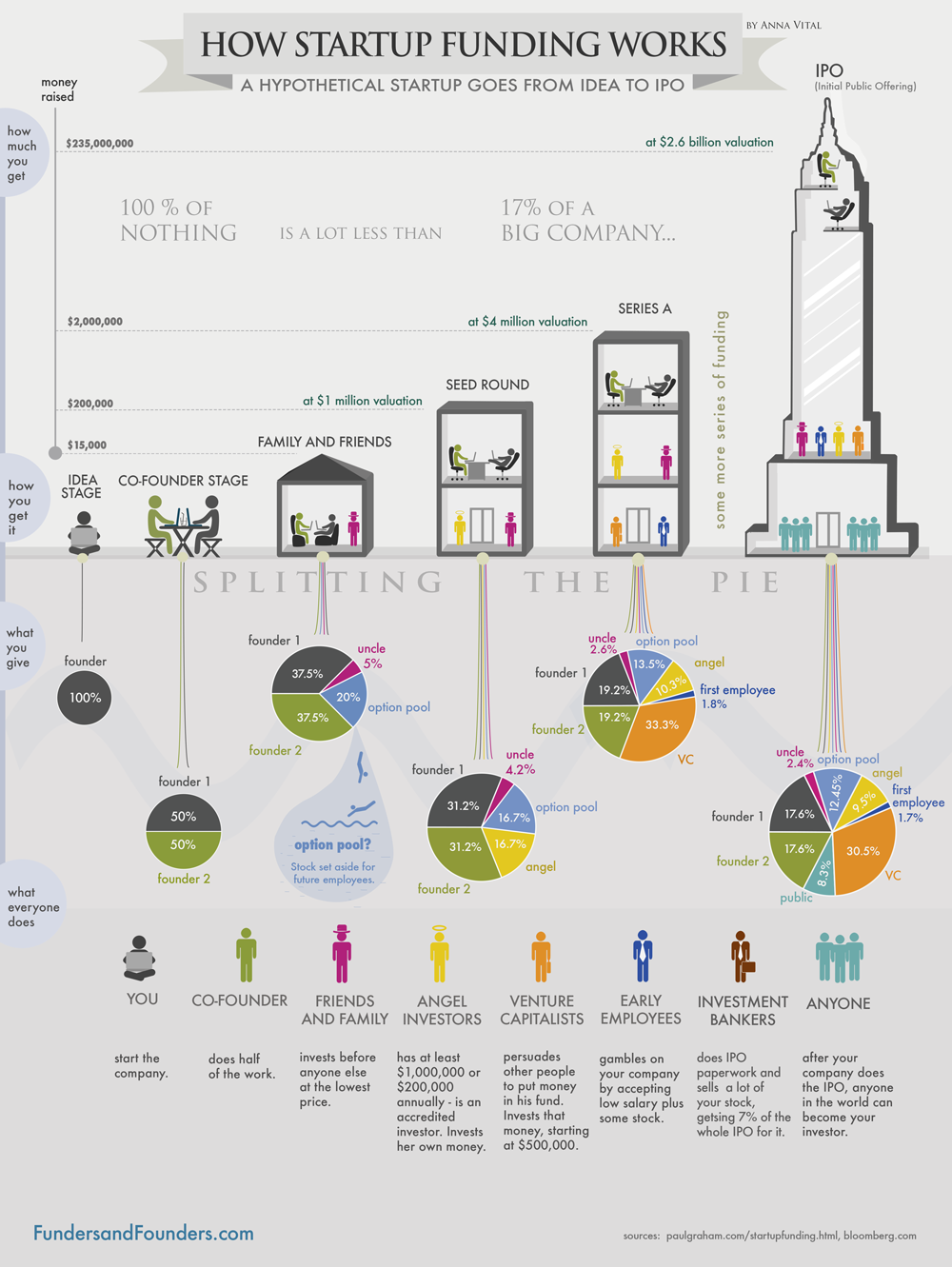
However, at no point in time (except after an IPO) is there anyone in this game who would take over the company at the stated valuation (i.e. >1 billion). This makes the question of the value of the start-up superfluous, because the value of a company is the figure that would result from a sale of the company. That is the difference between value and valuation.
Bubble, which bubble?
Seen in this light, the bubble is not tragic as long as it is created in the “private” sphere and in this way. Nevertheless, the unicorn craze is simply sending out the wrong signals. The wrong signals to new founders, to VCs and, above all, to decision-makers in the old economy.
Simply good companies rather than unicorns
The objective for Europe cannot be to generate as many unicorns as possible, but we should be broadly concerned that politicians do not create further hurdles for companies. By this I don’t mean reducing employee protection, but rather curbing all the madness surrounding regulations and rules. And to actively support founders and walk the first few very difficult meters with them.
We do not need more european unicorns (overrated startups) – we need more profitable start-ups #hub15 https://t.co/RYVOjyyzPu
– Johannes Loxen (@jloxen) December 10, 2015
Whether this results in large companies with enormous success stories or SMEs is of secondary importance. From a social perspective and actually also from a political perspective, an “army” of innovative SMEs would be much more helpful than 5 or 6 really large corporations, because “large” will be much less relevant in the future. In future, it will be about being as fast as possible. And whether you’re a “disruptive” player or not, that’s what you are when you’re small.
Artikel auf Social Media teilen: