Industrial Revolution 4.0 – What (dangerous) nonsense!
The World Economic Forum 2016 coined the term “4th Industrial Revolution”, especially in the media. Many recognized or self-proclaimed experts have adopted this terminology without further evaluation. But it couldn’t be more misleading. Here’s why.
(Reading time: 4 minutes)
Revolutions have to do with perception
The concept of economic revolutions is burned into our brains. We learn at school that these unexpected waves came over society and the economy. Basically, these revolutions are sudden efficiency gains that make it possible to solve a problem more easily, better and more cheaply. You can also call it disruption of existing structures, both economic and social. In my article “How industries get caught up in the maelstrom of disruption“, I gave some examples of the mechanics of industry upheavals.
If a technology is so efficient in disrupting existing structures, i.e. if it can not only permanently change one industry in a short space of time, but several at the same time, we commonly speak of an economic revolution. The terms 1. / 2nd / 3rd Industrial Revolution formed.
How we perceive and categorize an event has a great deal to do with its recurrence. This is a very simple psychological effect: the more often we experience something, the less it is perceived as extraordinary. We get used to extraordinary things relatively quickly. This is as negative as it is positive.
Society, and therefore the economy, has to adapt and change at ever shorter intervals. This is due to the progressive, or if you like, exponential growth of technological progress.
This effect is fueled by the greatly extended human lifespan (also read “perception span”). I have expanded a simple graphic from the “Concept of Perpetual Disruption” a little:
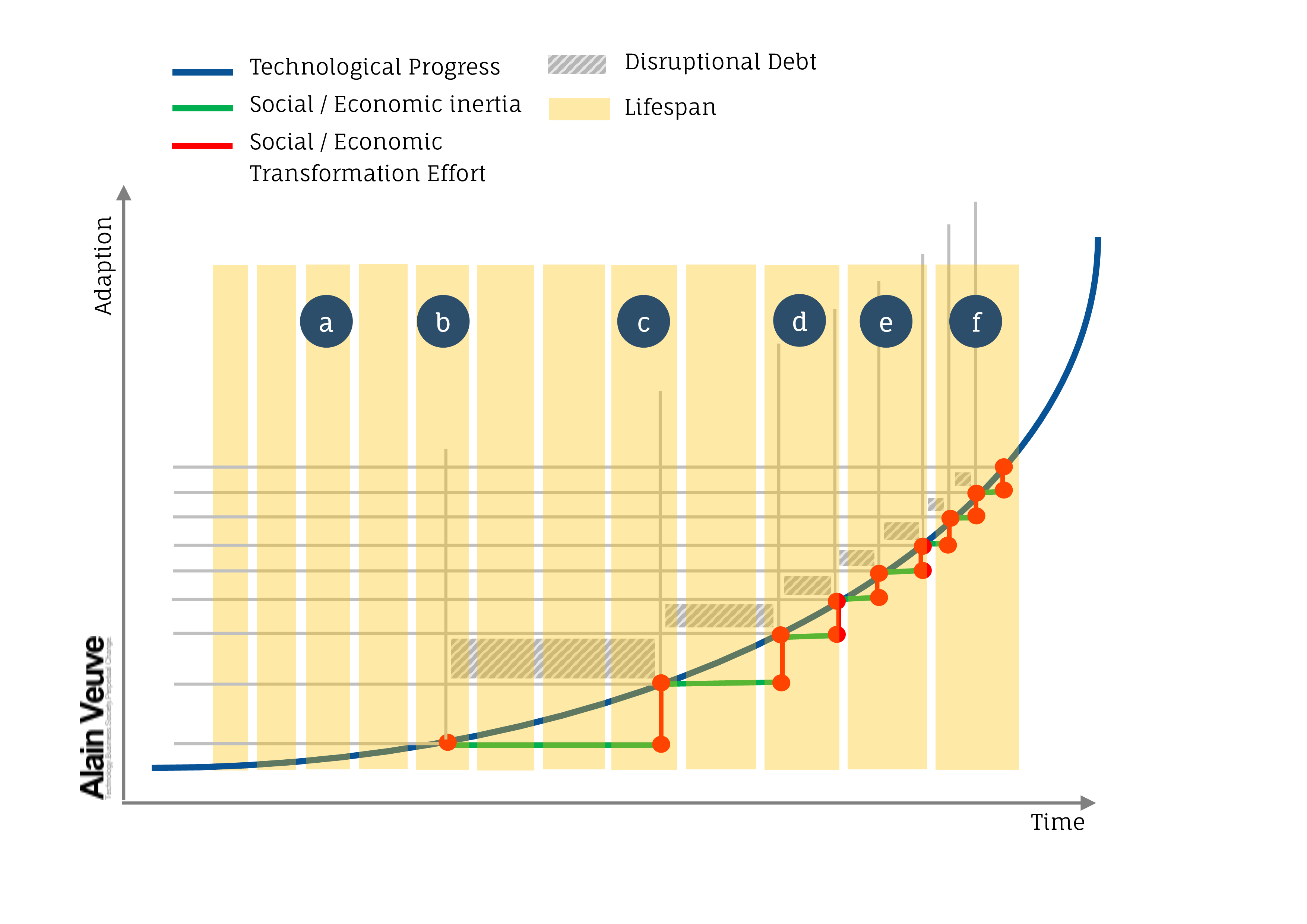
The blue curve represents technological progress, the green lines show society’s inertia in adapting to this progress and the red lines show the effort that society has to make to adapt.
Shown in yellow are the life spans, which are getting longer and longer on the timeline. We are living longer and longer, so we perceive more and more of the changes. For example, a person who has spent their life in span “a or b” has not experienced any upheavals. In life span “c”, on the other hand, he has experienced an upheaval and will probably call it a revolution (e.g. the agricultural revolution or the first industrial revolution).
The contemporary who lived in life span “d” may have experienced the 2nd Industrial Revolution and the 3rd Revolution. After that, it gets difficult: people in life spans “d”, “e” or “f” experience several Industrial Revolutions. The fourth? And the fifth? Industrial revolution no. 7-10 in a total of 10 to 20 years? The whole concept of revolutions is thus reduced to absurdity.
Industrial revolutions only make sense from a conceptual point of view if either technological progress has been linear or the lifespan is decreasing. It has been proven that neither is the case.
I therefore believe that the concept of “industrial revolutions” has done its job. And we must go further.
How do we respond to a stream of recurring upheavals
Klaus Schwab lists many different points in his editorial “The Fourth Industrial Revolution: what it means, how to respond“. He writes about the effects on society, politics and the economy, and although I am very grateful that the topic of transformation through technology has finally arrived in Davos, I am disappointed by the rather thin content. That’s not to say that I think the article is fundamentally bad, but I think these statements are perfidiously dangerous. Why?
Thinking from a bygone era
Instead of blowing the simple horn of industrial revolutions, Schwab could have called a spade a spade.
That we can then achieve the changes with as little social cost (read human suffering) as possible;
- if we fundamentally restructure our economic system in the direction of adaptability
- when we redefine work
- when we redefine remuneration
- if we reform intergenerational contracts (i.e. pension systems)
- when companies become agile organizations
- when all players act transparently and jointly
This is not as easy as simply proclaiming the 4th industrial revolution. I find it commendable that Schwab calls in the article for us to work together on the challenges.
Traditional, linear thinking
Schwab writes about the economic leaders:
“Today’s decision-makers, however, are too often trapped in traditional, linear thinking, or too absorbed by the multiple crises demanding their attention, to think strategically about the forces of disruption and innovation shaping our future.”
And by degrading the challenges to another “industrial revolution”, he makes the same mistake: he remains stuck in traditional, linear thinking.
The wrong signals
You could argue that this is just an empty phrase and not relevant. I think anyone who thinks that is wrong. Schwab has managed to capture the senior executive community and is doing a lot of good and groundbreaking things with his organization. Schwab is listened to.
By propagating the 4th industrial revolution, he sends a signal to managers: “(We’ve) been there, done that”. And thus conveys a minimum of mental certainty where there is none and should be none.
In fact, however, the current changes and challenges are not really comparable with the events perceived as revolutions. Unless we define the 4th industrial revolution as one without an end date. Only then is it no longer a revolution in our perception.

This article originally appeared in February 16 as part of my “Transformed!” column on t3n.
Artikel auf Social Media teilen: