Thoughts on Labor Day: What does the future of work look like?
The nature of work has changed steadily since mankind began using tools. These tools resulted in less and less work for the individual, but the bottom line is that more and more work could still be done. Over time, we developed an economic system that aims to reward work in terms of quantity and quality. How do we deal with the fact that in the future there will be less and less work as we know it? An assessment, far removed from politics, of the future of work, just in time for Labor Day 2015.
(Reading time 5 minutes)
The underlying problem
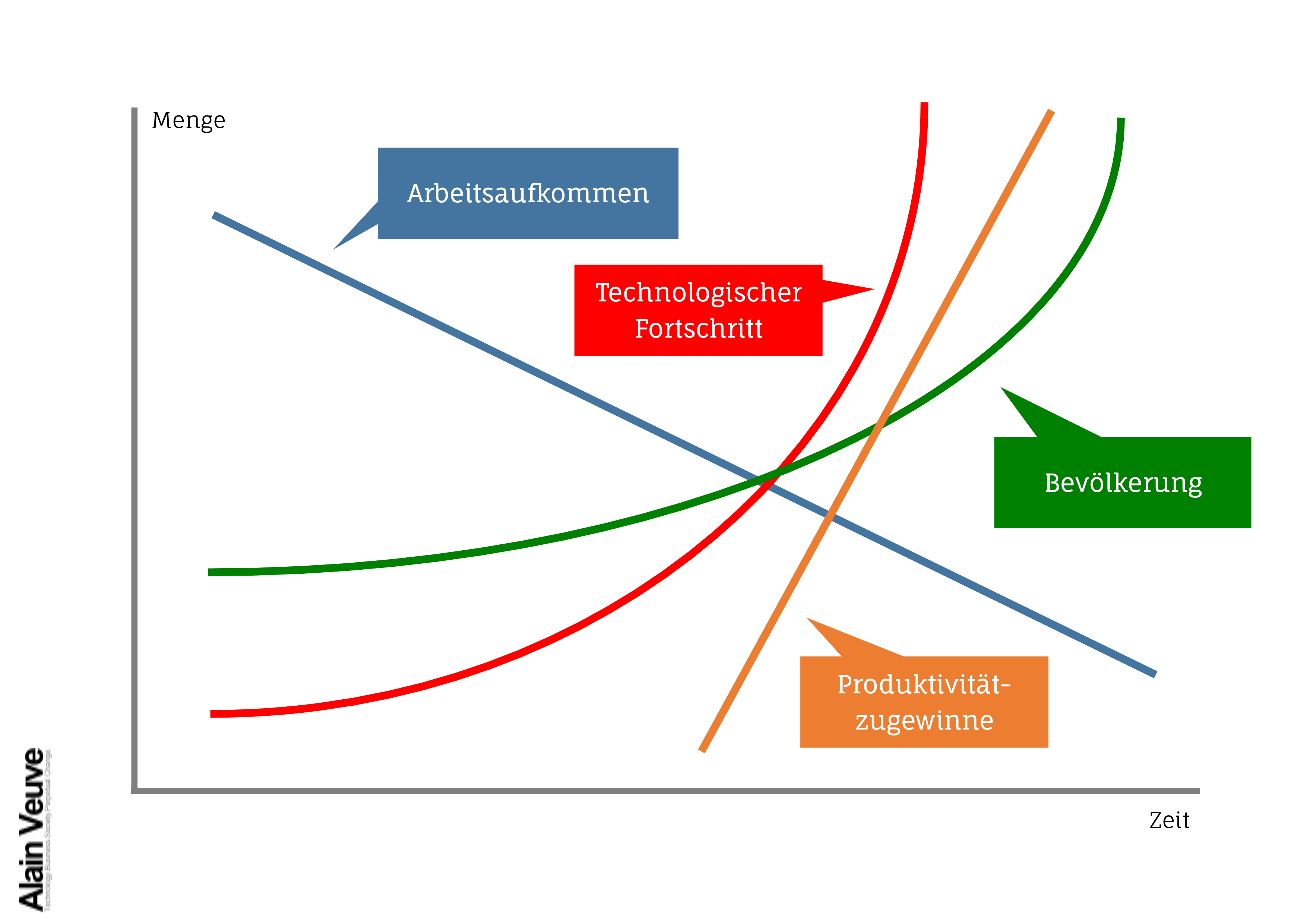
The problem with the economic employment of people is driven by 2 factors. Firstly, exponentially growing technological progress is leading to rapid productivity gains. This means that a lot of work that was previously done manually by people can now be carried out more efficiently using technological aids.
“Simply put, there is less and less manual work for more and more people.”
If you go back in time, you will see that we have always seen a shift from primary sector work to the tertiary sector. Increasingly, only a person’s intellect is of interest to the economy.
The second factor is the exponential growth of the population (which, incidentally, was only made possible by technological advances).
The previous recipe
Until now, this effect has been countered by simply reducing average working hours. Depending on the occupational group and country, we still work half the hours we did 200 years ago. (e.g. in Germany from 3,920 hours per year to 1,645 hours in 2014)
This calculation has worked out so far in an economic context because the economic system has been able to generate system growth despite higher incomes from technological productivity gains (no, this is not what the economics books say, but it is nevertheless the case). And because the economy has still not sufficiently internalized harmful side effects. In other words, the economy is still growing at the expense of the environment (today we need 90 million barrels of oil per day!).
Will it go on like this forever?
Our economic system is designed to monetize productivity gains and pay for work at the same time. There will be much more of the former in the future. There will probably be less and less of the second. However, the remuneration of work is the basis of income and this in turn is the basis of all consumption. So changing the parameters cannot be good in the long term. The system will no longer work. We are currently on the threshold of this upheaval. Please don’t get me wrong, I’m not expecting the end of the world or the total collapse of our economic system. But it will not continue to function without adjustments. That is why there is a public debate about longer working lives, lower pensions, etc.
The concept of work
It helps to look at the nature of work in a historical context. Work as we know it, i.e. with the hard division into leisure and working time, has only existed since the wage labor of the industrial revolution. For the last 80 years, gainful employment has been a fixed part of everyday life. And work increasingly fell into disrepute among some employees, as they did not like doing it but did it anyway because it seemed to make the most economic sense for them.
Ways out of the dilemma: 5 points
- Let’s let go of our idea of work.
Let’s just forget this “private” and “business” thing. We might lose a mental retreat (the private sphere in which we are/do not have to be available at all in predefined slots), but we gain the freedom to decide what we want to do all day long. When I talk to people who want to take the step into self-employment, I often hear “being your own boss” as a motivation. When I ask “What do you mean by that?”, the answer is often “just being able to take an afternoon off when I feel like it”. This kind of freedom and quality of life is worth more than, for example, always having to “take time off in the evening”. That should also be possible as an employee. - Do the work that is fun, not the one that brings the most.
Keyword desire: What we work on should be based more on personal talent and desire. I know so many parents who have already laid out a career path for their offspring and base all decisions on material parameters. This produces people who are well educated on paper and probably earn slightly above average wages, but who would actually like to do completely different things. This is wrong, both from a personal and an economic perspective. After all, employees are at their best when they can do what they enjoy. And people are fulfilled when their daily work not only brings them bread and butter, but also satisfaction. Super easy, isn’t it? - Beginning to change the system
As a first step, we need to find a way to make employees’ pay dependent on what they bring to the company. This is no more unfair or fair than time accounting. Of course, it’s a huge paradigm shift. But when you play out the thought experiment, you realize that it gives employees a lot more freedom. Time to live. What remains is that as an employee, you have to make an effort to do your job well and become better. But you have to do that anyway. It would also be easier for companies to make such a change; instead of dealing with overtime and undertime and a lot of administration and control, employees should be judged on their performance. Imagine working in a company where everyone does what they can and like to do and everyone makes a real effort. Wouldn’t the amount of time spent working be completely irrelevant? And wouldn’t that be fairer? Probably yes, and we could let more people share in the productivity gains because people would be more productive and adaptable overall. - The antagonism has to stop
When I look at the strikes in the transport industry and see them from time to time, I can only shake my head. These trench wars, like those in politics, are completely unnecessary. When will these “negotiating parties” learn that they can only work together and that (even non-physical) violence (always, absolutely always) generates counter-violence. In a social partnership, there must be no one stronger than the other. Anyone who does not recognize this has not understood that the employees need the employers as urgently as vice versa. Together or not at all. Instead of negotiating for a long time to get the best deal for your own party, it would be much more effective to look at the system as a whole and make changes together that help everyone. - An end to the abrupt end of working life
There should be no end to work. Retiring at a fixed point in life is a phenomenon of the last 70 years and is unnatural. For God’s sake, don’t get me wrong. In no way do I think that older people should have to work in order to earn a living. On the contrary. Senior citizens should be free to decide whether they want to work or not. But many people who are retired don’t want to be without work at all. Retirement is also always a social turning point. Senior citizens may simply want to do less, do other work, take it easy. And an intergenerational contract should ensure that this is possible. With fixed retirement, however, we are all pulling together and you know as well as I do that no two people are the same.
Structural change
The points mentioned above are approaches that will take us towards the work of the future. However, they do not solve the key problem that productivity gains are making more and more work superfluous. In a second step, we will probably have to redefine the concept of income. Two years ago, there was a popular initiative in Switzerland calling for an“unconditional basic income“. The idea behind the initiative was that all residents should be paid a minimum subsistence level without anything in return and that all social services should be waived in return. As much as something like this goes against the grain for me as an entrepreneur, I have to admit that the idea has something to it. Because:
“Performance must be rewarded, but existence is a basic right in a social market economy!”
That’s why I think one possible approach would be to pay a basic amount that ensures a minimum existence for the population. In addition, every employee would receive remuneration based on their contribution to productivity (regardless of whether this is in terms of quantity or quality). The productivity gains could then be used economically to finance an increasingly affordable livelihood for more and more people.
The discussion still seems rather hypothetical and theoretical at the moment. But let’s not kid ourselves, the pension system, this intergenerational contract, will not simply last another 80 years. We would do well to discuss changes openly as early as possible. Even if they are sensitive for everyone. By doing so, we prevent people from basing their life plans on assumptions that will not become reality.
Artikel auf Social Media teilen: