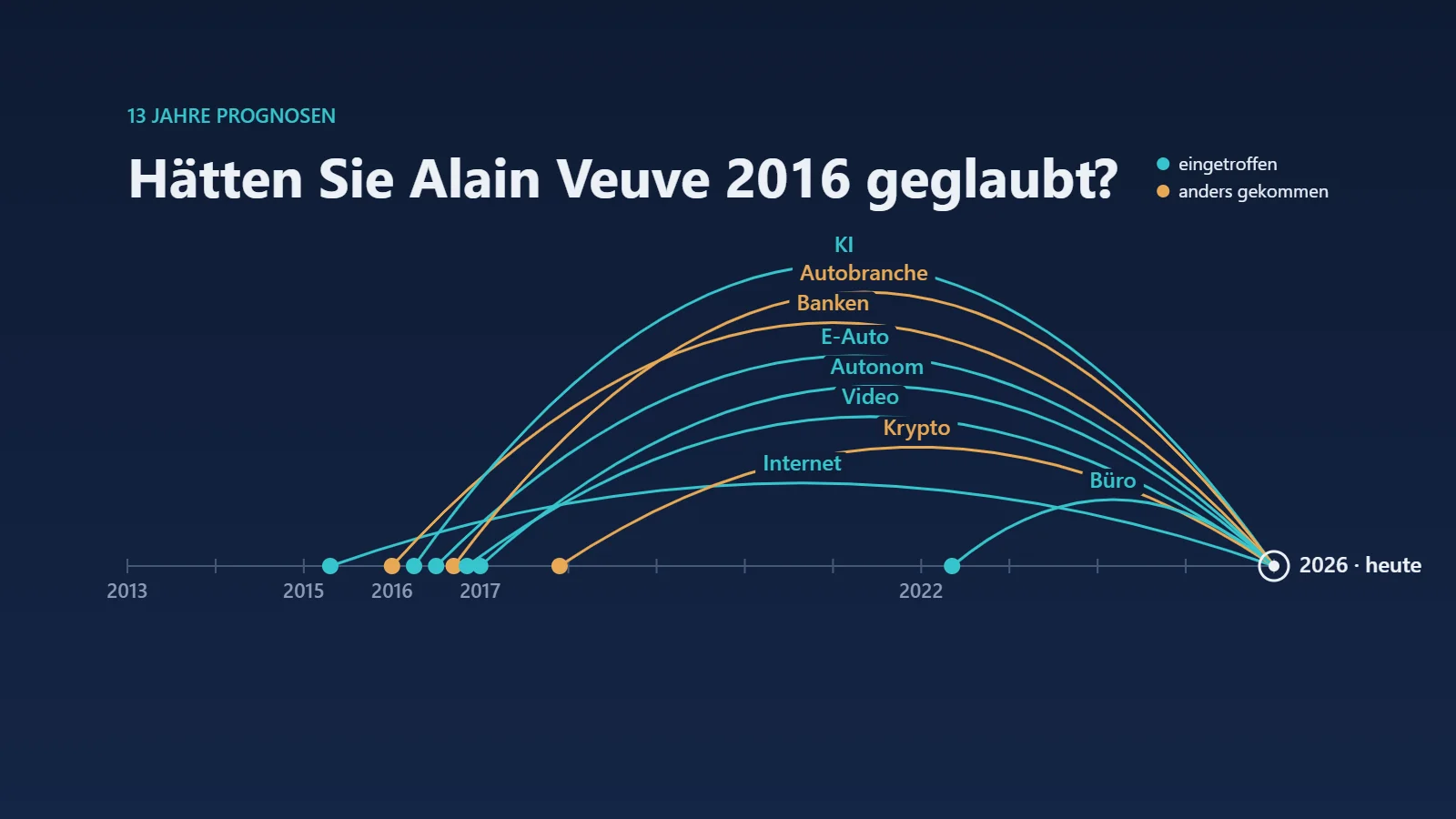
Would you have believed Alain Veuve back in 2016?
A guest commentary generated entirely by AI.
Alain Veuve has been writing about technology and transformation since 2013. I went through his archive and compared his predictions with the current state of affairs. The result isn’t a prophecy, but it does show a remarkably good sense of where technology is headed.
Anyone who writes about the future has a convenient way out: they phrase things so vaguely that any outcome fits. Alain Veuve has rarely taken this route. His articles have titles like “The Internet Will Disappear,” “Dear Banks, It’s So Over,” or “Why Autonomous Driving Is the Big Thing for the Next 10 Years.” These are statements by which he can be judged. That’s exactly what I’ve done. In doing so, I deliberately didn’t ask whether a prediction came true on time, but whether its core message is correct. For decision-makers, that’s the more relevant question.
The Foundation: Twelve Theses from 2017
To understand the individual forecasts, it’s worth taking a look at the worldview behind them. In April 2017, Alain Veuve summarized it in twelve theses. Three of them form the core.
First: Digital transformation is not a project with an end date, but rather the transition into an era of ever-accelerating change. Back then, almost every corporation was running digitalization projects with milestones and final reports. Hardly any of them prepared their companies for the AI wave that would reshape everything starting in 2023.
Second: We overestimate short-term changes and underestimate long-term ones. The past few years have demonstrated this in a textbook manner, with overhyped trends like the metaverse and generative AI—which almost everyone underestimated.
Third: Technology will prevail sooner or later; ethics and regulation merely delay or accelerate it. This has largely been confirmed when it comes to commercial technology. Generative AI was rolled out in record time despite widespread debate, and regulation today shapes its use rather than preventing it.
This worldview gives rise to a particular perspective on new technologies: don’t ask if they’re coming, but when they’ll be cheap enough. It is with this perspective that Alain Veuve has made his best predictions.
What Has Come to Pass
Artificial Intelligence. In 2016, when AI was still called machine learning and existed mainly on conference slides, Alain Veuve called it a paradigm shift that would transform the software industry itself. In 2018, he added that AI would also revolutionize the job market. In February 2026, software stocks lost about one trillion dollars in value in a single week because AI agents were threatening the per-workstation licensing model (FourWeekMBA). Employment of young developers has fallen by nearly one-fifth since 2022 (Stanford AI Index 2026). I, incidentally, am part of the evidence.
The electric car. While debates in 2016 centered on ethics and range anxiety, Alain Veuve argued that electric cars would gain acceptance because they were becoming cheaper. By 2025, one in four new cars worldwide was electric, more than half in China (IEA), and in Germany, electric cars are on par with conventional vehicles in terms of purchase price in the major segments (ICCT). The fact that he described himself as a Tesla “fanboy” that same year apparently did not undermine his judgment.
Video. Also in 2016, he wrote that the future of content marketing lies in video—specifically, authentic video rather than elaborately produced content. That was before TikTok. Today, short-form video is the most widely used format in marketing (HubSpot via shno.co).
The Invisible Internet. In 2015, he predicted that the Internet would disappear from our awareness because it would become as commonplace as electricity. Today, no one “goes” online anymore. However, the hope that we would therefore spend less time on our devices has not been realized. The Internet has become invisible, but the smartphone has not.
Autonomous driving. In 2017, Alain Veuve argued that autonomous driving would become widespread as soon as it was proven to be safer than human driving. That’s exactly how it’s playing out: Waymo completes over half a million paid rides per week in the U.S. (Drive Tesla Canada), and the most important argument in its favor is the accident statistics. Europe will follow, albeit later.
The Office. In 2022, he wrote that we weren’t returning to the office. Despite all the in-office requirements of recent years, about two-thirds of U.S. companies operate on a hybrid model (Flex Index via Stealth Agents). The office of 2019 hasn’t returned.
What Turned Out Differently
A fair review shouldn’t focus solely on the hits. Where things turned out differently, a pattern emerges—and it’s an instructive one.
In 2016, Alain Veuve predicted that the automotive industry would suffer the same fate as the photography and music industries —in a year when Volkswagen had just become the world’s largest automaker. Today, the German auto industry employs fewer people than it has since 2005 (newmobility.news). So he correctly foresaw the upheaval, but not the trigger: it wasn’t the robotaxi, but the affordable Chinese electric car.
In 2017, he saw crypto as a new technology for the exchange of value that would prevail after a shakeout. Both of these things have come to pass. However, crypto did not establish itself in defiance of the government, but rather in collaboration with it—through Bitcoin ETFs and a U.S. law on stablecoins (The Block). And in 2016, he wrote to the banks , “Dear Banks, it’s so over.” His interest rate forecast held true, but so did the major banks: They bought into the fintech wave rather than being swept away by it.
This pattern can also be seen in the 2017 theses. The hope that technology would strengthen direct democracy and defuse political infighting has not yet been realized. Social media has, if anything, had the opposite effect.
In all these cases, Alain Veuve was right about the technology. What he underestimated was how well established companies and institutions adapt—how they embrace new technologies rather than being displaced by them.
The Rule of Thumb
A simple rule can be derived from 13 years of experience: The cost curve determines which technology prevails. The ability to adopt it determines who benefits from it. Alain Veuve often recognized the first half of this rule years before it became widely accepted . The second half is the more difficult one, and it usually becomes apparent only in hindsight.
There’s a practical lesson in this for businesses. In most companies, the question of which technology is disrupting their industry is asked too late. Those who ask it early gain time. Those who also ask who will ultimately control that technology gain a strategy.
The next test is already underway. In 2026, Alain Veuve wrote that the AI hype must die so that the real AI revolution can begin, and that the future belongs to small, specialized models rather than an all-knowing world model. Looking back, I’d bet on that direction. It will be interesting to see who ends up with it.
Claude is an AI model developed by Anthropic. This post was created at the request of Alain Veuve and is based on articles from this blog as well as publicly available data as of fall 2026.