Why is the digital transformation being overslept?
Anyone who has worked as a consultant or project manager in the digital sector over the last 15 years regularly wonders why so many companies did not see the digital transformation coming and in some cases still ignore it today. Why is that? An attempt to explain.
(Reading time: 5 minutes)
In 2003, for example, I still understood that. This “Internet” was not yet widely used and everything was cumbersome, expensive and slow. I remember the story of a former business partner who wanted to make the Internet and eCommerce appealing to a drinks manufacturer and ordered a pizza online for demonstration purposes in a customer meeting. The pizza arrived, but everything was so uncertain and new that an agency employee had to call the pizza delivery service to make sure the order wasn’t a joke. That’s how unusual it all was back then.
Today, I have only a very limited degree of understanding for this oversleeping. I have no understanding at all for all the fears that still linger in large, successful companies. Why is it that C-level does not understand the opportunities that arise for almost every company from the digital transformation? I think the following 3 points are decisive:
Personal socialization
For a few months now, a quote from the collection of texts “The Doubt of the Salmon” by Douglas Adams has been appearing in the context of digital transformation:
“I’ve come up with a set of rules that describe our reactions to technologies:
- Anything that is in the world when you’re born is normal and ordinary and is just a natural part of the way the world works.
- Anything that’s invented between when you’re fifteen and thirty-five is new and exciting and revolutionary and you can probably get a career in it.
- Anything invented after you’re thirty-five is against the natural order of things.”
If you look at the average age of the C-level of medium-sized and large companies, the majority of them fall into category 3. Basically, it is indeed the case that many managers have simply been socialized in a completely different world and do not have the mental elasticity to initiate change accordingly. Another factor is that the willingness to take risks diminishes at an older age. Why should I, in the autumn of my successful executive career, my last 5 golden years, start another comprehensive restructuring of the company? That’s probably not in the interests of the company, but it’s a human way of thinking. At the end of the day, there are more important things than business.
Do you think today’s 30-40 year olds will no longer be so narrow-minded? Make no mistake. Ask 5 people in this age group if they could imagine having technology implanted for non-medical purposes (e.g. digital identity as a chip). You won’t find many. But the topic will certainly be on our minds in the coming years.
Dot-Com Bubble Trauma / Early Adopters Fail
A significant number of larger companies are still suffering from the dot-com trauma. They invested too heavily and too much in Internet technology (directly or indirectly) during the first upswing of the digital transformation and have not been able to amortize these investments in the slightest. For several years, I accompanied a company that had invested a high single-digit million amount in eCommerce shortly before the turn of the millennium. The eCommerce offering was simply too early because it did not yet have the critical mass of users. The initiative therefore flopped and the investment had to be written off. Since then, this has weighed heavily on all digital activities. Senior management is a burnt child. So burnt that today, whenever a major digital investment proposal is submitted for a decision, they refer to this experience and cut it back so much that only half-hearted projects can be realized. Logically, these then fail to achieve the necessary success, which once again confirms the old guard in their decision. Spiral.
Paradoxically, these companies make the same mistake today as they did back then: instead of analyzing exactly how the customer behaves and how this behavior develops, they only think and act within the business and/or technological corset. Entrepreneurship looks different.
Speed of technological development and adaptation
The speed at which technological development and the adaptation of technology by users has taken place is indeed unprecedented, even in a historical context. From experience, entrepreneurs at the turn of the millennium simply could not have expected that so much would change so quickly in the next decade. The following graphic illustrates this:
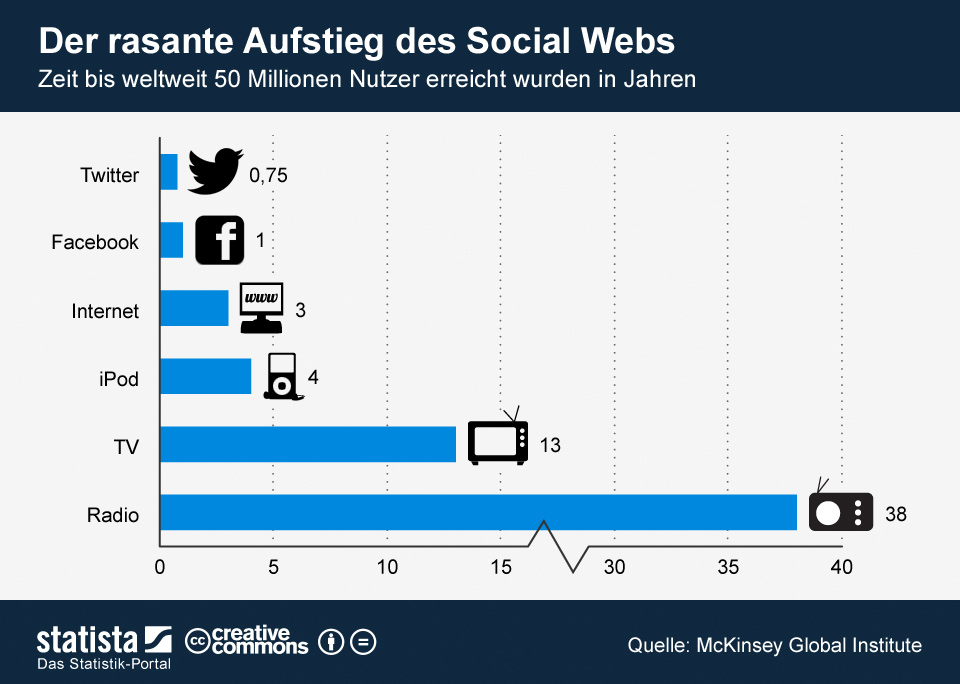
So they were quite simply taken by surprise. And there are quite a few signs that development will continue to pick up speed. I think that the current pace of technological change is the slowest I will experience in my lifetime.
Companies that consistently focus on their customers and their relationship to technology (or adaptation of technology), develop good and appropriate offers from this knowledge and maintain a good level of curiosity, willingness to take risks and a feel for opportunities will survive in the future, even in a rapidly changing and high-tech society.
Artikel auf Social Media teilen: