Why established companies can learn less from start-ups than they think!
If you want to make a difference in your company as a top executive today, you hold a few start-ups. Or regularly travel to Silicon Valley. There’s no doubt that this is the great age of start-ups. As a start-up person through and through, I think that’s basically a good thing. In the general euphoria of CorporateEurope about learning from start-ups, it is sometimes forgotten that an established company is under pressure to make progress and a start-up is at a completely different point in its development. Yes, they can learn from each other. But less than is generally thought.
(Reading time: 4 minutes)
Foosball table and bunk slide
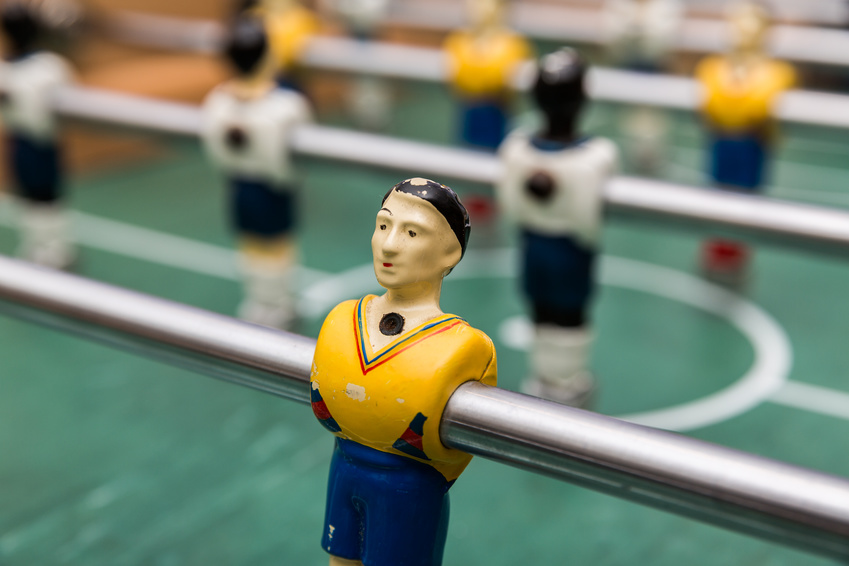
“Oh boy” is what I sometimes think to myself when I am once again shown an artificially created start-up cell in a large company. “We now have a table football table and we’ve given out Nerf guns. It’s a pretty cool feeling here,” I’m told. But it feels more like the rabbits have been given lots of carrots and cut grass in a big plastic box. It doesn’t look like a real meadow. The rabbits go home at five o’clock.
I often experience this kind of external alignment. And I don’t think it’s completely wrong. But it must be clear that the (emerging) culture shapes the environment. And not the other way around.
You are not hip, agile and “disruptive” by decree, so to speak. It’s the people who get things off the ground. The way they interact with each other and above all, really above all, their attitude to what they create with their work.
So if you want to sow start-up culture, first give it a real mission. For example, a deeper meaning or a crazy goal. It’s amazing how this can awaken the ambition of many good employees. Well understood, not the English way. You decide what works in terms of culture. But starting with the football table? Not really.
Nothing to lose
The methods and processes that start-ups use to get ahead are sometimes simply illegal in large established companies. And, as start-ups differ considerably from large companies, the risk situation is completely different. While start-ups generally have almost nothing to lose, there is almost always a lot at stake for established companies.
Using the same or similar methods can therefore be fatal. So be aware that the two types of company are at a completely different point. What is right for one may be completely wrong for the other.
Start-ups generally have neither technical nor social debt
One huge advantage of start-ups is that they can begin on a greenfield site, so to speak. Established companies are completely different. They are full of dependencies. There is “system xy” that you can’t just adapt or replace. Cleaning up such environments, as I experience every week, is extremely expensive and time-consuming. In most cases, existing setups also have to be “rediscovered” first so that the impact of a system change can be assessed. It’s not for nothing that people often like to joke “Never change a running system”. I also hear this from CIOs. Gallows humor.
The other is the social structures, most of which have grown over decades. I’m not talking about wanting to make people redundant, but about reallocating tasks and restructuring. In most cases, this is simply impossible because people have informal arrangements with each other. You can’t and don’t want to do this to your long-standing employees.
That really narrows the scope. It’s completely different in start-ups. There is usually neither technical nor social debt. There are far fewer dependencies and therefore many more opportunities. It’s easy to think freely when you don’t have to adhere to anything.
So before you dream of acting as quickly, uncompromisingly and cleverly as start-ups, bear in mind that your entrepreneurial environment is different. And that some of your employees are probably not in the mood for “the start-up life” right now.
The Hustle
When I talk to executives about start-ups, I always find that they have quite romantic ideas about start-up entrepreneurship. Of course there are the well-financed stars with a business that goes like butter. But they are rare exceptions. The start-up phase is tough for most young entrepreneurs.
This “hustle“, the constant preoccupation with the venture, especially mentally, is an incredible burden. Work is always part of the equation, as Gary Vaynerchuck never tires of preaching. And he’s right.
People who achieve great things in the start-up sector usually wear themselves out massively. It’s a good idea to know your mental and physical limits before you commit to something like this. And you should have developed an unemotional relationship with your own failure. Otherwise you will constantly make the wrong decisions. And you can’t sleep either.
People in conventional companies don’t know such things. And they shouldn’t know it either. This is your responsibility.
Change through pop-up business models
Of course, it is by no means the case that companies that deal with start-up culture and methods simply blindly adopt everything. I also see a much more differentiated approach to the topic and I welcome the initiatives. But not every company needs its own incubator or its own start-ups. The more I learn about these cultural transitions and see the effects, the more I come to the conclusion that established companies should focus on their strengths. Not try to bend themselves. Because there are so many things they have ahead of start-ups. It’s not all bad.
What these companies are typically bad at is driving forward the development of new business models and products. Improvements and developments are often only gradual.
In an article for T3n, I presented a model of how large companies can use so-called pop-up business models to develop new products and approaches without having to bend completely.
Integrating this renewal process into the entire organization without completely disrupting the existing organization is essential for the development of companies. After all, it is no use if the bosses come back from California with shining eyes. And then, as happens too often, order kick tables and return to day-to-day business.
Artikel auf Social Media teilen: