
This is why Germany’s electromobility is not getting off the ground.
Electromobility is developing rapidly almost everywhere on the planet. Only Germany, measured against its size, is lagging behind. As a result, the shift towards simpler and more cost-effective individual mobility is not being recognized in Germany. On the other hand, despite their international orientation, this is deceiving German car manufacturers. However, there are very simple reasons why Germany is lagging behind.
(Reading time: 6 minutes)
It is not the current market share that counts, but the almost exponential growth of the portfolio
As the Center for Solar Energy and Hydrogen Research Baden-Württemberg determined last year, the number of electric vehicles worldwide has almost doubled every year.
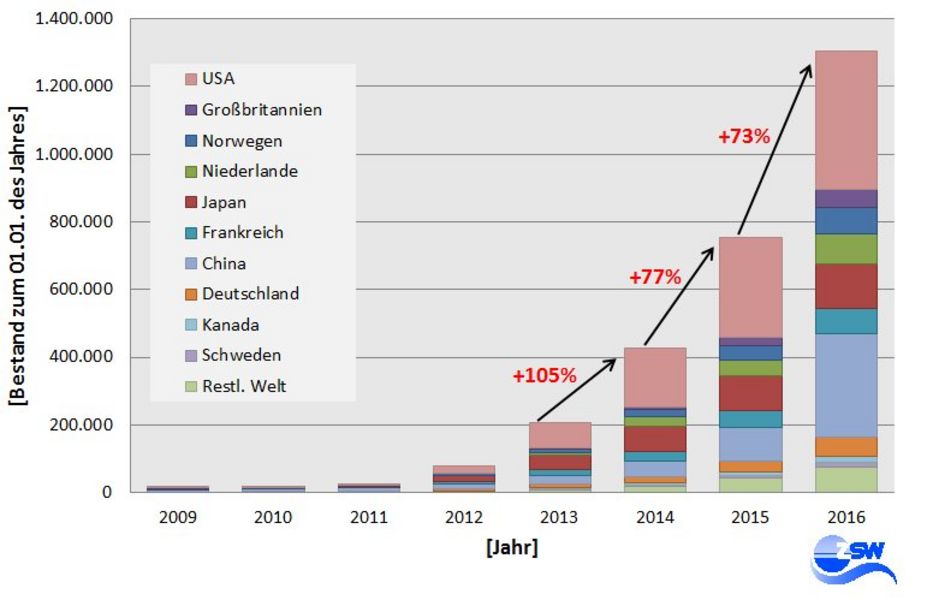
And it is not foreseeable that this trend will reverse in the future. On the contrary. The diesel fraud/scandal combined with the increasing number of driving bans for city centers will additionally fuel sales in the future.
In addition, and this is the crucial point, battery costs will continue to fall sharply. Sooner or later, the electric car will become the cheaper alternative.
Without Germany
So electric cars are everywhere. Only in Germany is it not really working out. And that’s a tradition, so to speak.
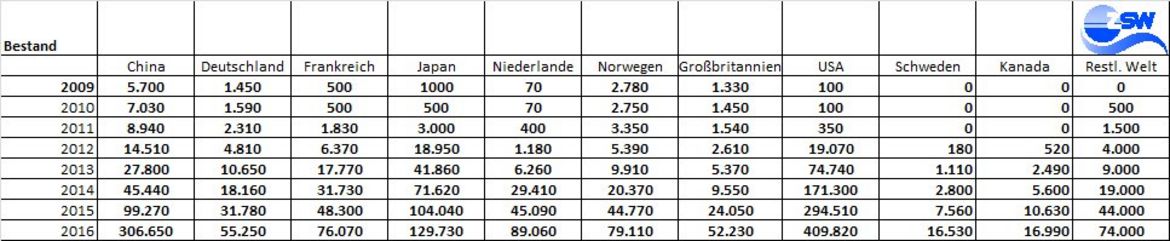
If you compare the numbers, Germany is pretty much at the bottom of the league compared to its size and economic power. And while in Switzerland, Norway and many other countries, for example, the topic of electric cars is already being welcomed by a broader section of the population, it seems to me from many conversations in recent months that Germans have almost developed an intuitive defensive attitude. Why is the rejection so great?
3 reasons
I think the following 3 simple reasons are the main reasons why electromobility is not yet making any headway in Germany.
Reach
Germany is a large country with a well-developed road infrastructure. It usually takes a few hundred kilometers to get from one city to the next. The range of today’s EVs is not sufficient.
But above all, it’s also a cultural issue: as someone who lives in Switzerland, it’s completely incomprehensible to me why so many of my German colleagues drive these long distances at all. It’s extremely tiring, expensive, statistically dangerous and inconvenient. But you drive Frankfurt – Hamburg in Germany. That’s completely normal.
But the fact that Germans actually need so much range in their daily lives is, of course, complete nonsense. Most cars just stand around most of the time. But that doesn’t mean that today’s EVs already cover all use cases, such as field workers with many appointments.
In Switzerland, you practically can’t drive through a Tesla battery charge without running out of Swiss soil, so to speak. And one or two hours of driving is usually perceived as quite a long time. People are much more likely to switch to the train. Probably also because the train is faster in many cases and works exceptionally well.
The range problem is therefore not an issue in many smaller countries, as they simply have a smaller radius of action.
Autoland Germany
Furthermore, Germany is closely linked to the history of the automobile and everyone knows at least one person who earns their money directly or indirectly in the automotive industry.
There are also a number of traditional, highly acclaimed German car brands. They have long been technological leaders and the quality of German cars is unrivaled.
What the German car manufacturers don’t have are electric cars that are suitable for everyday use. Even the first serious German electric car, the Opel Ampera-e, is imported from the parent company.
So if you want to drive an electric car in Germany, you inevitably have to rely on foreign manufacturers. And this “poaching in foreign territories” is something that is not exactly culturally fashionable in Germany. In my opinion, it is also completely legitimate: if a country already has a strong, successful industry, then it is proud of it to a certain extent and wants to use its products.
To make the comparison with Switzerland again: for many Swiss people it is unthinkable to buy foreign chocolate, cheese or watches. They simply believe that their own products are the best anyway.
Politics and structural change
The third reason why Germany is no further forward with electromobility concerns politics and the car industry. Since the scandalous diesel scam, more and more is coming to light about how the German government and the car industry are almost working in tandem to maintain the existing technology.
And there are good reasons for this. The development and production of electric cars requires much less capital and far fewer employees than that of combustion engines. A rapid change in technology would make many workers obsolete, especially at suppliers. This is why manufacturers are extremely hesitant when it comes to developing new models with alternative drive systems. What we are seeing is a token exercise. For years.
Politicians subsidize diesel through fuel taxes (18 cents less than petrol) and this ensures that all manufacturers are more or less committed to diesel. Investing in other technologies therefore simply made no sense. In the medium term, this is a logical economic decision on the part of the manufacturers. In the long term, it is extremely dangerous.
Downward spiral
This is because diesel has now reached a dead end. Obviously, it is not technologically or economically possible to comply with the increasingly strict environmental laws. The large-scale fraud and, above all, VW’s refusal to give a proper consumption and wear guarantee on the vehicles that have received the software/engine update cannot be interpreted in any other way. The Bavarian police recently caused a stir because they have not yet received the necessary assurances from VW and have therefore not had the software update carried out.
However, the innovation gap between German manufacturers seems to be considerable. There is no other explanation for the constant announcements of new electric models for delivery in 2020 and beyond. Cars are announced as technological innovations that Tesla actually has on the road today.
And we are now forced to move towards electromobility. Not because it’s suddenly hip and cool, but because at the moment it seems to be the only way to comply with future legal requirements. This is because all manufacturers must comply with the limit value of 95 grams of CO2 per kilometer per vehicle by 2020. Although the interim target of 130 grams was only just missed in 2015, this seems increasingly questionable in light of the diesel scandal. Are the figures even correct?
However, it is clear that something has to happen. Among the German manufacturers, Daimler currently seems to me to be in the best position. Instead of just making new concepts and announcements over and over again, we are seeing a reorganization of operations at Daimler and the company also seems to be slowly but surely becoming more agile in cultural terms. In my opinion, it is therefore quite possible that Daimler will take on a pioneering role among the traditional German manufacturers.
However, whether this will ultimately lead to a similarly strong market position as today is another matter. The global competitors are far ahead in terms of technology and are achieving growth rates that traditional manufacturers can only dream of. So it will be exciting.
Artikel auf Social Media teilen: