Europe’s Silicon Valley complex and the role of politics.
Apparently it’s good form these days for European managers and/or politicians to travel to Silicon Valley to be “inspired”. When you get back, you say things like “I’ve just come back from a trip to Silicon Valley and it’s [insert any superlative here] impressive…”. We’ve known for a long time that Silicon Valley is “cool”. What’s new is that politicians and old-economy people, the very people who are largely responsible for the somewhat backward tech and startup culture in Europe, are getting excited about it.
(Reading time: 6 minutes)
Regional example
The trigger for this article was ultimately an interview with the CEO Beat Oberlin of the local bank BLKB here in Switzerland. He heads an institution that operates solidly, is considered to be rather conservative, but has also been able to make a name for itself in the Swiss banking scene with a few new concepts in recent months.
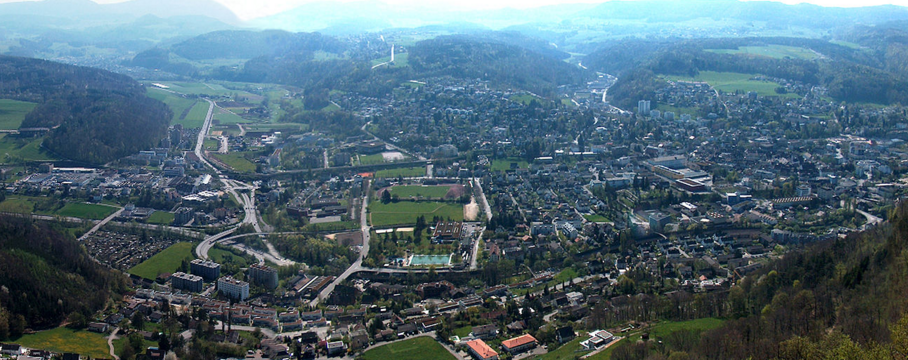
(View over Baselland, Switzerland)
The interview was preceded by the annual “New Year’s Apéro”, a kind of “get-together” of the local business community. In a speech by the head of the (private, self-appointed) Chamber of Commerce, he called on the canton (comparable to the federal state) to make more savings in education and culture. It is undisputed that the canton needs to make savings, as it has been badly run down financially in recent years.
However, in his speech at the same event, bank manager Beat Oberlin called for an end to the slashing of education and culture budgets because, to quote him, “we are also cutting part of our future and identification”. Saving without perspective certainly does not create a spirit of optimism, but this is exactly what this region urgently needs.
This kind of contradiction from the supposedly same camp is, of course, a real treat for a local journalist. Hence the radio interview. And Beat Oberlin doesn’t need a minute to rave about his Silicon Valley trip. In my opinion, however, his conclusions and recommendations are groundbreaking and apply far beyond Switzerland. A few of his points:
Knowledge is central to the creation of new business models.
The development of knowledge and education is central to the development of new business models. This development will be a key challenge in the coming years. Nothing new so far. Where it usually remains lip service, especially from the business world, he stands up and demands that no compromises be made when it comes to education.
Cluster of education, research, entrepreneurship
Following this realization, it is important to establish a corresponding cluster of education (universities/institutes), research and entrepreneurship. This is the only way a region can ultimately discover new technology, help shape it and turn it into economic solutions.
Breaking out of narrow-minded “retreat thinking”
However, it is also necessary to break out of narrow-minded “retreat thinking” (Swiss“reductivism“). Innovation does not tolerate isolationism and harmful populism can be seen everywhere in Europe in this regard.
A collaborative approach to policy
Concordance is a central component of successful politics. In such a constellation, no actor (or party) should be able to push through its maximum demands. He was also not sure whether the left-right grid was not outdated. What is needed is a coming together and the inclusion of all ideas and aspects in order to create new and good solutions. A sovereign majority always includes the minority accordingly.
If you want to listen to the interview, unfortunately only in Swiss German, you can do so here.
Remarkable votes
I think these are remarkable votes. There is no blind neoliberalism, no usual “we-must-strengthen-the-economy” blah blah blah – but on the other hand, no socially romantic illusions either. Instead, it is a call for more joint work. For openness and for the dawn of a new era.
Politics hinders not only the economy, but also progress, including social progress.
Why the apparent clash between a “business representative” and a second “business representative” occurred at all is due to the perfidious entanglement of business and politics. The representative of the Chamber of Commerce is primarily a politician, his statements at the event were political, although he presented himself as a business representative. And that’s where the dilemma begins. And I think this is also symptomatic for Europe.
I am not trying to make another comparison here between Silicon Valley and European start-up culture. It is incredibly pointless to do so in many areas because all the basic requirements were/are different.
It is just as pointless to want to build a second Silicon Valley. Because anyone who thinks Silicon Valley can be built with state programs is mistaken. Wherever certain tech centers have formed (which are then also called Valleys – e.g. Silicon Wadi in Israel or Silicon Savannah) – there has never been a solid political plan at the origin of the formation of a center.
On the contrary: after almost 20 years of experience as an entrepreneur and start-up person, I have come to the conclusion that politics hinders rather than promotes the creation of new things in the economy. There are two reasons for this:
Protection of vested rights
Through the interlocking of politics and business, the existing industries can enforce political vested interests. What is acceptable and legal today as lobbying must be seen from a distant perspective as a “system of institutionalized bribery”. I know that sounds drastic.
But we have many good examples here in Switzerland where industries and large companies have influenced political decisions in their favor. This is fatal for start-ups, as it allows the “existing” to better protect themselves legally against new players.
Such a construct is pure poison for economic and social change. New and truly innovative ideas always lead to upheaval in existing industries. There is no strong lobby for start-ups. The trade associations, especially those, are not in the least.
Regulatory mania
In every job I’ve done so far, I’ve repeatedly come across incredibly complicated and unnecessary regulations that do nothing but create a lot of work. Want an example? The handling of additional meal expenses in Germany. Read about it and feel all the madness that entrepreneurs are confronted with today.
You can have a quick grasp of things. I maintain that they cannot read through the regulations in one go and reproduce them correctly afterwards. And that’s what you’re supposed to work with. Nobody seems to think about the negative impact of such regulations. If we want to turn more people into entrepreneurs in Europe (which is what politicians want), such things should be abolished immediately.
But that doesn’t mean that we don’t need regulation at all. On the contrary. Of course we need rules that protect minorities, safeguard employees’ rights, create order and transparency and prevent abuse. But the rules should be a means to an end and not unnecessarily burden and demotivate companies.
Politicians would therefore do well to create good basic conditions, i.e. primarily infrastructure, and largely stay out of the details of economic activity.
One of the reasons for this is that the start-up scene generally pays relatively little attention to existing laws. This does not mean that they break them. Rather, it means that when developing new business models, the legal requirements are initially neglected. This is done in the belief that what benefits the end customer will ultimately be reflected in legal changes. A gray area, to be sure.
Many start-up people are largely free of politics. Not because they are not interested in society, but because they see no value in political events for the future. This is exacerbated by the fact that the really good people deliberately don’t go into politics.
The promised land
Silicon Valley has lost none of its appeal, not least because of this. At Hub15, many start-ups told us that it would actually be better to go to the USA. The reasons for staying in Berlin, or rather London, are mostly of a personal or, let’s say, national romantic nature.
 (View over Silicon Valley, USA)
In the USA, it is not part of the culture to feel committed to the place where you were born. Accordingly, people there are more agile and quicker in decision-making and execution.
This is part of the cultural difference that undoubtedly exists and that we don’t want to change because it’s hopeless.
“Europe, and Germany and Switzerland in particular, have enough strengths and values of their own on which to build a great technological future. It’s just that constantly comparing with and emulating Silicon Valley won’t bring that about.”
I’ve asked myself a few times why I don’t go to Silicon Valley. Or what I would be working today if I had gone 10 years ago. There’s no doubt that I experienced exciting years in the local digital sector and was able to help shape a lot of things. And I was also successful. I don’t really have the slightest reason to complain.
Education counts: For progress and peace
On the other hand, I still haven’t really found an answer to this question. Of course, there are the personal circumstances. (Which, on closer inspection, don’t weigh so heavily – selling the house, companies, friends & family further away, etc.) Why I would leave, however, is clear: to be able to work with more people who believe in a better future through technology.
And that brings us back to education, which creates precisely such people. No, we are not doing ourselves any favors by making savings in education. Please do not confuse this with the fact that we should not make education more efficient.
But if Europe wants the new generation of entrepreneurs to bring their strength to the ground here, it must ensure that education is top-notch. And that the unnecessary regulatory mania comes to an end. I am not very confident that this will succeed and it is by no means clear to me personally that I will continue to work here forever. It rather depends on how the framework conditions develop.
I am therefore encouraged by statements such as those made by CEO Beat Oberlin. We can only be grateful to him on behalf of all those who stand up for a good future together.
Artikel auf Social Media teilen: