Digital basic income and unconditional revolution
The day before yesterday, DIE ZEIT interviewed Timotheus Höttges, CEO of Deutsche Telekom, on technological changes and the relationship to work. His statement on the unconditional basic income in particular provoked numerous reactions in comments and on Twitter. Since my article on the work of the future, I know that the subject of an unconditional basic income is a hotly debated and often polemical topic. But we should be taking it seriously.
(Reading time: 7 minutes)
Read the interview
The ZEIT couldn’t help itself. To turn what was in itself a very good interview into a clickbait-like teaser article, which reproduces some things inaccurately and too sensationalistically. You can find it here.
From the teaser, you might think that Höttges was seriously of the opinion that there would be fewer jobs in the long term. But that’s not what he said. He correctly recognized that technology has always created more jobs overall. What he is saying is that structural change in the labor market will generate losers who probably cannot be retrained. That is not the same thing.
The title “Telekom boss Höttges in favor of an unconditional basic income” also suggests that this is a firmly established opinion. That is simply wrong. He doesn’t say a word about it. But what he does say, and what I find extraordinarily clever, is:
“That’s why we also need to think about unconventional solutions: An unconditional basic income can be a basis for leading a decent life (…) We must not reject such ideas simply because they seem useless from today’s perspective
.”
Hearing such an attitude from a supervisory board member of a major company gives me courage for Corporate Europe. Up to now, we have mainly been good at dismissing new ideas in advance. Only to fly to Silicon Valley a few years later and be “inspired”.
So I can only advise you to read the whole interview. It would probably have been a lot better and more substantial if this Giovanni Di Lorenzo (questioner) hadn’t tried to provoke the boring clash of “technology makes vs. brakes us” in an obsessively old-fashioned way. Höttges seems to be relatively immune to this and his answers showed well that this is not the point, but that we have to deal with the challenges in a much more differentiated way.
30 to 40 years for structural change?
Höttges says that a lot of work will be substituted in the next 30-40 years. I am amazed at the timeframe and think it is fundamentally wrong because it is too long. It will happen much faster because technological progress is advancing exponentially. And new jobs will also be created much faster.
If we look back 30 years, 1 million jobs were created in the digital economy in Germany alone. Anyone who believes that these are all highly skilled jobs doesn’t have much of an idea of the digital economy. A certain amount of retraining is possible (please don’t think this is done voluntarily and with pleasure) – but there are also clear losers.
How do we manage such structural changes socially and economically?
Another point that confused me is that Höttges wants to cushion the social consequences of this structural change with a kind of “innovation tax”. The fact that he is calling for “financing through the profits of Internet companies” (as written in the by-line of the teaser) is simply misrepresented. Höttges merely said that the welfare state could no longer be financed from income taxes and that the system should focus more on corporate taxes.
What he fails to take into account is that the nature of work will change. Today, work is fundamentally measured in units of time. This was basically a good thing, as more investment of time also meant more productivity.
However, it is precisely this connection that is softened and ultimately dissolved by the inclusion of greatly improved technology. The time an individual needs to contribute to productivity thus becomes irrelevant. Compensating work according to time thus becomes wrong. And consequently, this also becomes the income tax as we know it today.
The fact that the companies with the highest productivity are taxed the most only looks right at first glance. If we want companies to be innovative and (socially) more secure in the future, we need to turn it around: The companies with the smallest profits pay the highest taxes. (In this context, please do not understand the term profit according to IFRS, but as a general, defined contribution to society).
As a result, companies would do everything in their power to generate high profits and thus pay as little tax as possible. On the other hand, companies would go bankrupt much more quickly if their business models stopped turning.
That would be a good thing, because all hard cuts are a social problem. Example: If a company has to make 200 employees redundant every year, the economy and society can cope better than if 1000 employees are out on the street in one fell swoop after 5 years. So the sooner a company that is doomed to die is forced to cut back, the better.
Structural change
But it also amazes me that in interviews and in many conversations with top managers, there is still talk of structural change. As if we were moving from one structure to the next. It is more obvious than ever that we are entering an age of permanent change. I have called it the age of “perpetual disruption“. The stable times we have had for the last 70 years are no longer here. They can no longer come.
We would therefore do well to build our society and, above all, our companies in such a way that they can anticipate and deal with this permanent change. This is precisely why I warned against taking the term “digital transformation” too literally at the beginning of the year.
However, it turns out that many decision-makers are doing exactly that: they think it’s all about digital and a transformation that has been completed. Neither is the case. With industrial 3D printing, for example, the next wave is already forming, which will change Germany’s economy to a much greater extent than the little bit of “digital”.
Unconditional basic income
As far as the unconditional basic income (UBI) is concerned, at least as far as Switzerland is concerned, we already have it. Not officially and formally, of course. But yes, you read that correctly: nobody who doesn’t want to work in Switzerland has to. A dignified life is still possible. The social systems are so good.
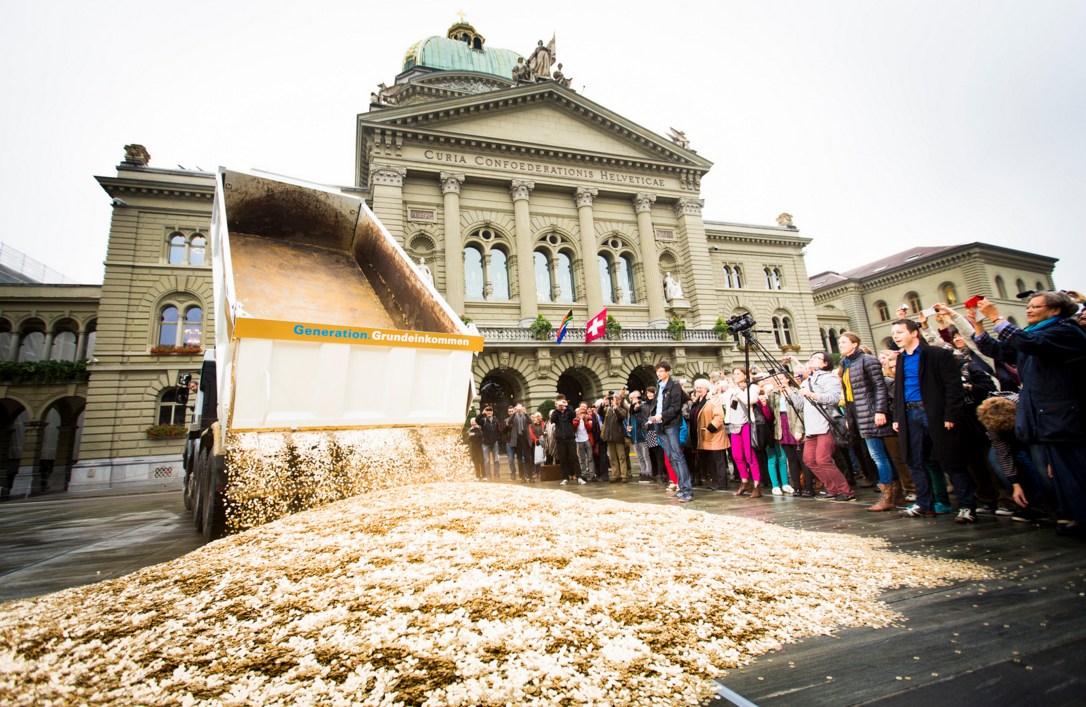
However, this does not mean that you lead a materially good life (but it does mean that nobody is hungry or cold or has no television). Or that this status would be socially accepted. The unconditional basic income would not solve the former. The second, after generations, probably would.
As far as the idea itself is concerned, the initiators in Switzerland are not doing well to remain so vague. Read the legal text here. Everyone probably understands this to mean something different and too often what they would simply like. The website generation-grundeinkommen.ch illustrates this very well.
BGE as sun, fun and nothing to do
Some people see the UBI as an opportunity to finally do nothing at all. The initiative envisages an amount of CHF 2,500 per month in 2050. Even today, this is not an amount with which it is possible to live well in Switzerland. The standard of living is much higher and will remain so. The idea that people would no longer have to work with the UBI is simply an illusion. One that will certainly last for a few months, but will then fade.
UBI as a step towards ruin
I often hear the argument that the UBI would be a step towards total ruin, especially from middle-class people and so-called bourgeoisie. It’s sad to see what image of humanity these people have. The UBI would free people psychologically to take a more relaxed approach to everything, to try out more things and probably also to be more tolerant. But do nothing more? Stop working? I don’t believe in that. Nobody who has any faith in people can believe in that.
We define ourselves precisely by the fact that we always do more than is necessary to simply make a living. Otherwise we would live in the forest. It still works well. I even had to do that once during my studies. That the whole country would collapse is simply nonsense.
UBI as an efficiency gain in the social sector
I have spoken to some people who take a more nuanced approach to the subject about the UBI as a measure to increase efficiency in the social sector. Their calculation is as follows: Total social spending in Switzerland amounted to CHF 170 billion in 2013. If we divide this amount among the population (everyone over the age of 15), everyone receives CHF 2,000 per month.
With an average annual inflation rate of 0.7 %, we are already at the equivalent of CHF 2,500 in 2050. The current social security system is costly and complicated and a private industry has grown up around it, which is not conducive to the overall cost structure and can also count on an increasingly strong lobby.
This development could be halted by the uncomplicated distribution of the money as a UBI. And the bottom line is efficiency for the citizen. The idea is appealing insofar as the question of financing, which makes the UBI seem so illusory, has been clarified right from the start.
Lack of money as an excuse for all sorts of things
These days, a lack of money has to be used as an excuse for all kinds of missed out lives. I can’t help suspecting that many such people have come to terms with it very well. The lack of money explains why they haven’t followed their dreams or done what they originally wanted to do. Consequently, for these people, the UBI would be the removal of the biggest blocker to leading a self-determined life.
I cannot estimate what the social consequences would be if ~ 20% of citizens gradually realize that the UBI cannot deliver on these promises of freedom and, much worse, that they themselves and not money were the blockers in their lives. I know it’s a bit philosophical, but I imagine it would be very depressing.
Not pro-BGE, but pro “new concepts discussion”
I’m still not really pro UBI. Just as I am not in favor of maintaining the status quo. What I do very much welcome, however, is the discussion about change in the interaction between technology, society and business. I find it remarkable that a society is actively trying to shape this change and it would be a novelty.
Let’s work on it. The discussion about the UBI is a valuable part of this. To repeat Höttges’ words: “We must not reject such ideas simply because they seem useless from today’s perspective”.
In the past, we have let things run their course (agricultural revolution, industrial revolutions, digital revolution) and the strong, rapid changes have always generated more human suffering than necessary.
In my article on the future of work I wrote:
“Performance must be worthwhile, but existence is a fundamental right in the social market economy!
”
I believe in this more than ever today. If we consider both equally important, we will create a world that reconciles radical progress with humanism for the first time. The reason why this is now possible is quite simple: it is the productivity gains achieved through greatly improved technology.
Now we just have to manage to get it right socially. Unfortunately, this is by far the biggest challenge.
Artikel auf Social Media teilen: