Corporate model of the digital age: the agile company!
I have already written a lot about the fact that technological progress will change the next few years enormously. What concerns us all is, on the one hand, how a society deals with rapid change without breaking too radically with its zeitgeist values. On the other hand, and this is a core topic of digital transformation, we are primarily concerned with the question of how companies need to be positioned in the future in order to capitalize on change. In the following article, I would like to explain a few points in more detail.
(Reading time 6 minutes)
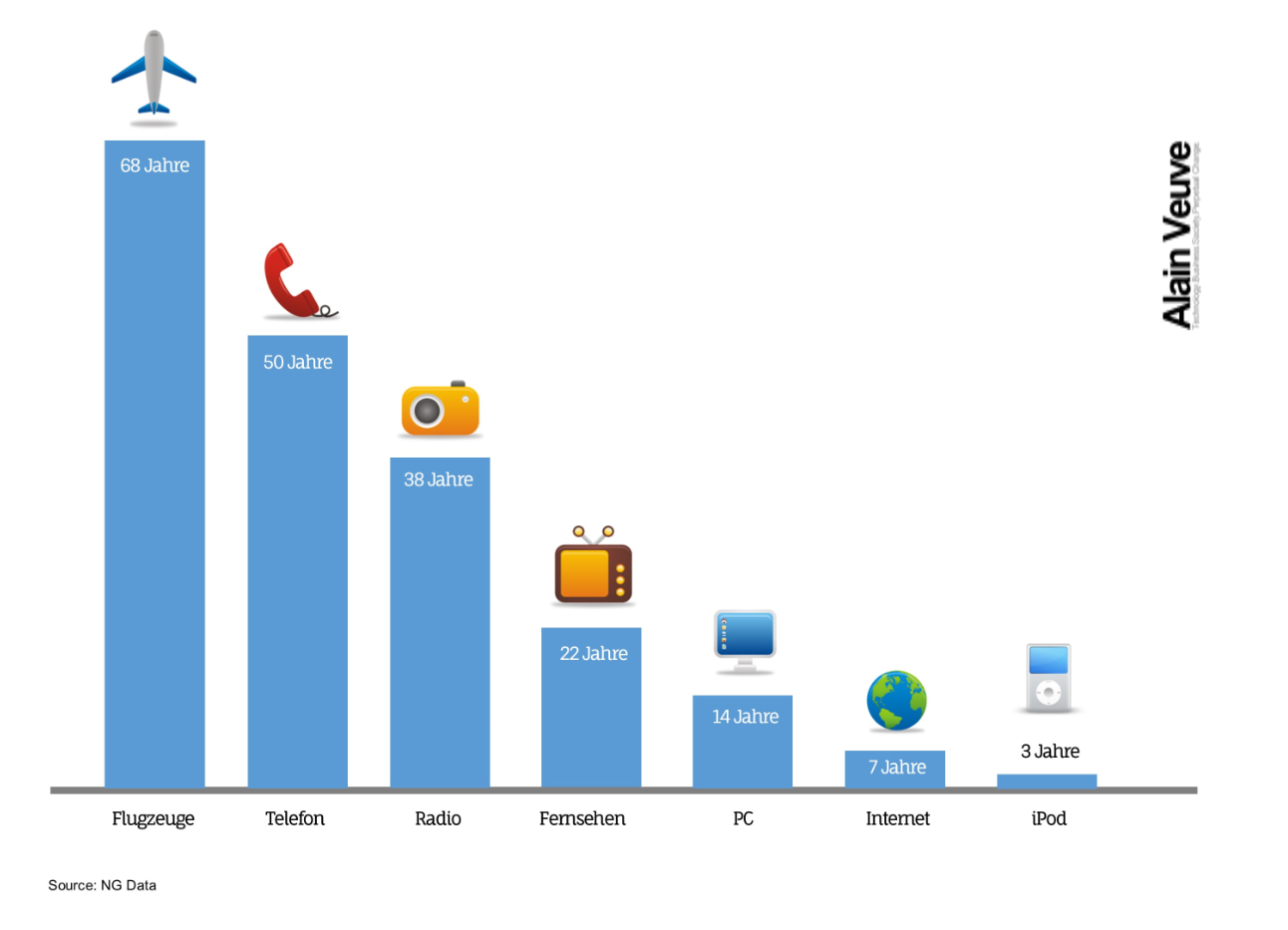
It is gradually becoming clear that companies must be able to react to a changed starting position and a changed environment in ever shorter cycles. The formula for this logic is banal: If in the 1960s it was enough to evolve on a horizon of 20 years, today these 20 years correspond to 5 years (indicative values). The decisive factor here is how quickly the masses adapt a technology. Here are a few examples: The number of years it took for the technology to be used by the masses:
So what does a company need to look like to survive in this environment? It is clear that the previous rigid models with large, rigid hierarchies and fixed processes are hardly capable of keeping up with this change. Adapting this organization would require so much effort and communication that the company would not be able to operate economically. Moreover, it would simply always be too slow.
The agile company
So we need a new form of company. For me, the only model that meets these requirements is the agile company. Please do not confuse “agile” in this context with the project methodology. Of course, as an agile company, it makes sense to work with agile project methods, but apart from the terminology, the two things don’t necessarily have to go together.
The agile enterprise model is not yet so well established that there is much literature on it; there is not even a wiki entry on it. businessdirectory.com does, however, have a well-rounded definition:
Fast moving, flexible and robust firm capable of rapid response to unexpected challenges, events, and opportunities. Built on policies and processes that facilitate speed and change, it aims to achieve continuous competitive advantage in serving its customers. Agile enterprises use diffused authority and flat organizational structure to speed up information flows among different departments, and develop close, trust-based relationships with their customers and suppliers.
When this article was written, I spent a long time looking for companies that are already organized this way. And as is the case, sometimes you can’t see the wood for the trees. It was no different for me in this case and I only realized late on that this is exactly how we are set up at AOE . Not that we don’t discuss these issues internally, but it already feels so normal that I don’t attach much importance to it in day-to-day life. I would therefore like to use our company to illustrate the components of an agile company and what works well and what doesn’t.
Teams instead of hierarchies
There are no hierarchies at AOE. Instead, there are teams. A team is a group of employees who organize themselves independently in order to provide a service. This service can be, for example, a customer project, marketing, office keeping, HR or whatever. Whenever something needs to be achieved, a group of people takes on this goal. As far as possible, it should be possible to switch from one team to another. This means that employees organize themselves, take responsibility for team performance and choose their own work. For example, vacations are not approved centrally, but employees coordinate with the team and are absent when it suits them and the team. Decisions are made and weighed up according to the situation in a small unit. The administrative overhead, e.g. for vacation planning, is limited to logging the days taken.
In terms of customer projects, teams are naturally quite fixed and need to be well-rehearsed in order to be able to build complex omni-channel platforms in our case. However, teams can also be formed on an ad-hoc basis if a need for action is identified somewhere. Usually, a few people recognize a need for action and side teams are formed to temporarily take on a topic. This process is institutionalized through “Open Friday” (coming later in the article).
Importance of management
When you hear the word management, you inevitably think of Porsches, pinstripe suits, business class flights, never being in the office, endless internal appointments, and so on. For a long time in my career, I practiced strong top-down management and quite honestly, I was only moderately successful with it. Demanding a lot, being strict, consistent and tough but fair are attributes of a patriarchal management model. As a member of management, you have to have personal and professional authority in order to lead effectively, as is still taught today. To be honest, I now think that’s nonsense. The time has simply passed.
As a manager of a company, for example, the paradigm of professional authority sometimes leads to a tendency to hire people who are professionally weaker than their superiors. The organization thus falls short of its potential. As a manager, isn’t it much better to hire employees who are better than you and then learn from your colleagues along the way? You have to let your employees do this, even if as a manager you are sometimes no longer able to judge exactly whether something is technically right or wrong.
Control is good. Trust is better.
It takes a great deal of trust in employees to act in this way. And if problems arise, it’s a good idea to approach them with as little prejudice as possible. It simply means investing a lot in the recruitment process and, once a decision has been made in favor of an employee, supporting them, clearing the way and having confidence that the employee will develop their potential. I see that this works for us every day.
Understanding management: servant leadership
Our management officially comprises 4 people for 200+ employees. The role of the official management is to create the best possible conditions for the employees. At AOE, this is sometimes taken to a certain economic pain threshold. This includes a wealth of benefits for employees. From Thai massages to lunch menus, automatic pay rises, paid ski trips for the whole company and so on and so forth. It is important to note that we do not have an inexhaustible business model that simply generates profits à fond perdu. On the contrary. Like all IT service providers, we have to hold our own in the global market. This means that these benefits come at the expense of net profits. As an entrepreneur, you therefore have to see servant leadership not just as a management method, but as an ideological commitment. In the long term, and I say this with a view to the sensationally low staff turnover, I am convinced that servant leadership is also economically worthwhile.
“A servant leader loves people and wants to help them. The Servant Leader’s mission is therefore to identify the needs of others and try to satisfy these needs.”
Kent Keith, CEO Greenleaf Center for Servant Leadership
I see servant leadership as an integral part of an agile company. I don’t know how else you could lead a rapidly changing company without constantly overburdening management.
OpenFriday
Developing the company is traditionally the task of management. This means that a strategy is worked out at the very top, if possible with external consultants, which is then implemented top-down. You are probably familiar with the comments from employees in the departments that they have decided something up there again and everyone thinks it is absurd. Not all strategic considerations are wrong or even absurd, on the contrary. However, as they were developed at the very top, they are always difficult for the workforce to understand, at least initially. In larger companies, a program is needed to “implement” the strategy. In terms of corporate culture, this is an unspeakable term. But all this costs an enormous amount and is not at all efficient. In an agile company, there is a communal vessel for this. At AOE, we call this internal event “OpenFriday”. I’m quoting from our intranet:
In an organization like ours we are all responsible to continuously improve our workaday life. We have the chance to improve EVERYTHING – therefore EVERYONE needs to get involved actively. The Open Friday is a safe place to share thoughts, new ideas, make announcements and discuss problems you may see.
We organize the Open Friday according to the Open Space Technology. These sessions are crucial for improvement processes and new teams implementing new requirements. Changes in the company are initiated here and find a natural path to implementation.
Our pacemaker: Growth
Our business model differs from that of a traditional agency in many respects. Explaining this in detail now would go beyond the scope of this article. So just this much: growth generates growth for us. And this growth is a real challenge. Take our headquarters in Germany, for example: in 2012, when I joined AOE, there were 51 permanent employees in Wiesbaden; today (May 2015) there are 150.
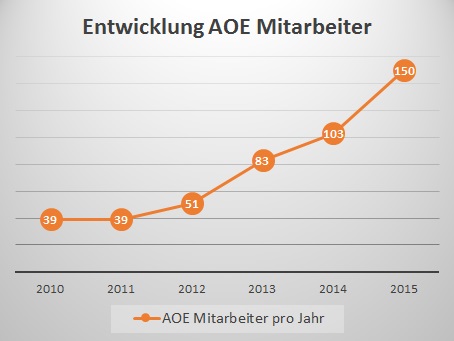
Growth of this magnitude, not least organically, is an enormous challenge in terms of infrastructure alone. Culturally, this is a huge step.
The growth is also due to the fact that we have moved into new business areas and are working with much larger customers. So we haven’t just done the same projects and served the same customers x times, but we’ve managed completely different projects with completely different customers. The fact that the team was able to retain its spirit on such a journey (even if very little remained the same) and was able to cope with these many new requirements and continues to do so is proof of concept for me that the agile company model is ideally suited to coping with rapid change.
When I spoke to a representative of a large company two years ago about us as an agile company, he said: “That’s all well and good, but let’s see what it’s like when you’re 200 people”. Et voilà, we are now +200 and it is still working and there is no end in sight.
Everything great? Please!
The above-mentioned points might give the impression that everything is running totally smoothly and without any problems and that the agile company model is the savior, so to speak. Of course it’s not and yes, of course we have massive problems at times. Things that don’t work out, projects that go awry, plans that have to be revised. All that glitters is not gold. Just as little with us as with, say, IBM.
I’ll pick out 3 points:
- Controlling
Team dynamics are difficult to keep under control economically. We don’t have any of these unspeakable time records at employee level. Nevertheless, keeping projects and their economic aspects under control is an enormous challenge. In addition, there are no really established cost accounting models in the field of agile project methodology . I think we are in the process of doing pioneering work in this area alongside conventional reporting. - Uncertainty
Employees who come to us from old economy companies usually struggle to deal with their new freedom at first. Questions such as: “How am I supposed to decide this myself?”, “What is my role?”, “Am I allowed to do this?” are omnipresent and it takes a moment for people to realize that initiative and commitment are desired and that no one wants to keep anyone on a leash. - Collaboration with rigidly structured customers
Collaboration with companies that are organized very hierarchically and have little knowledge of agile methods is becoming increasingly difficult. In many cases, they do not understand how we proceed and do not accept that teams can act autonomously. Fortunately, these dinosaurs are dying out en masse. However, discussions in this direction are still the order of the day.
Agile company – corporate form of the future
For me, the agile business model is clearly the model of the future. It is perfectly suited to anticipating rapid change and participating in it economically. It generates products and services that are faster to market and better suited to the needs of the customer. And it places employees at the center of economic activity in a people-friendly way. If we look at social developments over the last 20 years, we can see that this is exactly what people want. More freedom, more free time, more self-realization, more flexibility. In return, they are happy to give back more personal responsibility, more quality, more passion and identification and more flexibility. That looks like a mutual gain to me. Or rather, less alienation between economic and social life.
Of course, knowledge work is perfectly suited to the agile business model. But make no mistake about it, there are also manufacturing companies that are already living the agile enterprise model. I will present two or three examples in a later article.
Artikel auf Social Media teilen: