Automotive industry: On the way from announcement master to delivery master
A few weeks ago, Tesla CEO Elon Musk tweeted the ominous phrase “It’s what you don’t say”. After the delivery event on July 28, 2017, the meaning of the tweet becomes clear, because Musk didn’t actually say much at the event. And yet a lot was said. I believe this event marks the beginning of a new approach. That of a budding mass manufacturer à la mode Tesla.
(Reading time: 5 minutes)
No grandiose announcements, no new killer features
The event was atypical for Tesla: there were no spectacular announcements, almost no new details about the Model 3, no surprises. The spook was over after about 20 minutes. 30 cars were delivered, all to Tesla/SpaceX employees, whereby delivered in this case meant that the customers simply went to the parked cars on command.
Tesla fans
As a Tesla driver, I was also disappointed. We are used to CEO Musk announcing things over and over again that seem unreal and then making them possible, albeit usually late. That is the DNA of the Tesla myth. That’s why everyone familiar with Tesla naturally hoped that he would go one better: e.g. 5,000 Model 3s would be secretly pre-produced, the car would be able to drive fully autonomously or a completely new “not-of-this-world” feature would be built in. The wildest speculations were in the air.
The fanboyism surrounding Tesla has now taken on bizarre forms. The expectations are immense. Musk also addresses this and complains about it, rather jokingly. People would write to him “Elon, where’s my Model 3? What’s wrong with you?” Of course, that must annoy him and his people a little. Because with the Model 3, all promises have so far been meticulously kept.
Keep the ball flat
However, as someone who has been observing the automotive market from the perspective of transformation processes (for some time), this event was highly exciting. Because what appears to be a failure on the Tesla scale actually shows that Tesla clearly understands where it needs to go and what is at stake. And that must be really scaring conventional manufacturers by now. For the following reasons.
Cockpit shows how serious Tesla is about fully autonomous driving.
One aspect of the Model 3 that has long been a talking point is the spartan cockpit. Many “reservation holders” are obviously disappointed that there is no longer an instrument panel behind the steering wheel. This would be impractical, impossible, a no-go, even illegal in a few countries.
The cockpit does indeed take some getting used to. It is not tidy because there is simply nothing to tidy up. A wooden strip, a transverse fan outlet, a steering wheel and a display.
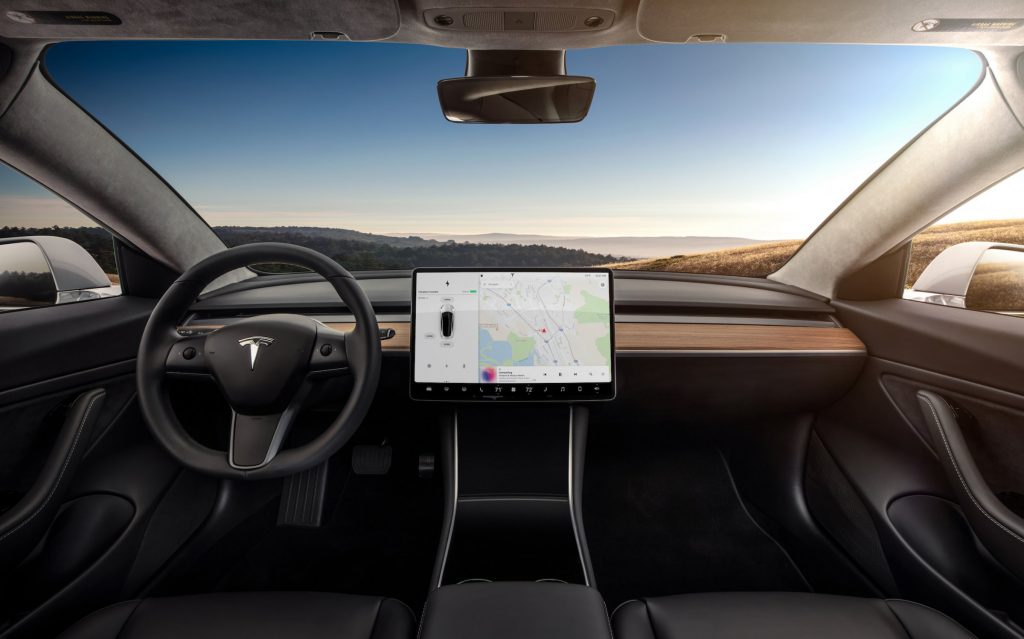
What many interested parties obviously don’t realize is that this cockpit is simply THE cockpit for an autonomous vehicle. If you look at it from this perspective, it is simply perfect. I have briefly removed the steering wheel from the official Tesla photos:
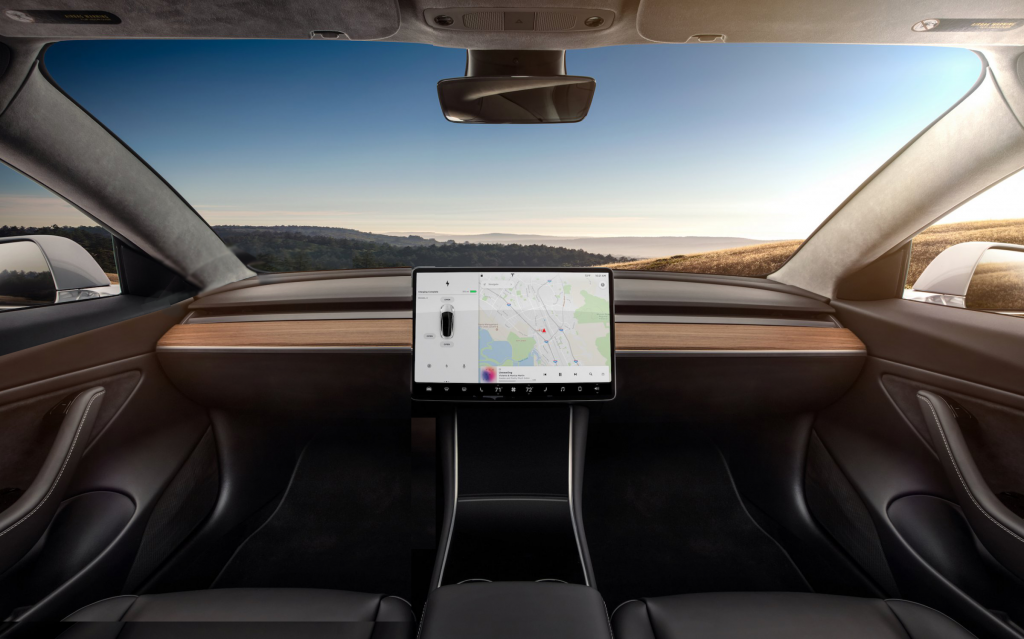
I would argue that the steering wheel is actually only present in this first version because autonomous driving has not yet been mastered in terms of software. You need to know that Tesla has parted ways with the external autopilot provider Mobileye and is now driving forward the entire development of autonomous driving on its own with its own concept. This is why this “new” Autopilot hardware was installed in all new cars in the fall of 2016.
Much to the annoyance of Tesla drivers, the new AP2 Autopilot is not yet at the same level as the old one from Mobileye. However, it is astonishing how much progress has been made in just a few months. The concept of fleet learning ensures that the improvements are accelerated. A cockpit so radically designed for autonomous driving is a clear sign that Tesla believes that it will be able to offer fully autonomous vehicles relatively soon. As far as the cockpit is concerned, only the steering wheel will have to be removed.
Production bright
Tesla is aware that this ramp-up of production will require a great deal of effort over the next 6 months. Musk calls this “production hell” and welcomes his employees to it with a laugh. The crowd cheers. When Musk says this, it seems kind of funny; he calls his people veterans. They are people who love these kinds of challenges, or at least endure them professionally. And Musk, as you can read everywhere, is a gifted driver. Because going home on time, that much must be clear, will not achieve such goals. At this moment at the latest, the works council at a German manufacturer would be calling the lawyers.
I also found the comments interesting, partly from people who work for German manufacturers, who pointed out that these might not even be production vehicles yet. I agree with that: If you define production vehicle according to conventional production methods, then these are definitely not production vehicles that have been delivered. This view reveals a lack of understanding of the fact that Tesla is breaking completely new ground in production and must do so.
Because if Tesla has proven anything in recent years, it is that they make logically correct considerations from the ground up and consistently implement them far from best practice. Musk has implanted this “first-principle thinking” in the company and, logically, they are following exactly the same pattern in production. As a traditional manufacturer, I would have a lot of respect for these new methods. If they make 50 per month to 20,000 in 6 months, where will they be in 18 months?
Dealing with the media
I also found it exciting that the decision was apparently made to feed the media exclusively with details about the vehicle. This meant that no details were shown at the event itself and that after the event, various major media houses plus all the relevant ones went live with corresponding stories. The articles about the start of Model 3 deliveries were consistently positive. This was a clever move and shows that Fremont has understood that as a budding mass manufacturer, you have to play to the general public and not your own die-hard community.
It remains super-risky
However, it also became clear at the event that Tesla’s mission remains extremely risky. Perhaps this is one of the riskiest moments in the company’s history. Model 3 must come quickly. I also thought there was a certain nervousness at the event.
Because this huge list of reservations and the wait for a new model is probably a great thing, but it also has a downside. If more and more potential customers who want to buy a Tesla in principle do not yet do so and wait in view of the new Model 3, this is extremely dangerous for Tesla. At some point in early 2017, they will probably have realized this in Fremont. In the Q1 investor briefing, Musk advertised Model S and X exceptionally strongly and emphasized that customers who order now will have to wait a very, very long time for Model 3 delivery.
This problem of cannibalization will probably be much greater than generally assumed. To make matters worse, Tesla is already selling very well in the upper segments (with the exception of Germany) and will simply not be able to continue growing at the same pace because the segment is also limited.
Even if deliveries are now ramping up, a Model 3 will probably have a negative contribution margin at the beginning. In other words, each car initially causes an operating loss. Economies of scale is a simple, clear calculation on paper. In reality, it often takes a long time for these economies of scale to kick in.
However, this is precisely what Tesla can only afford to a limited extent at the moment. Because if the high contribution margins of the Model X and S fall, even more financing pressure will build up. We will see what the effects really are when the Q2 figures are published next week. I assume that these figures will not be exactly exhilarating, also in terms of deliveries.
Under these aspects, it suddenly makes sense that a lukewarm event by Tesla standards was played out. The signal to future buyers is: If you want the right stuff from Tesla in the here and now, buy a Model S or X. It’s not worth waiting for the Model 3. This triggers everyone who can afford a Model S or X in the first place. The others, who can’t anyway, are a little disappointed, but you won’t lose them substantially. Simply because there is no real alternative to the Model 3 at the moment.
From announcement master to delivery master
Looking back over the last few years, there has been a turnaround in the market. While Tesla had been branded for years as an “announcement master” that would probably never deliver anything or deliver it much, much too late, the signs have changed.
Not a week goes by without a traditional manufacturer announcing a new Tesla killer for 2020 or 2025. So far, nothing of the sort has been delivered. Meanwhile, Tesla is constantly delivering everything that was promised. They will have taken a liking to this in Fremont and it seems as if they want to make it part of their program. It is only logical that the promises are backed down. It is the variable in the equation that also improves the result. “It’s what you don’t say”.
This makes it all the more incomprehensible that the traditional manufacturers are making such a fool of themselves with their own announcements. I’ve had a few conversations with older people who are interested in a new car in the last few weeks and after a little research they all realize that what Daimler and VW are promising for 2020 is already available from Tesla today.
The new 3 Series
The Model 3 has the potential to turn the mass market upside down. It will sell itself, because anyone who has ever experienced the superiority of the electric drive, the driving dynamics, will immediately realize that this is the better concept. I let a lot of people drive my Tesla. I’ve never met anyone who didn’t think it was great. And almost everyone says: if it was cheaper, I would buy one. The Model 3 is cheaper. If Tesla’s plans work out reasonably well, there will be thousands of Model 3s on the road in a year’s time. And these cars are the best advertisement every day.
Artikel auf Social Media teilen: