Chief Digital Officer. Unfortunately not.
Two years ago, I wrote an article entitled “Why every company should have its Chief Digital Officer!”. I was convinced by the concept of the special representative. After 2 years of countless conversations with people who deal with digital change in companies, I have to admit that a Chief Digital Officer is not such a good idea in the vast majority of cases. Here’s why.
(Reading time: 5 minutes)
Where are they?
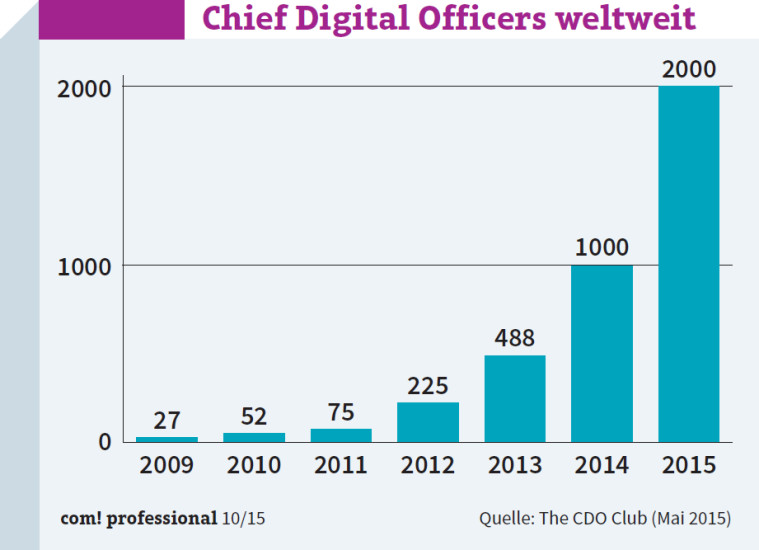
In 2012, Gartner predicted that 25% of all companies would create and fill the position of CDO by 2015. This has not even come close to happening. As an article by “com! professional” points out, just 4 Dax/MDax companies in Germany have a CDO. And according to estimates by the CDO Club, the situation is not much better worldwide.
The all-purpose weapon CDO: Forget it.
Rather, my experience is that different people from the C-level take on different tasks relating to the digital transformation. When a CEO is new in their position, a lot usually happens in a relatively short space of time.
I believe that some company managers would like to have a person with digital knowledge. In my opinion, the fact that this rarely happens is due to a fundamental conflict of objectives:
CEOs who want to appoint a CDO generally don’t want to give them a great deal of authority. However, potential CDOs can only do their job really well if they have extensive opportunities to shape the company. The good candidates know this and tend to aim for traditional C-level positions.
Undesirable effects
However, the use of a CDO also provokes undesirable effects:
Outsourcing of digital know-how
Instead of the company’s top management intensively acquiring digital know-how itself, this is only made available. I have already written a lot about the fact that “digital” must not be viewed separately, but must be an integral part of the corporate strategy and the actions derived from it. With a special officer for digital, you tend to work in the opposite direction.
He’s doing that now
This is linked to the attitude of the C-level, which I often experience in consulting: he (CDO) can do it, he’s doing it now. This means that this arduous digital transformation is mentally delegated and the company management no longer has to deal with it. Yes, that is of course an exaggeration. But this attitude, even if only rudimentary, is the free ticket to your own abdication, so to speak.
Alibi CDO
In the last two years, I have seen twice myself that someone was hired as CDO (or “digital rock star who is now doing everything differently”) with the sole aim of “having someone”. For example, to show the shareholders that “something is being done about digital”. I find it particularly perfidious when the supposed CDO then comes to terms with this role and doesn’t take it seriously at all, but simply explains social media internally and has the offices remodeled in a start-up style. Then nothing happens, except that there is now free Club Mate in addition to the vending machine coffee. In my opinion, good CDOs leave the company immediately when they realize that they can’t make a difference.
Better this way?
So you see, I am no longer convinced that the CDO is the right instrument for digitalization. I was wrong.
And it’s probably for the best. Because there are very few people who could fill the role of CDO. I have already written here about the qualifications required to fulfill this mission.
Such people are not looking for a job. They are in high demand. And to make matters worse, in my experience they are also very difficult to motivate extrinsically. Actually positive.
How, if not with a CDO
It is much better if the CEOs or company management take the arduous path and educate themselves. I recently tweeted the following sentence:
“A CDO is most successful when he is also CEO.
”
I think the main task of company leaders today, as in the past, is to put companies in a position to assert themselves. Adaptability is the be-all and end-all. Today more than ever. And “digital” is the change of the hour.
Anyone who has recognized this will only employ managers with change experience and a positive attitude towards change. For me, “digital skills” are of secondary importance.
Of course, it is good if managers have already done something with digital and I think that today it is simply the basis from which to start. In the medium term, however, the decisive factor will be how well these managers can deal with change.
Artikel auf Social Media teilen: