Why technological progress creates more work!
In a comment on my t3n article “Job destruction through digitalization: The scaremongering business! “, it was noted that I was arguing purely historically that technological progress creates more work. Until now, I hadn’t really realized that the majority of people don’t even know why this is the case. But it’s quite simple. An attempt at an explanation.
(Reading time: 6 minutes)
“Thanks for the article, but your way of arguing is fundamentally wrong. The argument that people have always been afraid in the past and nothing has ever happened is simply a naive way of arguing. The thought pattern of a pig in a sty: “Oh, the human is coming again today and is bringing me something to eat. I don’t need to be afraid of him, the last 150 times have been positive.” is only correct until it’s slaughter day.”
Thomas, on 27.01.2016
Just because it has always been that way
Thomas is absolutely right, of course. It makes no sense to argue like that. Why I brought it up anyway was because I wanted to emphasize that this effect doesn’t just exist in theory. Rather, that we have already been able to observe it a number of times.
In fact, I generally think that the past is a relatively poor guide when it comes to predicting the future. Things are changing. Faster than ever.
Automation vs. manual work
But why is there this effect that we have more work over time as technological progress increases? The following diagram shows in simplified form the basic “mechanics” behind the relationship between human and machine labor.
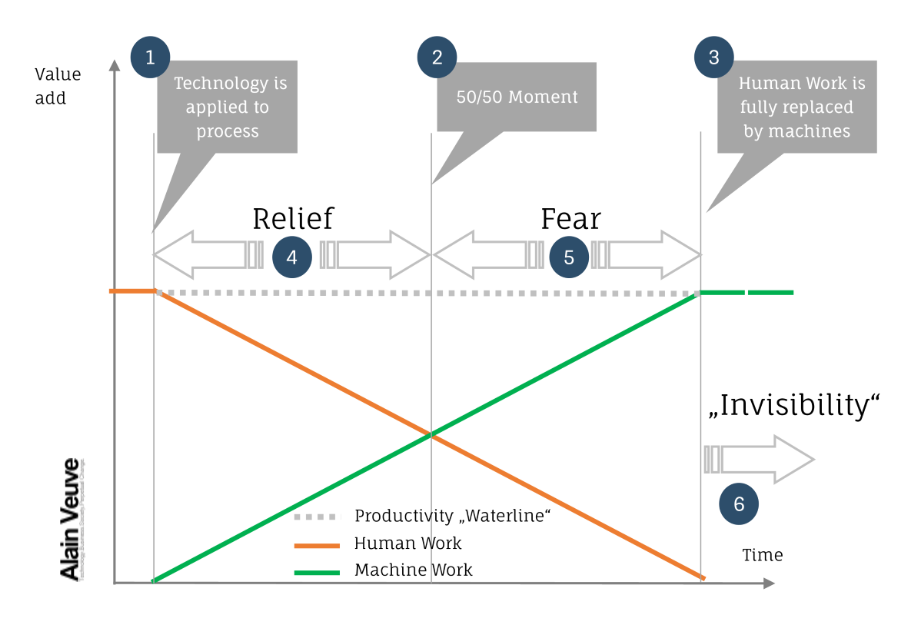
In this model, we assume that at the beginning (1), 100% of the work is performed by humans. For the sake of simplicity, we also assume that the value added by the combination of human and machine labor only increases by leaps and bounds (next chart). In reality, of course, this is a fluid concept.
In this model, we see that the work is increasingly taken over by the machine over time, until the moment when it is proportionally equal (2). Up to that point, machine work is perceived as a relief (4). Typically, monotonous, repetitive and dangerous work is shifted to machines first.
Once this point is reached, all work is gradually taken over by the machines (3). This phase usually creates a fear of becoming obsolete.
Let’s play through this briefly using personal short-distance transportation: At the beginning of this process, there was the sedan chair, which only a few could afford. 4 people carried someone from one place to another. The use of technology, e.g. the wheel, made it possible to do the same with one person. The use of the horse brought further gains in productivity and made things easier. The use of automobiles further optimized this relationship, which, together with other factors, meant that many more people could afford this service. Today we know this service as a cab. If we continue with the (quite predictable) development, self-driving vehicles will increasingly come into play. It is very foreseeable that this service can be provided entirely by machines.
At the end of this development, I expect these services to become invisible to people. Invisible in the sense that they are simply there and usable. However, people will no longer worry about whether human labor is required in the process. New generations perceive them as a kind of common good.
Limited horizon of perception
Now the human is completely replaced. That’s all the fun. And we all have free time. Where are we supposed to make a living?
That is the thinking of the general public on this issue. People are not thinking beyond this one development step. But what is actually happening is this:
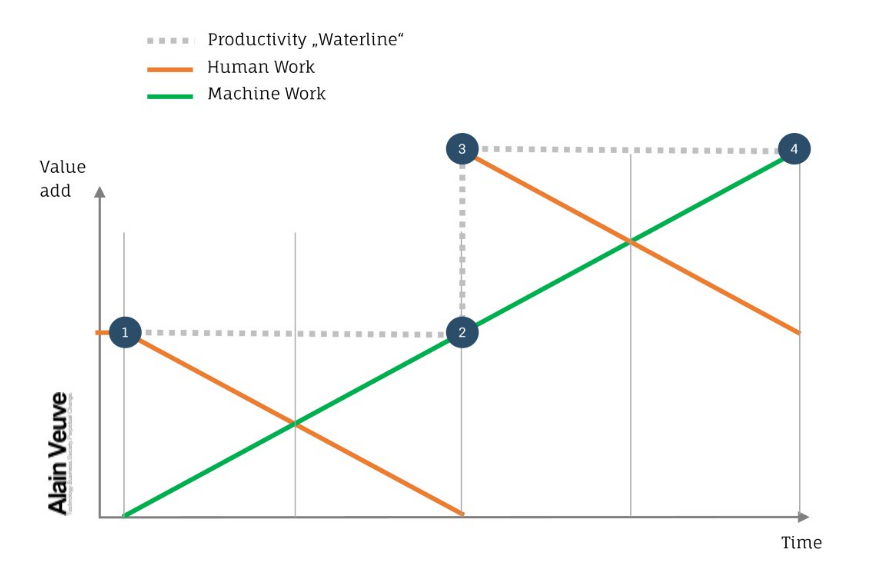
Points 1 and 2 are shown again in the graphic above. At the point where we have fully automated a process, we raise the bar. We ask ourselves very specifically, now that we have worked this out, how can we use it to further improve our situation. This kind of desire for improvement is in our genes.
What we humans then do, in turn, is that we quickly compensate for the missing technological achievements with human labor (point 3). And the same optimization/automation then follows the same pattern again.
This explains why we always have the same amount of work. We are riding on the technological development, so to speak. But the fact is that work is increasing.
Rapid increase in possibilities
This is because a machine-optimized/solved process usually does not simply entail a subsequent process, but rather generates a multiple of new possibilities.
“The central point of technological progress is that it creates many times more new possibilities than previously automated processes.”
So if we take the above graphics and look down on them from above, we get the following symbolic picture:
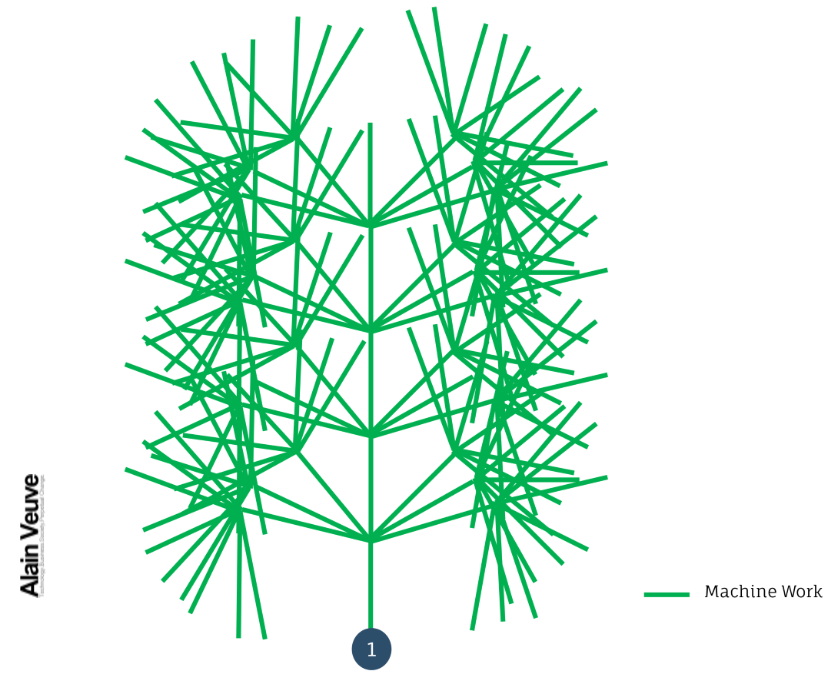
So what began as a single process (1) enables a multitude of new processes that can be combined as required. And as already mentioned, each one is balanced at the beginning with human labor. That’s why there is more work.
When would there really be no more work?
It’s pretty obvious that if we settle for something, there’s no more work to do. For example, with the status quo. Resigning ourselves to everything and accepting it. But it is precisely what characterizes people that they don’t do that. On the contrary. We are fanatical about constantly improving our situation. This applies to the individual, albeit with different characteristics and individual exceptions, as well as to our species.
Work is not the same as a job
Now, many people confuse jobs with work. Work is the human effort to accomplish something. Jobs or positions are the entities defined by our current system to capture work economically. Just because there is more work does not necessarily mean that there will be more jobs as we know them today.
Challenge: Redefining work and professions
The challenge can therefore only be to find suitable containers for the work of tomorrow. And, above all, to design transitions from one system to the next as well as possible. By good, I mean with as little human suffering as possible. We are all called upon to do this.
We can start by not collectively clinging to our idea of jobs or even individual jobs. I am therefore a vehement opponent of subsidies to maintain structures. They add fuel to the fire of change. They encourage harsh and crass economic changes that always leave people behind.
That’s why I think we would do well to actively push for change and cut jobs when it becomes clear that an area will undergo fundamental change in the coming years.
Coming back to the cab industry, this would mean actively starting now to prevent newcomers from entering the industry and creating real alternatives. This is the only way to avoid having an army of drivers on the streets within a year when the first self-driving cabs are launched.
Artikel auf Social Media teilen: