
Vibe Coding: Because they don’t know what they’re doing. (And I like it!)
A few weeks ago, I was a guest at the Vibe Code Fest in Basel and had the opportunity to chat on the panel with Céline Solenthaler, Silvan Hagen, and Lida Ahmadi, the co-organizer of this fantastic event. And I was sitting there as someone who has been building and selling software with his teams for many years.
(Reading time: 4 minutes)
Culture: Code That No One Reads
As far as I know, the term “Vibe Coding” was coined by Andrej Karpathy in early 2025. If “Vibe Coding” doesn’t ring a bell: It refers to a form of “programming” in which you don’t write the software code yourself, but instead tell an AI solution what you’d like to achieve, work with the result, and—so to speak—forget that the code even exists.
The core issue is simple: Code is generated that the person who creates it doesn’t understand. Because they don’t know what they’re doing. It’s perfectly normal not to understand how the things we use work—very few people can explain in detail how the components of a car work. But the fact that I can create them myself, even if with the help of a tool, is something new.
As a software entrepreneur, I naturally have to find this borderline questionable—at least in principle! Little by little, however, I realized that Vibe Coding is so much more than that. It’s a kind of culture and movement.
And that really hit home for me this weekend. Writing code using AI is one thing, but the other is that even people who previously had no interest in software development can now create digital products themselves.
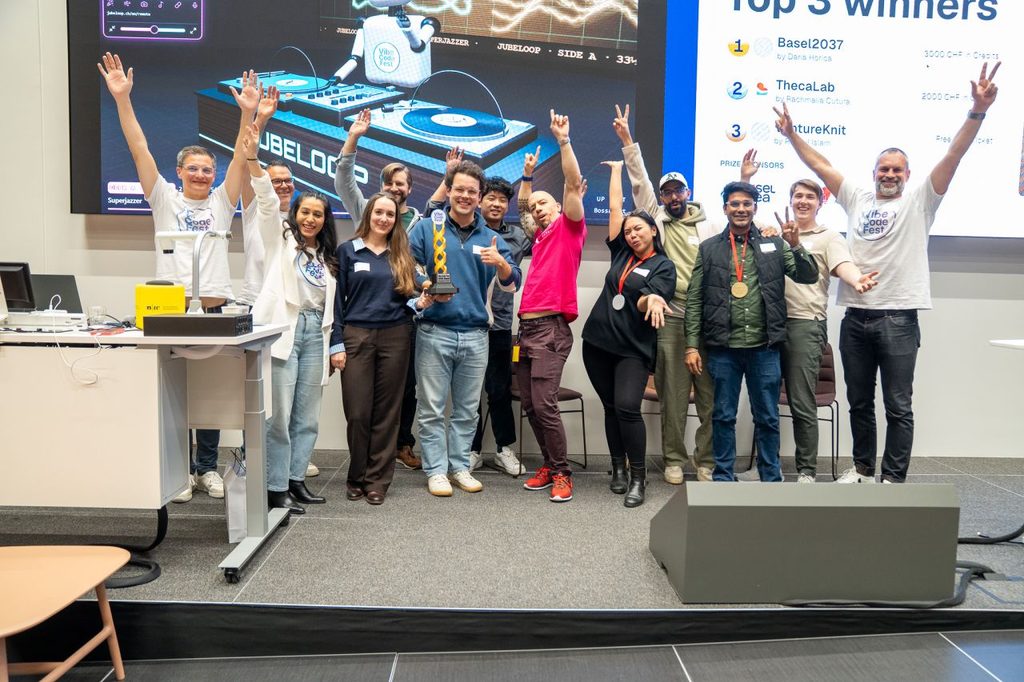
This goes far beyond the code itself. The “digital dishwasher career” is, so to speak, being democratized—and thus made accessible to everyone. The atmosphere in the room was electric, somewhere between gold rush fever and a sense of new beginnings. A sense of community that I’d previously only experienced at open-source events.
Software Industry: “Oh my God, customers are building it themselves“
And yes, Vibe Coding is quite inconvenient for my industry. For decades, software was something we sold. Now our customers are literally sitting at their kitchen tables and building their own tools. The fact that it usually doesn’t work out and end up being used isn’t really that important. It sparks a debate along the lines of “Look, now anyone can do this.” It has to be cheaper, simpler, faster. This is noise we weren’t used to in the industry—and until recently, we even frowned upon it.
But of course:
Any software a customer builds on their own is no longer purchased from us, the software providers. I don’t write this sentence without some trepidation.
And yet I still believe that what’s currently emerging through Vibe Coding is of enormous value to society. For the first time, a broad group of people can create a software product. An idea in the morning, a working app by evening—or rather, the idea in the evening and the app the next morning.
Above all, though, it gets people into the “doing”. A hundred years ago, almost everyone could create something valuable with their hands: a table, a tool, a garden. In the knowledge society, we’ve lost that to some extent. In a world that has become largely digitized, the “do-it-yourself” mindset is making a comeback.
An ERP System Built at the Kitchen Table
To me, hardly anyone embodies this trend as consistently as my “Twitter buddy” Stefan Stillhart. He’s an entrepreneur, not a computer scientist, and is building a complete ERP system using AI for his own business. He’s been sharing the entire process on X. The ERP system is now in daily use at his company, with several employees working with it. He started with simpler functional areas and has since moved on to financial accounting. In September, he posted what he himself described as his first “primitive” balance sheet and income statement.
You can also read about the downsides there. He described a crash of his test server—and the subsequent recovery—as a “nightmare” for someone who isn’t a computer scientist. He checks the AI’s results by hand, table by table. Now that’s what I call thorough work!
Of course, I still strongly doubt whether it makes sense to build an ERP system on your own (how could it be otherwise?). After all, writing code is only a relatively small part of the overall software project—let alone a software product. Operation, maintenance, security, and adaptations to new laws are still to come. Stillhart is experiencing this firsthand as he prepares his ERP system for a potential increase in the value-added tax.
Credit is due to anyone who creates
But I tip my hat to him. He’s just doing it, he’s learning in the open, and he’s honestly showing what works and what doesn’t. I’m following with great interest how serious software—the kind a real business needs every day—is being developed. By now, I no longer have any doubts that it will succeed.
And I note with a bit of consternation: A first prospective buyer already wanted to acquire Stillhart’s ERP. The entrepreneur is quietly turning into a competitor.
In response to my concerns, he recently told me on X: “Even though we have chainsaws today, not everyone cuts down their own trees.” But the software industry needs to learn that it is replaceable. Let’s hope he’s heard!
Means to an End
For professional software development, the picture is a bit more sobering. Code written quickly isn’t necessarily good code. More often than not, it’s exactly the opposite.
That’s why Vibe Coding is at the very beginning of the software development process in our industry. It’s unbeatable during ideation, feature grooming, requirements engineering, and visual preparation. Instead of describing requirements in documents, we work our way through functional prototypes together.
After that, teams that know what they’re doing with code, infrastructure, and security take over. Seen this way, Vibe Coding is a means to an end—faster and more affordable software. Because the reality is: We simply have to deliver more value than a customer could build on their own at the kitchen table. This major transformation in IT is beginning now.
Knowing What You’re Doing
Yes, many who “Vibe Code” today don’t really know what they’re doing. But: they’re doing it.
In a culture that today is primarily about scrolling, rating, and commenting—in other words, consuming—this is extraordinary. Makers and builders deserve the utmost respect, always. Even if their code isn’t perfect. For us professionals, this means: Let’s take the pressure in stride and take responsibility where software needs to be secure and scalable.
For everyone else: Just get started. Build, create! The world has never been more open to you.