
The charging park – big business of the future.
I have to admit that when I first started looking into the transformation of the automotive industry, I thought that everything would take much longer. In fact, many things are happening faster and are accelerating. It’s exciting to see how the existing providers take up the concepts of the newcomers and where they don’t or don’t understand them. Not everything new is automatically good and forward-looking.
(Reading time: 5 minutes)
Three interrelated paradigm shifts
The automotive industry is undergoing three interrelated paradigm shifts. The first is the transition from combustion engines to electric drives, the transition from control component-based cars to software-based cars and the transition from human-controlled, individual cars to autonomous fleet vehicles.
All three paradigm shifts have a mutually beneficial effect. On the one hand, electric cars will ultimately cost fundamentally less than combustion engines. On the other hand, the software-based vehicle will reduce maintenance and functional costs and facilitate autonomous driving. Last but not least, autonomous driving will completely redefine public and private transportation and thus also the business model of automotive technology providers.
“The cards are not being reshuffled in the automotive industry, the entire casino is being rebuilt.”
Frightful “store”
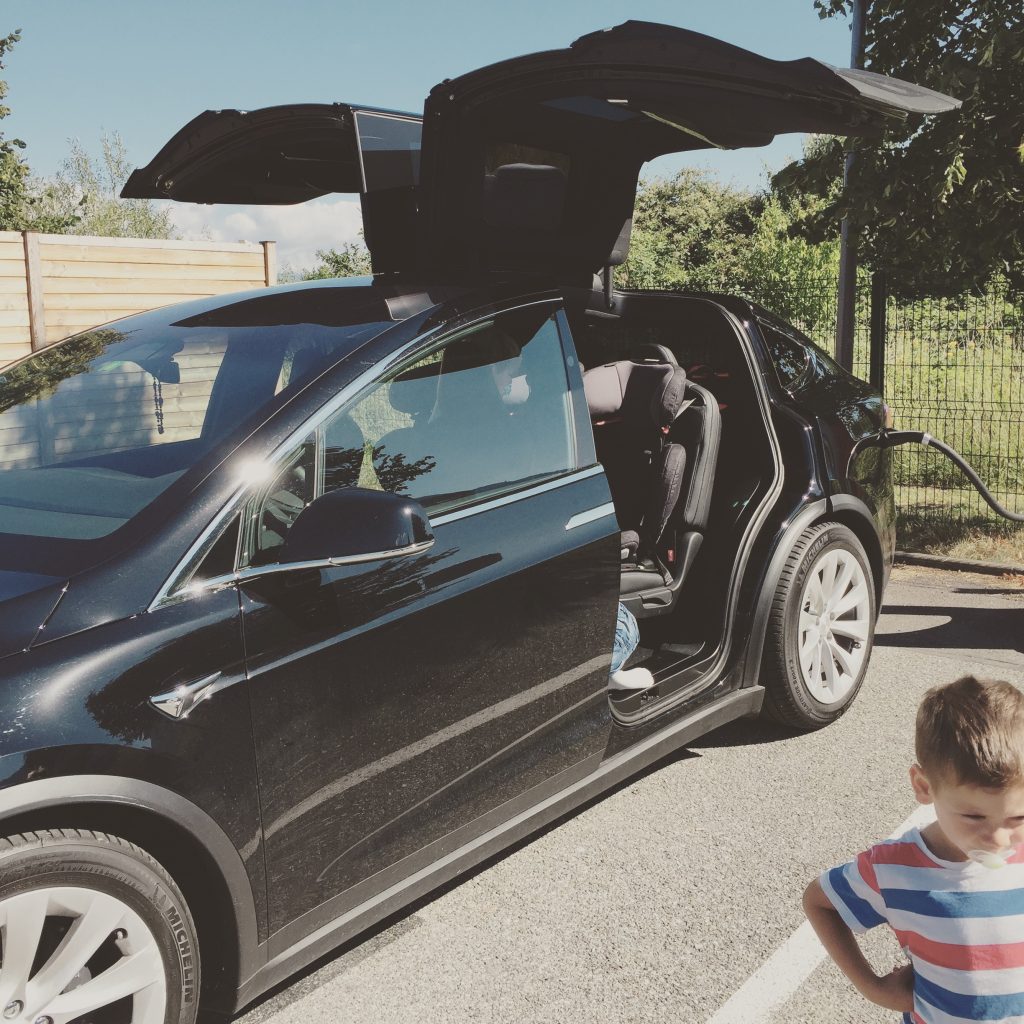
Unfortunately, it has to be said so clearly: there is general electromobility and there is Tesla. General electromobility is something I would never do to myself under any circumstances. The ranges are too short, charging on the road is too tedious and the cars are too slow and uncomfortable.
A general electric car along the lines of the Renault Zoe or BMWi3 is a perfect city or “radius” car. As soon as the daily or weekly radius of action gets bigger (distances over 200 km) it becomes super cumbersome. Different billing systems, many non-functioning charging stations, time-consuming localization of the charging stations. I definitely don’t want to do that to myself.
There are hundreds of reasons why people buy a Tesla. I don’t think there’s one typical reason, and it’s certainly not ecology, as the general public probably thinks. But if you talk to Tesla owners, it’s clear that Tesla’s own charging network was practically always one of the reasons for choosing Tesla.
This is what made the Tesla suitable for everyday use. If I want to drive from Basel to Helsinki, for example, I enter the route in the sat nav and it shows me the route including all charging stops. I stop at the charging stations every 300 to 400 km and charge for between 15 and 30 minutes. Plug in, charge and that’s it. No charging cards, no “credit card-SMS-reconfirmation-what-do-I-know-everything”. I don’t even think about having to worry about charging. All the hassle would be too much for me and I would drive a Panamera.
It can’t be
I think I was recently asked on Twitter that it can’t be that every manufacturer is building its own charging network. This also seems to be the general view of the traditional automotive industry. Calls for government support in the development of the charging infrastructure are getting louder and louder. In Switzerland, the state has somehow even come up with the idea itself.
I don’t like it at all and find it completely wrong from an economic point of view. Why should the state help pay for a product that private providers are launching. These demands become all the more embarrassing when you put into context the fact that Tesla, which was notoriously declared bankrupt, built a nationwide charging network on its own. Why shouldn’t VW, Mercedes, BMW and the like be able to do the same?
No, it is a complete mistake to give car manufacturers a helping hand now. If the state, no matter which one, wants to do something for electromobility, it can do so by very simple means. For example, by obliging landlords to allow tenants to install a charging station in their parking spaces, at the tenant’s expense, of course.
Charging is part of the product
What the existing providers obviously don’t understand is that long-haul charging is part of the product experience and offers great business opportunities.
Having regular contact with the customer is crucial. It is no coincidence that all major brands have forced their dealers to subject their dealerships to a uniform brand design. The dealership will disappear and with it the touchpoint. The manufacturers will do what little service they can themselves, because this small added value will no longer be able to finance such an external service organization. At the risk of being accused of being a blind “Tesla fanboy” again, anyone who has questions about the future car manufacturer’s model will find almost all the answers at Tesla.
The charging point – a huge opportunity
Building this infrastructure is a great opportunity for manufacturers. Now, and only now, can they lay the foundations for creating new, strong revenue streams in the future.
This is because charging stations or charging parks like the hundreds Tesla has already built offer a wide range of business opportunities. On the one hand, electricity can be sold there, and on the other, stores, restaurants, complementary services and, in the long term, service stations can be integrated. Tesla has obviously recognized this and is already experimenting with the first stations, albeit on a really small scale.
In the long term, two different types of charging parks will become relevant. Those for long-distance journeys and those in the city or conurbation for people who cannot charge at home.
In my opinion, it is crucial to design the customer experience for long-haul flights in such a way that the customer can recover well from long journeys in a short time.
It is important for local charging parks to offer services that are as complementary as possible. Shopping as we know it from petrol stations. But above all pick-up points from online retailers. The possibilities are almost limitless. And they have a direct impact on the desired loading times. I maintain that these no longer need to be faster than the current ones at Tesla. Faster charging times are even counterproductive in this context.
I wouldn’t be surprised if we see a corresponding pick-up cooperation between Amazon and Tesla in the States in the next 24 months. First, Tesla’s customer base has to grow to a size that is relevant for Amazon. That could take time.
Like an airport on a small scale – but better
The loading park is actually a bit like an airport in terms of the model. We also have a circumstance, loading or flight handling, which reliably brings in large numbers of passengers. The charging park operator only has to ensure that it can manage and locate businesses under concession. This, combined with its own services and offers, can earn good money. The advantage of the charging station is that the whole pax transaction is simpler.
Compatibility
Of course, the different charging systems should be compatible with each other, which they are not yet. But I’m not worried about that, as soon as charging points are seen as a business, as an operator I have a natural interest in having as many drivers as possible with me. For car manufacturers, this is also a very good opportunity to convert customers to their own brand.
Counterproductive
Well, you don’t have to be particularly clever to come up with the points mentioned above. They result, so to speak, from the changes we see. This makes me wonder all the more why German manufacturers are not making this comparatively small investment. They don’t see these opportunities.
I think this probably has to do with the fact that people are still too firmly rooted in the current concept of individual mobility with the division of roles between car manufacturer, filling station, fuel producer, dealer and service concessionaire, etc.
It is always difficult to venture into new territory and make investments. I am fully aware of that. But it’s also rare to be presented with a new future revenue stream on a silver platter, so to speak. A revenue stream that will be urgently needed in the future. When autonomous driving will hit the ground running. Nota bene “when”, not “if”.
Artikel auf Social Media teilen: