
Could or should the retailer have known that it would be overrun in this way?
It has now reached the general public. The retail sector is in a profound crisis. Stores are closing, sales are falling and, once again, industry representatives are good at blaming all kinds of circumstances. In reality, the only ones to blame for the misery are themselves. And, this much in advance, one could have foreseen the development.
(Reading time: 5 minutes)
USA is leading the way
The extent of this development can be seen in the USA. Over 3,000 stores are expected to be closed there in 2017 by the larger retail chains alone.
This development is also reflected in Europe, albeit not yet on the same scale. The emphasis here is on “yet”.
You could see it coming
When representatives of the beleaguered retail trade now act as if these were all completely unforeseeable developments, it makes observers wonder.
While other industries could not really recognize that a radical change was imminent, retail could not claim the same. The fundamental trend was too clear.
Customer frequency
When I wanted to open a jeans store as a teenager, I quickly learned that customer frequency is one of the primary success factors in stationary retail. In simple terms, this means that the number of customers who walk past a store every day defines the basic quantity from which I as an entrepreneur can convert customers.
Customer frequency is a key value when evaluating new locations. Thinking in terms of customer frequency must therefore be instilled in every retailer, so to speak.
However, this customer frequency thinking was obviously not applied in the market observation. Because this customer frequency has gradually been built up on and with the Internet.
Internet use = customer frequency
To recognize this, you need do nothing more than consult the most banal surveys on Internet use.
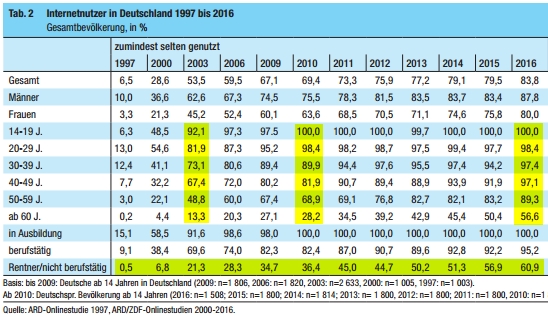
The emergence of the Internet is very well documented, for example, in the ARD/ZDF online studies for Germany. There are countless other such studies. In order to assess a future change in consumers, it is not necessary to look at existing consumers, but at those who will follow.
These latecomers, the Internet users in the 14-19 age group, amounted to 6.3% of all young people in 1997. Three years later it was already at 48.5% and another 3 years later at 92.1%. This group was one of the fastest to adapt to the Internet. And although these young people were not yet particularly relevant for the existing market at the time, they represented a customer base that is relevant today. In this column from 2003, you can see the Zalando customers of today, so to speak.
By 2003 at the latest, it was clear that the Internet would play an important role in future society. The next generation was socialized with it and of course still is, as 100% adoption rates in the following years show. At the same time, acceptance of the Internet also increased among older groups. The curve for pensioners is also impressive, with a value of 60.9% in 2016.
You never buy that online?
Internet use does not yet mean online shopping. And it was obvious at the time to assume that products that also need to be haptically qualified would not be bought online. But that was only a superficially logical argument.
After all, Internet use means customer frequency: there are potential customers in a room. At the time, it was only logical that sooner or later, corresponding (online) stores would have to be created to cater to this customer frequency. And that sooner or later solutions such as free returns and the like would be found to counter disadvantages such as the lack of haptic qualification.
It is quite astonishing that entrepreneurs who think in terms of customer frequency have not made these considerations. Because where there is potential, it will be exploited.
The reason why Zalando exists is the failure of the major fashion retailers to correctly read the development of Internet use and to exploit the resulting entrepreneurial opportunity.
The emergence of new players who recognized this potential is nothing groundbreaking. It was only the failure of the established players to exploit this potential that made it possible. And to continue to exploit it.
Would have, would have bicycle retail chain
People say that everyone always knows how to do it. Some before and others after an event. And yes, it is of course easy to look at statistics in hindsight and explain or substantiate a profound change. But it has to be said, it was pretty obvious.
To make matters worse, many e-commerce consultants, such as the Swiss Thomas Lang, have been drawing attention to these developments in online and stationary retail for years and raising awareness of them. If you code in fashion retail today, you can’t claim that nobody warned you in advance.
Well, the past is past. Lamenting about it is of course tedious. But it is important to admit your own mistakes. Because these are the basis for being able to exploit opportunities in the future. Self-awareness is the first step on the road to recovery.
Self-knowledge
It is precisely this self-awareness that I miss when I hear these statements from shrinking or bankrupt providers. It’s always everyone else’s fault. That doesn’t exactly make me optimistic for the remaining players.
Because time is now getting really tight for many. This can also be seen from the figures. In addition, the willingness of consumers to (also) buy online is increasing. In “stationary language”: consumers walking down the street are not just doing so because they want to stop off at Facebook, but because more and more of them actually want to shop.
Developing the necessary expertise and strategic direction as a retail company is already difficult from a position of strength – it now seems almost impossible under pressure. We will see more store closures and bankruptcies. I fear it has only just really begun.
Artikel auf Social Media teilen: