Customer-centric pricing
Anyone who reads here often knows that I think products and services should be designed to be as customer-oriented as possible. Of course, this doesn’t stop at the price. While the customer basically just wants to pay as little as possible and, as we know, you can’t start there because performance has its price, price modeling has a very significant influence on the customer’s willingness to make a decision. This is especially true in the software sector, where complicated and cumbersome pricing models have almost become a tradition over the years. Spryker, the relatively new eCommerce software provider, is breaking new ground. With a pricing model that is simple and customer-oriented.
(Reading time: 4 minutes)
Pricing as part of the customer experience
Pricing is a key element of the customer experience. If you make it complex and expensive, customers are less likely to choose your product. I would even go so far as to define the price as the fundamental user story of the product. If it does no good, it does no harm.
Price model does not equal calculation
Please do not confuse the price model with the service or product calculation. This is essential so that you know what lower sales you need to generate in total, e.g. across all products. The price model deals with the distribution and organization of these required sales, broken down into conditions that the customer can classify.
Establish a relationship between the value of the product and the price
In fact, the pricing model is all about enabling the customer to establish a relationship between the value of the product and the price to be paid for it as quickly and stress-free as possible.
Many companies get carried away here with sophisticated pricing models. In theory, these are usually super-fair for the customer because they try to take the polluter pays principle into account. This is the provider’s point of view.
From the customer’s perspective, however, it is primarily the value of the service or product that is compared with the price. And in many cases, this no longer has much to do with the costs generated by product consumption. So what seems fair and logical from the provider’s point of view is rather inhibiting for the customer.
I think the number one rule is to approach the pricing model from the customer’s point of view, so it has to take into account the customer’s value and not the provider’s costs.
Simplicity
The second important point is the comprehensibility of the pricing model. If the customer has to take countless factors into account in order to calculate a price. If these factors are easily changeable, and/or even worse, the changes to these factors cannot be influenced by the customer, it becomes increasingly difficult for the customer to relate the value of the product to the price.
So make sure that the customer understands which price is relevant for them almost immediately by using clear pricing models that are as simple as possible.
The ideal pricing model
The ideal pricing model is designed in such a way that the customer
- paid for the value of the product resulting for him
- has the lowest possible entry barrier to using the product at all
- as the value of the product decreases, less is paid for it
- as the value of the product increases, less is paid for it in relation to the gradient
- understands the pricing model immediately, and I mean immediately
Spryker Pricing
Until now, pricing models in the eCommerce software sector were not ideally aligned with these principles. In most cases, you had to buy a relatively high initial license and as the online store grew, additional costs were added. Everything from the turnover of the store to the number of orders, the number of servers and the number of users was tested. Sometimes even combined, which caused and still causes additional confusion.
This had negative consequences for Spryker. When I spoke at the eCommerce Forum Karlsruhe in January, quite a few people were interested in Spryker. However, there were also numerous comments that the barriers to entry were very high because the basic license would cost around EUR 100,000. Such price tags, whether they are true or not, quickly get stuck in the minds of decision-makers.
Spryker has now changed this pricing. It easily fits on the much-quoted beer mat.
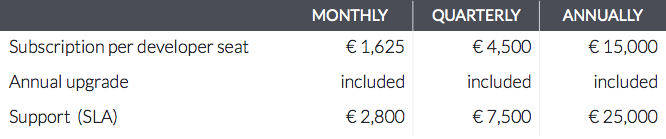
Spryker comments on the model on its website with the following 3 sentences:
You pay per developer seat. You can flexibly add or delete seats on a monthly basis. It gets cheaper if you book longer terms.
That says it all when it comes to understanding the pricing model. Super-simple: If you don’t understand this, you will probably have a hard time with many other things in your eCommerce project.
Benchmark
So let’s briefly benchmark the Spryker pricing model against the 5 points mentioned above.
Value from the customer’s perspective
Is fulfilled, as it is completely logical for the customer that the more developers he has on the project, the more interaction he will have with the software.
Entry hurdle as low as possible
In fact, the customer can set up the project and take the first steps with a developer and thus a license. It is quite clear that a large eCommerce project, for which Spryker is primarily intended, will require more developers and therefore the fees will also increase. But the entry hurdle is simply fundamentally small.
With decreasing value, pay less
This is of course related to point 1 and is due to the fact that if the customer has fewer developers on the project, he simply has to pay fewer licenses.
Pay less in relation to usage as usage increases
This is because there are these volume discounts. Two simple levels: Quarterly package and annual package.
Comprehensibility of the model
I don’t think you can make it any easier in this area.
Conclusion
Well done, Spryker! Not simply following industry standards, but cleverly evaluated and developed. This model gives Spryker an additional advantage in the market. And that’s ultimately what it’s all about.
Artikel auf Social Media teilen: