Developing democracy further? A conversation with Hannes Gassert.
Over the last two years I have written several articles on the evolution of politics(Digital Politics – How digitalization will change politics & What if politics is the problem?) . There was a great response – probably also because of one or two controversial statements. In a society that is changing rapidly, the systems that regulate it – to which I count politics – must inevitably also change and evolve.
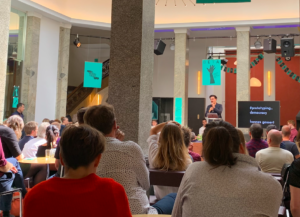
Three weeks ago, the “Democracy Festival” on this topic took place in Basel, Switzerland. Enthusiastic about the idea, I registered and exchanged ideas with Hannes Gassert, who gave the keynote speech.
Hannes Gassert, there are probably very few people in the Swiss digital scene who don’t know you. As this blog is also read by many Germans, who are you?
I am a digital entrepreneur and activist. I help build companies, the software forge Liip for example, the strategy developer Crstlthe crowdfunder Wemakeitnon-profits such as the programming school for refugees Powercoders or Opendata.chthe Swiss branch of Open Knowledge International o working with startups like Tadah or Democracy.ch. And for many years I have been doing digital politics in the background. Slowly, with small baby steps, I am now moving more into the foreground. Because it’s time for digital responsibility. In politics too. That’s why I’m currently running for the National Council in the canton of Zurich. In Germany, that would be the Bundestag. Whew.
Three weeks ago, the Democracy Festival took place in Basel, where you gave a fiery keynote speech on the topic of political willingness to change. Did the festival live up to your expectations?
It was a beautiful confluence of all kinds of currents that have one thing in common: A progressive spirit of optimism and the idea that our democracy still has its best days ahead of it. There were the people who are working with Wevote to get voter turnout above 50%. There were the campaigners for parental leave, the Extinction Rebellion, but also Professor Gilardi, who analyzes the digitalizing politics at the University of Zurich – and so on. And so many participants that the event was simply full far in advance.
To be honest, as a visitor I was a little irritated at first. If the aim is to further develop democracy, I would see it as a basic requirement that participants from all political camps take part. During your keynote speech, I looked around the room and wondered where, for example, the civic representatives were. The chosen venue is not exactly a neutral ground. How do you see it?
Sure, the place is politically influenced, it was and still is the headquarters of the people behind the initiative for an unconditional basic income. But it is not party-political. I also saw a lot of people in the audience who later represented opposing positions in the workshops. But yes, of course, the projects presented in the workshops as applications of new democratic processes were rather left-wing. No question about it. But it also somehow makes sense that new approaches are not the domain of conservatives.
Nevertheless, I thought the event was quite successful. What I perhaps missed a little were concrete systemic approaches to change in order to “migrate” the democratic system into our time. I am also aware that this is a very tall order. What do you think needs to happen to ensure that politics can keep pace with the rapid technological and resulting social developments in the future? How does it need to evolve?
Yes, that would have been a different occasion. Well, I am convinced that we need to reform our institutions. For one thing, our state must change. From the inside out, in order to provide the services we expect from it more quickly, more effectively and more efficiently. More service design, more agility, more open source, more genuine, really good collaboration. To OneTeamGov one has to think of the Presidential Innovation Fellows (which I help to port here), in Switzerland perhaps the state laboratory. Then there are structural reforms. For example, I have already called for a technology departmenta decentralized one with a strong focus on AI. On the other hand, the legislature needs just such an update. And then, of course, there is the question of the system as a whole, which naturally poses completely different challenges in Switzerland with its direct democracy than in other countries. But all of this requires people who are willing to participate. And people must be at the center of all this. This is exactly what I did last week TeamHuman was launched last week.
Crystal ball question: What will the political system look like in 2060?
I hope that we will not only make better, more informed decisions, but also faster. Yes, the autocrats will always be faster, there’s no need for a democratic process. But fast is the new strong, and we must not become too slow in comparison, even if that is sometimes our strength. I hope that we make more and more decisions in the functional areas that are affected. Sometimes that’s my street, sometimes Switzerland, sometimes the whole of Europe. Sometimes the whole world – keyword climate. We want to continue to uphold the principle of subsidiarity, to make decisions as locally as possible. But in more dynamic units.
I hope that we can increase the range. Not just send a yes or no, 0 or 1 in a vote, but be able to express ourselves in a more differentiated way. I hope that we citizens will be able to contribute more and more ideas, real participation instead of mere nodding off. I hope that we as citizens will not only be able to give orders through votes and elections, but also receive updates and learnings about what happens afterwards. We will smile about how we gave political input long after “fire and forget” and then were rarely able and allowed to understand exactly what actually happened afterwards. Build-Measure-Learn is what you call it in your start-ups. I hope that we will have citizen time budgets for this. I hope that we will have banished the huge influence of big money more and more from politics and brought full transparency to political funding. In 2060, the arguments should have more power than the marketing budget. I hope that the good idea counts for more than who lasted the longest in a marathon session. I hope that we will have the right to vote for foreigners. Because anyone who is part of society here should have a say, no “taxation without representation”. I hope that we will then have a voting age of zero, as a counterbalance to democratic development. And of course I’m not just hoping, I want to work on exactly that.
What do you think of “liquid democracy” and “parliamentary” and “non-party” approaches? One thesis, for example, says that representatives of the people were mainly appointed because we were not technically able to organize direct voting and elections in the past. With today’s means, a “liquid democracy” approach would at least be possible in terms of organization and costs, so it would be better to do without the system of elected representatives (with the negative phenomena of lobbying and corruption).
The complexity of business is great and is increasing. The speed is also increasing. Accordingly, not everyone can always be an expert in everything and systems are needed to represent interests, if only to reduce complexity. I also suspect that, sooner or later, similar patterns would emerge in a system like liquid democracy. With working groups, interest groups, influencers… and so on. A liquid democracy can be just as corrupt and more susceptible to hacking. And lobbyists can wield more power the less their counterparts know. Accordingly, I am critical of whether we would be any further ahead if we were to digitally atomize our political network into individual parts. But with all that: Yes, of course, we must continue to work on democracy. If we want to preserve it, we have to develop it further. What stands still dies.
Switzerland is doing surprisingly well politically compared to other countries; in other words, we manage to work out solutions that are politically acceptable to the majority and still manage to bridge the gap between party fights. Why do you think this is the case and how can we ensure that this remains the case in the future?
Switzerland is a village, the distances are short. And we have practiced direct democracy for a long time. Referendums that really make sense are not easy to achieve. There has to be absolute trust in the system, the right questions have to be asked and information has to be secured. We can do that; a story like Brexit, where many people thought it wouldn’t count after all, would be almost unimaginable here.
And it helps if you know each other. Our parliamentarians bicker in front of the camera and then go to the after-work beer on a first-name basis.
The population is considered to be disenchanted with politics. Why is this the case and what can we do about it?
When I look at the climate youth, when I look at the women’s strike: It seems to me that the opposite is the case. Despite all the complaints about “Americanization”: I am very much in favour of “hot” politics, with emotion, passion and humanity. We need more of that, I want more of that.
When I talk to colleagues who are entrepreneurs, the majority of them tell me that politics is simply perceived as a big waste of time and that they therefore never get involved in politics. You yourself are a high-profile entrepreneur in the digital sector and are now running for the National Council. I have great respect for everyone who gets involved. On the other hand, why are you doing this? What do you hope for the country, what do you hope for yourself?
I’ve been doing this in the background for many years, but only now is it slowly becoming visible to the public. Open source, open data, such “niche” topics of “digital sustainability” have also been on my political agenda for a very, very long time. But slowly but surely, I no longer want to give input, provide ideas and contribute expertise, I want to be more direct and closer to the issues.
And in the end: I work for impact. Whether I achieve this with a non-profit, a start-up, a service company or with a party in parliament: it doesn’t matter. The only thing that counts is the impact.
No worries about sitting in the Federal Palace soon and thinking that I could actually achieve much more out there?
As the saying goes: If you’re not at the table, you’re on the menu.
When I asked you on Twitter whether you were running for a party, you replied almost apologetically “Yes, the parties. Difficult, I know. I’ve done a lot around them for 10 years now, so it has to be like this”. Isn’t the fact that you hardly stand a chance politically without belonging to a party a fundamental problem of our political system? After all, it inevitably pits relevant opinions against each other politically and thus encourages the further polarization of society?
The big, old parties need to renew themselves. You can also see that in our neighboring countries. I want to work on this, because mine, for example, has been around since 1888. There is so much history in it, so much blood, Switzerland and tears, so much lifeblood: it’s sustainable. Because the historical dimension is really important to me, politics is such a long-term affair… What we discuss today may have an impact in 10 years’ time. So the historical background helps me as a foundation. Because if you don’t know your history, you’re doomed to repeat it.
One approach would be a “party of independents”, which I personally think would have a pretty good chance. Even if that sounds strange at first. A party that only takes care of the administrative day-to-day business of porting candidates, but does not itself have a political program and therefore no election and voting recommendations. What do you think of that? Utopia or a possible counter-movement to the ever-increasing polarization on the left and right?
That’s a bit like what the 5-Star Movement in Italy is trying to do. Everything is presented to the members online, there is little in the way of a program in the true sense – apart from not being the establishment. It obviously worked. But it remains to be seen whether it will work in the long term. I doubt it, because the compass that a party’s basic stance gives you over the years helps a lot not to get lost in the storm.
What are the three most urgent and serious challenges that Switzerland must solve as a country in the next four years?
- We need to clarify our relationship with Europe. Geostrategically, we don’t even need to discuss Switzerland’s sovereignty if we are not part of a self-determined, strong Europe. This is a question of basic security. Because the world is becoming less secure.
- We must master the consequences of demographic change. Secure pensions, ensure the dynamism of society and its performance. Even if we are getting older and older.
- We have to come to terms with climate change. Stop what we can stop, mitigate the consequences where we have to. Invest massively in open innovation, similar to how the WWW was invented here in Geneva at CERN or the Higgs boson was discovered – and all of this was available to everyone worldwide at no extra cost. Can we do that with the climate? The money would be there, as would the brains?
- We need to take a new approach to the issue of migration and integration. More constructively and together with the issues just mentioned, which all have a major impact on this. I’ve already called for the digital asylum application on site, but it’s about more fundamental issues.
Representatives of the digital economy are few and far between in the federal parliament, even though our industry will soon be the most important in Switzerland. Do you also have contact with other political protagonists who were or are active in the digital industry?
Of course. But of course, there are more farmers and even more lawyers. Some say we need a digital training program for parliament. I say yes: the program is called elections.
Digital initiatives regularly turn into a debacle in the federal context. Especially in the important issues of e-voting and e-ID, I am dismayed to see that these fundamentally important issues are obviously not being tackled with the necessary priority. Why is this the case and what needs to happen for us to make progress here? More “Gasserts” in politics?
Of course :)
Last but not least: Pitch for Hannes Gassert as National Councillor. Why should the people of Zurich vote for you?
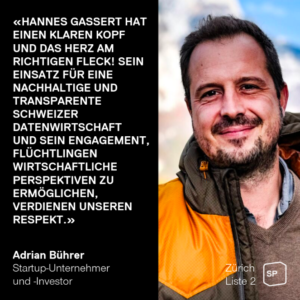
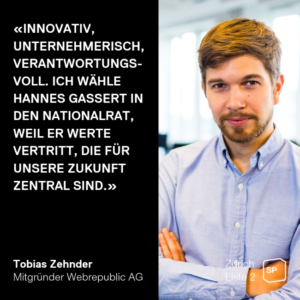
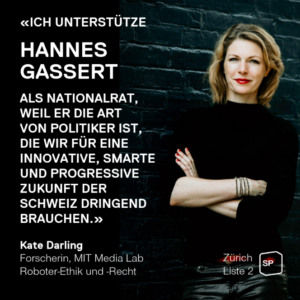
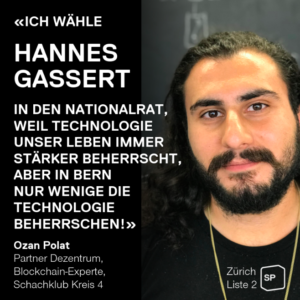
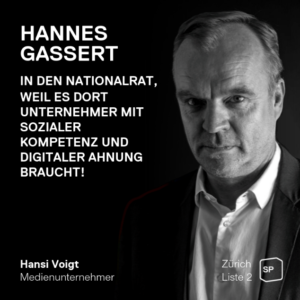
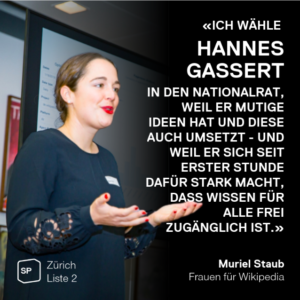
I’d better let the voters speak for themselves:
Dear Hannes, thank you very much for the interview and good luck!
Merci! :)
Artikel auf Social Media teilen: