Service-Post: How do I increase my personal productivity?
In a retro a few months ago, part of my team told me that I had an “inhumanly high level of productivity” (whatever that means exactly…) in the things I do. And; I should show everyone how I organize myself and how I do it. I then put together an internal presentation about all the companies I work for and – oh, how ironic – didn’t manage to make the deadline because I kept finding something else more important. So this article here is a kind of service article for our teams.
(Reading time 5 minutes)
Dealing with pressure, stress and exhaustion
Everyone reacts differently to pressure, stress and dealing with it. Basically, I believe that you don’t have stress, you create it yourself. A lack of time is often cited as one of the main causes of stress.
What many people perceive as a lack of time is in fact a lack of overview of the importance and urgency of individual tasks. If I have a large number of tasks and don’t know which I have to tackle when and how, uncertainty arises. If I am under pressure to deliver in this state of uncertainty, I am hounded by deadlines that suddenly burst in, by times that don’t add up.
Discipline and order
To deal with this, I have relied on a system of discipline and order for years. That sounds rather old-fashioned and boring at first. But it actually helps me enormously to know what I need to concentrate on at any given time. I think I can only pay a limited amount of attention to one thing at a time.
Discipline & order beats passion by far. Sorry.
So the less I have to worry about coordinating tasks, the more I can focus on the actual tasks themselves. In other words, when I’ve started a task and am working on it, I literally block out everything else in inner peace.
The system is very simple: I see creating order as a task like any other. And I try to be as disciplined as possible when working through the tasks. In other words, I don’t do anything other than the tasks I have set myself.
Planning as a lifestyle
I think many people today see planning as a bad thing and have the wrong idea of what the aim of planning is. I think the purpose of drawing up a plan, be it for big or small things, is not to do something exactly as planned – by hook or by crook, so to speak – but to show a possible variant of implementation.
Everybody has plan, until they get punched in the face.
(Mike Tyson)
It is more about understanding the priorities and dependencies of the tasks. To assess the impact of a work result. In short, to get a picture.
Don’t panic!
It is quite normal for priorities to change. It’s also normal for things to come up. Getting emotionally invested in these things is therefore completely pointless, so you can let it go. It’s extremely important not to let this upset you mentally. I generally believe that people who are easily rattled lose much more often and lead a comparatively difficult life.
Even when pretty crazy things happen – both good and bad – (and yes, unfortunately they do happen more often than I would like) I just tell myself “Don’t panic” and usually just ignore them for the time being. As a result, I have remained functional in many critical situations and was able to deal with the situation quite well immediately. The most important thing is that my judgment and ability to act is much less restricted.
Local separation of quiet and team work
My tasks mean that I often have to work on something in peace and quiet. I set aside 3-4 hours early in the morning for this (I’m a real morning person), which I use consistently. Later in the morning, usually at 9 a.m., I join one of the teams and take care of my team tasks there. This separation of the two types of work has brought enormous benefits for me.
Practical approach
So much for the theory and vision. In practice, my personal organizational toolkit consists of a simple Kanban board (Trello). This is divided into “Backlog”, “This Week”, “Tomorrow”, “Today-Ruhearbeit”, “Today”, “NOW”, “Waiting for others”, “Done”, “Next Week” (from left to right).
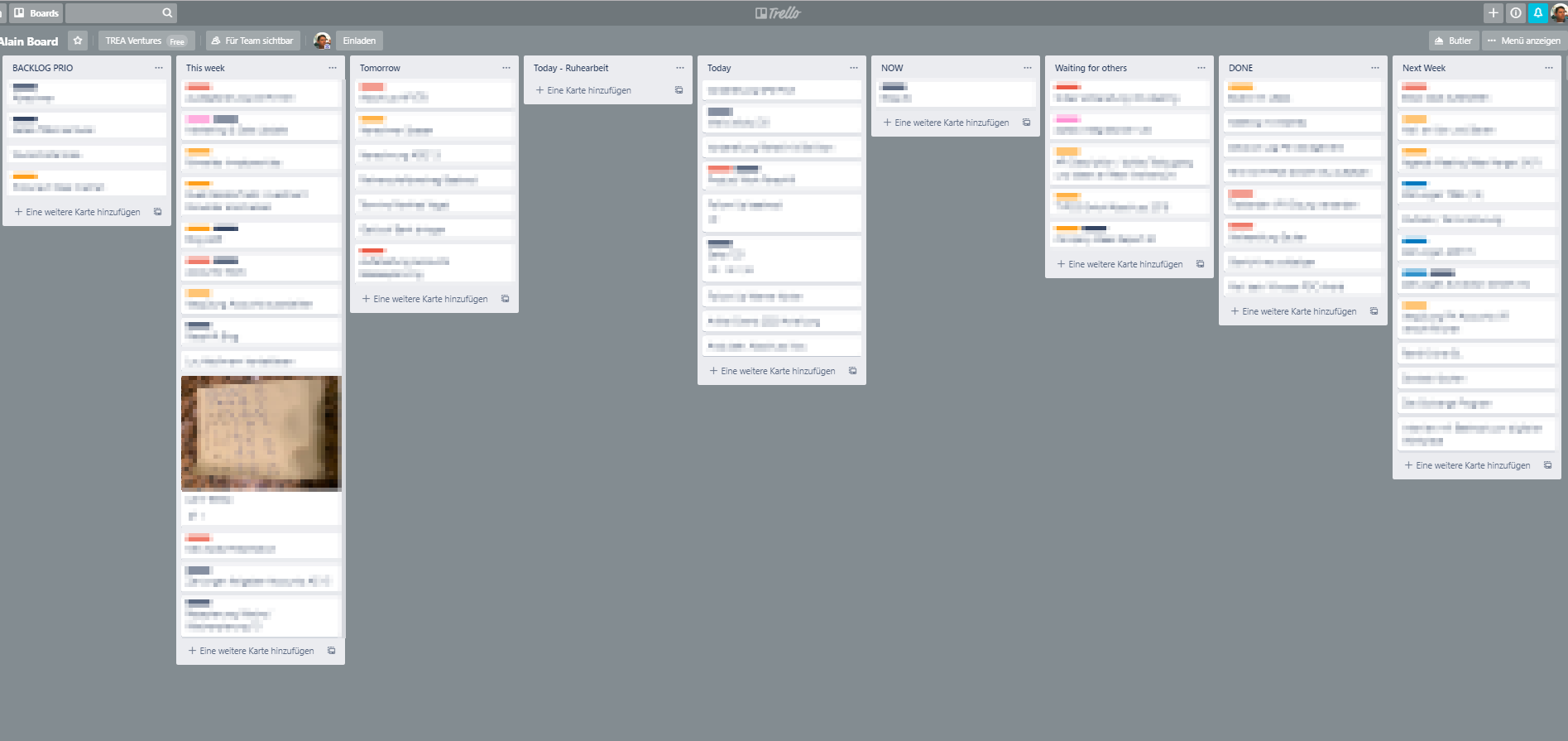
I use this board to consciously plan my week, the next few days and the actual day. In other words, the last thing I do the day before is put together the tasks for the next day. I usually do the same on Sunday evening for the whole week. Every task, every idea – simply everything I can think of goes on the board. And I consciously decide how important the task is when planning. If it is so important that I have to do it straight away, another task is removed from the daily schedule. If I can’t complete tasks within a reasonable period of time, I inform my peers by email.
The “NOW” column contains the task I’m currently working on (at the moment “Blog AV”). When I show this to someone, they often smile at me a bit, saying it’s a lot of effort, a bit childish. I don’t think it is; on the one hand, it’s always a good feeling to set a task to “Done” (ok, but that’s really childish), on the other hand, you often get pulled out of the task by phone calls etc. and it’s hard to find your way back.
Getting back to the task you were already working on as quickly as possible is essential. I often notice that people do something completely different after an interruption and then get back to the actual (prioritized) task. It was no different for me in the past. The loss of time is immense.
15 minute intervals
I have found that dividing my daily schedule into 15-minute blocks works best for me. This probably has a lot to do with personal preference and the type of work you do. Whenever possible, I try to complete tasks in multiples of the standard clocking in the Rest Work block. This clocking is important for intuitively estimating tasks. The clocking also specifies the maximum number of tasks that can theoretically be completed per week.
On average, I look after my companies for around 80 hours a week, so the maximum number of theoretically possible tasks is 320 per week. Minus travel time and lost time, there is probably room for around 250 small tasks per week. I have already managed 217 once. Knowing this quantity structure is extremely important so that you don’t over- or underchallenge yourself.
Travel time = working time
Another important point is to use unproductive time as productively as possible. My commitments require a lot of time on the road (a good 15-25 hours per week, mainly on the train). I use this time consistently. Sometimes I only write half an e-mail between changing from one train to another. But all in all, I use a lot of time that I would otherwise just “wait and see”. Ultimately, it’s just a matter of getting used to it.
Say no and do nothing
Although a truism, it is worth noting here. The best way to become more efficient is to leave things out completely. Over time, I have learned to separate important things from unimportant things with razor-sharp precision and to invest my energy in such a way that I always do what serves my long-term goals. That’s why I also radically reschedule meetings when other things become more important. This is often not pleasant for me and those around me, but it ensures that I am usually really mentally present in the things I do.
How far you want to go with personal efficiency is up to you. This is both a blessing and a curse: A blessing because everyone works differently and has a different attitude, a curse because many people have no awareness of what they are doing with their time. This is not limited to the business world. My urge to organize myself as well as possible is due to the awareness that my remaining time is extremely limited. What this creates for me in my perception is a feeling of really having a lot of time. And in the end, I think that’s what we’re all about.
Artikel auf Social Media teilen: