The creeping end of the workplace as we know it.
The Swiss initiative for an unconditional basic income was rejected by the people, which was to be expected. The concerns about a radical change to the system are too great and all sorts of frippery was interpreted into the banal initiative text from all sides. It is quite obvious that the core of the debate has been overlooked. Namely, the question: What will work look like in the future and how will it be commercialized?
(Reading time: 4 minutes)
The existing system works well
The Federal Councillor’s reaction on the Sunday of the vote was consistent with his previous statements. Swiss television summarizes Federal Councillor Berset’s comment (in French) as follows:
“For Federal Councillor Alain Berset, the clear ‘no’ to an unconditional basic income shows that the Swiss people want to stick with the current economic and social system. It works well, Berset told the media in Bern. Those who need support are supported. The system is regularly adapted, for example with the current pension reform. There is no need to revolutionize it.
Digitalization and automation have an impact on work, Berset admitted. Profound changes of this kind have already had to be dealt with in the past.
However, it is possible to respond to such developments with good training opportunities, research and innovation as well as stable social security. It had been an interesting debate, but he was pleased with the clear result, said Berset.”
It now sounds as if the debate is over. However, I think we are only at the very beginning of this discussion about what human work will look like in the next 100 years. The Federal Council has just demonstrated impressively that they do not understand how serious the changes of the next few years will be. We urgently need a discussion about changing the system.
Because the economic system is adapting a little every day. Even today, some economic principles are no longer valid. However, the social system is lagging far behind. The political process cannot keep up with this pace. And demographic developments are adding fuel to the fire. You don’t have to be a specialist to realize that the system as we know it today cannot be financed in the long term. Even the reform of the reform of the reform won’t help much.
Not money, but power
On the other side, the initiators are positively surprised by the result of the vote. The debate is only just beginning and the idea has also attracted a lot of attention abroad. And then Daniel Häni, himself an entrepreneur, talks about the issue of power: the UBI is not about money, but about power, and people don’t like to give it up.
As if there were an “inner circle” that controlled and subjugated the people in Switzerland. In Switzerland, where no one has to starve, no one has to work if they don’t want to, no one has to beg, everyone can take part in political discourse. Everyone gets a fair trial. I have never seen a country where there is more perfection, more prosperity and greater social peace.
Most people here, I must conclude, have no idea how things are going in the world. Otherwise they wouldn’t always be complaining and moaning.
Since I (unbeknownst to me) don’t think Häni is that short-sighted, I can only attribute his statement to a hidden disappointment. The people on the initiative committee showed foresight and ran an incredibly good campaign. And paradoxically, they have shown that political discourse on the future of the country is possible beyond party gardens.
Work is always part of the equation
If you want to have a better life beyond social security, you have to do something about it. This will not change and would not have changed with the UBI. However, it is quite unlikely that this will be the job as we know it today. As is so often the case, it is worth taking a look back.
The workplace as we know it is only around 150 years old
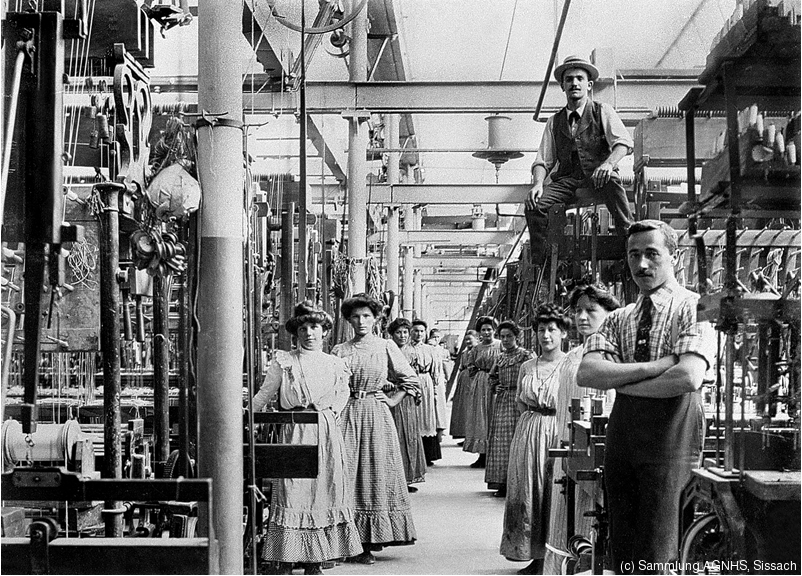
Before industry centralized work, it was completely normal for the whole household, i.e. men, women and children, to contribute to the family’s income. This not only applied to farm work, as one might think today, but also to production. In the valley where I live, silk ribbon weaving was a cottage industry for a long time. Everyone’s work was an absolute necessity and a matter of course. Factory work was also considered inferior, as the workers lost their autonomy in terms of time management and pace of work.
In 1864, the canton of Glarus, equivalent to a federal state, enforced a restriction on working hours and a ban on night work for everyone – a first in the whole of Europe. In other words, also for children. In the canton of Baselland, a factory law was then passed in 1868 that only allowed children from the age of 12 to be employed. The usual working time at that time was 10 hours.
This separation of home and work also created the division of roles between men and women’s work. All this was less than 200 years ago. My grandfather’s grandfather lived during this time.
Further development of the work
This centralization of work and production made a great deal of economic sense. More could be produced and in better quality, and the bottom line is that today’s prosperity was achieved in part as a result.
But I think we are now at a point where these drivers are becoming less important. Production can be freed from more and more human work through further optimization and automation.
At the same time, knowledge work is becoming increasingly important. It’s not completely obvious yet, but we will need a lot of people to advance our technology. And we are not aware of how much work is already being put into certain things. These include many new things that are not yet present in our daily lives. For example, Amazon’s Alexa, a kind of voice-controlled assistant.
The permanent position and the company
The organization and monetization of work via companies and jobs made sense in the industrial age. But I doubt that it still does in the knowledge age.
Because when I, as an entrepreneur, think about how I want to set up my new start-up, I would actually quite like to do it without traditional employees. The whole administrative process and the resulting, sometimes absurd responsibilities are too much for me. That’s something I experience with a lot of people who are entrepreneurs today. They want to remain as lean and agile as possible.
This entrepreneurial need meets the need of employees to be able to determine their own schedule, pace and place of work. The fact that this is possible also has to do with the technology that makes it possible.
A relapse into the 12-hour week?
I can already hear them, the concerns that we will fall back into the exploitative times in such a working world. And yes, the objection is justified.
However, the last 10 years in particular have been characterized by a fundamental change in attitude. Sustainability, especially in the social sphere, is no longer just a buzzword. I am confident that society will find a way to move forward here.
We need a model for the “bogus self-employed”
I think one working model of the future will be in the direction of micro-entrepreneurship. A model in which everyone can work much shorter and more flexible shifts on their own account. Underpinned by a social safety net that cushions him or her when illness or misfortune strikes.
Ironically, this form of work is often prosecuted today as “bogus self-employment”. Instead of promoting such a flexible way of working, it is prevented by all kinds of laws and disadvantages. The positive effects of such a model, such as combining work and home, and collaborative working, are alien to us today. But they will come back, because they are simply more natural and more human.
Unless you do
I think it is rather unlikely that these concepts will be changed through the political process. The debate about this is certainly being conducted in politics. But real change comes from doing.
I’ve been carrying a business idea around with me for a while now that should enable exactly that. Simple collaboration across team and company boundaries. A platform that removes all barriers and enables new forms of work. In accordance with existing laws, of course.
Someone will realize something like this and slowly but surely change the way we organize and remunerate work. Change always comes about because someone does something. From this perspective, Häni may even be right. Because whoever does something has power. Inevitably, whether they like it or not.
Artikel auf Social Media teilen: