Forget the digital natives – rely on experience.
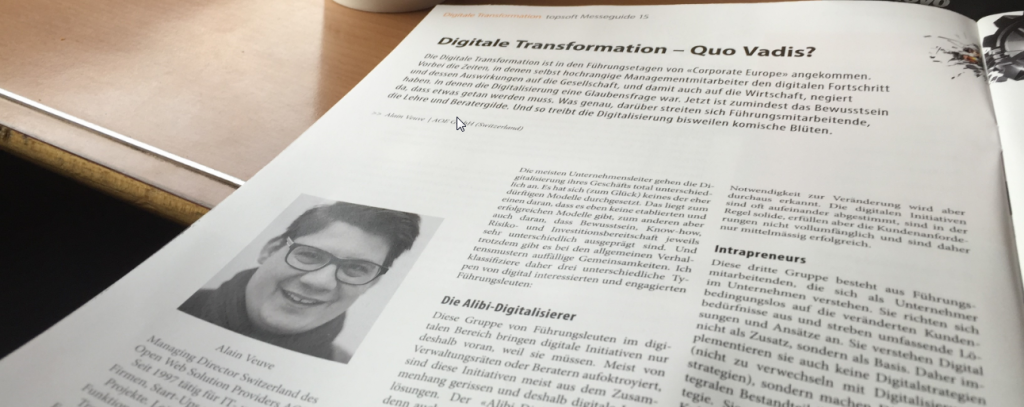
The following article was published in Topsoft magazine in August 2015. I am publishing it here as many German readers do not subscribe to the magazine.
The digital transformation has reached the executive floors of “Corporate Europe”. Gone are the days when even high-ranking management staff denied digital progress and its impact on society and therefore also on the economy. The times when digitalization was a question of faith. Now there is at least an awareness that something needs to be done. What exactly is being debated by managers, academics and consultants. And so digitalization sometimes produces strange results.
(Reading time 5 minutes)
Digital management personnel
Most company managers approach the digitalization of their business in completely different ways. (Fortunately) none of the rather poor models have prevailed. This is partly because there are no established and successful models, but also because awareness, know-how, willingness to take risks and willingness to invest are very different in each case. And yet there are striking similarities in the general patterns of behavior. I therefore classify three different types of digitally interested and committed leaders:
The alibi digitizers
This group of digital leaders only push digital initiatives forward because they have to. Usually imposed by boards of directors or consultants, these initiatives are usually taken out of context and are therefore isolated digital solutions. The “token digitizer” usually does not believe that digital could really benefit the company. They only lead the initiatives because they need to create an alibi within the company and fulfill the requirements. The representatives of this group are often in their final years as members of the management board and don’t want to take any more risks. They put their own interests above those of the company, so to speak, and do not realize that they will get into considerable difficulties in the medium term as a result.
The good-community digitizers
This second group is there out of conviction, but does not grasp the full scope of the changes to be made and therefore does not follow through accordingly. In most cases, there is also a lack of digital know-how. However, the strategic need for change is certainly recognized. The digital initiatives are often coordinated, are generally solid, but do not fully meet customer requirements and are therefore only moderately successful.
Intrapreneurs
This third group consists of managers who see themselves as entrepreneurs within the company. They focus unconditionally on changing customer needs and strive for comprehensive solutions and approaches. They see digital not as an add-on, but as a foundation. This is why they do not implement digital strategies, not to be confused with digitalization strategies, but make digital an integral part of their corporate strategy. They try to establish a culture of change and speed within the company. They create new offerings in a short space of time, test them on the market and let them die again without further ado if they are not successful.
I estimate the distribution among the three groups at 30/60/10 percent, with the group of token digitizers rapidly decreasing and that of intrapreneurs rapidly increasing.
Forms of external support
Some companies are bringing in external consultants for digitalization. Looking back over the last 12 months, I am skeptical about this. Too often, I have seen how digital change is delegated away from company management instead of being absorbed and internalized. These companies are becoming increasingly dependent on consultants because they are externalizing their corporate knowledge, which is now becoming more and more “digital”.
Hiring a Chief Digital Officer (CDO) is another way to drive digitalization forward. Although better than hiring a consultant, this option also has the disadvantage that the other members of the management team can at least partially withdraw from the change process. If the company’s backlog is very large and a lot needs to be changed in a short space of time, a CDO is certainly a good alternative. However, CEOs are well advised to give CDOs a great deal of freedom and competence.
Forget the digital natives
Many companies therefore make sure that managers are as “digital natives” as possible or are familiar with as many technologies and trends as possible. Of course, it never hurts to have IT knowledge. But it should not be a basic requirement for a management position. Rather, managers should have proven that they can successfully master change.
The ability to adapt and reshape oneself and one’s business environment to the constantly changing requirements of customers is the key requirement for successful leaders today.
Whether this leader also uses Instagram and Twitter is perhaps nice, but actually quite irrelevant. The constant stream of new technologies and products ensures that such “qualifications” are becoming even less important.
What remains invaluable, however, is experience. If you think 25-year-olds who are “totally digital” can take large companies and departments much further than older semesters, you are fundamentally mistaken. Such notions and ideas are only popular because today’s managers focus far too often on managing and maintaining the status quo rather than actively driving their business forward. As a rule, they are far too mediocre. But there are enough experienced leaders who have repeatedly adapted and reinvented business models and products. And have been successful with them. These are the really interesting candidates. So go for experience and people who have proven that they can also do business when everything is in upheaval.
Beyond Digital Transformation
This is important because the digital transformation is just the beginning of an era driven by permanent technological change. There is so much new technology in the world’s laboratories that will change our lives forever. Only a fraction of it is “digital” as we understand “digital” today. And this technology still costs a lot of money. Soon, however, it will be available at low cost. We have already seen these effects in the development of computers. There is also no end in sight when it comes to computing power: The first computer with exaFLOPS capacity is expected by 2020. This is roughly equivalent to the theoretical computing power of the human brain. These extreme improvements also have an immense impact on the research and development of other new technologies. The challenge for entrepreneurs is to recognize these technologies and use them for their business. While “your business” used to be a constant, clearly defined area, in future you will be able to redefine your models and business areas again and again. This is probably much more difficult, but also much more interesting and lucrative. We are already seeing the first signs of this.
Digital transformation as the first stage of natural selection
Many companies see this digital transformation as a threat to their business and are trying to hold on to their principles and constants. Sometimes this is confused with values. Two years ago, I was still trying to convince people and raise awareness. Today, however, I take a more relaxed view. No company can exist forever and it is in our nature that we rarely create much that lasts. Ultimately, business is a means to an end.
From this perspective, the companies that fail to master the digital transformation, this first test in the age of rapid change, are the breeding ground for new companies and initiatives. They are not to be mourned. However, I feel that the schadenfreude that is sometimes expressed in the digital economy is totally out of place.
Opportunity
The digital transformation is one thing above all: an incredible opportunity. Every entrepreneur who recognizes this and acts accordingly will benefit from it. I can only encourage you to venture into new areas with optimism, a willingness to take risks and curiosity and to seek out new paths and business opportunities. The possibilities are endless at the moment.
Artikel auf Social Media teilen: