Why Europe Secretly Wants to Be Just Like the U.S.
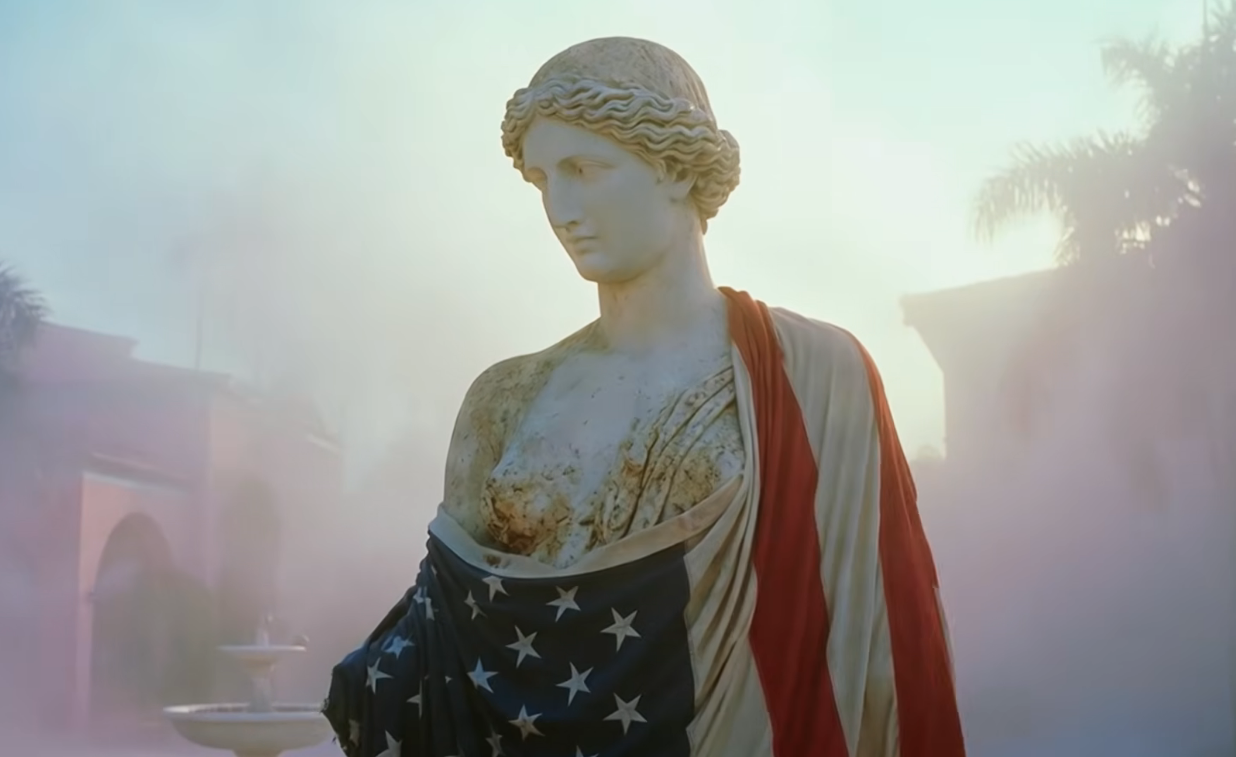
To mark the 250th anniversary of the United States last Saturday, a music video has been making the rounds that is remarkable in many ways. For one thing, the video created by the creator/artist “Heavy Pulp” is almost entirely generated by AI (!). It blends real historical footage, science fiction scenes, and conspiracy-themed scenes in the style of a Katy Perry music video.
But what makes it particularly remarkable is the text. Rarely has anything in recent times captured the current zeitgeist so perfectly. It poses the question “Quo Vadis” to the United States and provides the answer right away: “Literally anything is possible.” For better or for worse.
See for yourself:
A strange feeling
This video kept me thinking all weekend, which was unsettling. Because at first glance, it’s just another heroically staged, patriotic video, and I’m—to put it mildly—not exactly susceptible to U.S. patriotism, were it not for this deep-seated doubt and the bitter jabs at everything that makes the U.S. and the West in general great.
Dancing on the Edge During the Fireworks
A text with an unintended impact in all directions. Below are a few annotated excerpts.
“Oh sweet land, sweet land of the weary and the wild. Oh where, oh where are you, my sweet?”
The U.S. and Europe are searching for their identity as rarely before. The incredible rise of recent decades—those boom years—has increasingly blurred what is worth striving for, fighting for, and dying for. As a result, with each passing generation, people have forgotten more and more who they actually are.
“The garden is either dying or about to come alive. The river is either drying up or deep enough to dive into. I can’t tell if it’s dusk or if dawn is breaking. Are we moving forward, or are we going, going, gone?”
“Are we facing the ultimate convergence or a new beginning?” This is the defining question of the moment, especially for people working in technology. In a perverse way, both are probably true at the same time—we are facing both.
It is foreseeable that the world as we have built it over the past 70 years—with its political systems, comprehensive government structures, regulations, and social welfare—will not be able to continue on the same scale and in the same order as we know it. To say that reforms are needed is an understatement; no, what is needed is a fundamental transformation.
On the other hand, there are many signs that we are on the verge of a truly massive leap forward in technological development. This is an extremely critical, explosive situation, and it is completely unclear whether it will, so to speak, blow up in our faces or serve as a springboard to the next level of prosperity for humanity. Literally anything is possible right now.
“So tell me, is it going to be free energy forever, or just the same old grind?”
You really can’t put it any more succinctly than that. While technological changes are happening far too quickly for the general public, many in the tech world are longing for the ultimate breakthrough. “Free energy forever” is the ultimate symbol of this.
“Are we one year away from the grave, or is this just the beginning of my sweet child? Oh, you’re my star-spangled dream, half a savior, half a liar.”
Then there’s this merciless reflection on its own myth, especially on the 250th anniversary. The country has long known that the “American Dream” is often a sham. But instead of cynically deconstructing this narrative, as we Europeans do, people simply believe in it even more “fervently.”
And in doing so, it indirectly makes it a real possibility. Mind you, of course, such a path—a phenomenal rise in material prosperity—is still possible in Europe as well.
“And nobody can promise me that we’ll make it to the light. So is this an awakening, or is this just another night in the night? So come on, brother, sister, stand up tall, because guess what? When one of us goes, we all go.”
The slogan “Where we go one, we go all” is a rallying cry of the right-wing conspiracy movement “QAnon,” which uses it to signal unity within the movement.
The author ironically applies the slogan to the entire country, to society as a whole. This is as insidious as it is brilliant, and it shows how double-edged all identity ultimately is.
Despite all the political division, this sense of unity in the U.S. is still impressive. And it manifests itself in details that are completely incomprehensible to Europeans:
A few years ago, one morning before the Kennedy Space Center opened its doors, I was standing in the blazing sun as the national anthem played on a large screen—as it apparently does every morning—and about 200 waiting visitors spontaneously turned toward the flag, sang along, and/or placed a hand over their hearts. A chill ran down my spine—partly out of irritation at so much overt, unwarranted patriotism, but also because there was this feeling: No one can break this country.
“If you can hear this from the other side, across this great quantum divide, don’t get me wrong—now is the time to stay strong.”
And then there’s this almost religious invocation of the shared nation—the last, fragile glue that keeps the shared idea alive. The common ground of a country doesn’t have to be particularly broad; it just has to be broad enough that, at the right moment, everyone pulls in the same direction.
In Europe, we’re not particularly good at either recognizing the right moment or pulling together. The reason is simple: culturally speaking, that common ground—no matter how much European leaders might want it right now—simply doesn’t exist.
“So please, just know that we can still rebuild. We can still make something… better.”
The text answers the defining question of our time in the West—“Can we still build something?”—in the affirmative, but not without some doubt.
The West has been “forked”—for ages
Those lines confused me and got me thinking. Ever since Donald Trump gave the Europeans a rude dressing-down, many people in Europe have been demonizing the U.S. And we get the impression that Trump has caused a rift.
I think that’s wrong. In reality, the West “forked” the moment the first settlers established themselves in the United States. It was literally the adventurers—those very “weary and wild” people from Europe—who laid the foundation for the United States. And as for Europe’s poor: It was only about 120 years ago that the municipalities in the region where I live financed the emigration of welfare recipients to the U.S.—never to return—just so they could finally be rid of them.
It is these people who built the United States, and it is this spirit that continues to define the success of the country and the American ideal.
250 years later, this prodigal son is still running rings around us, though not without having to save Europe along the way from a Germany that had gone off the rails. And the current guy in the driver’s seat with the orange hair gives us the middle finger every time with a broad grin.
The Price of Rescue
The price we paid for this salvation was primarily a cultural one: Over the past few decades, everything that came from the U.S. was, at first, dominant. Music, movies, and the economy—our generation absorbed all of that from an early age.
The Americans had thus created the perfect market for themselves, and when China began to function as the perfect manufacturing base for the U.S., an era of relentless growth ensued. This development was accompanied by the narrative of transatlantic friendship. In doing so, the Americans feigned a little more affection for lovely Europe than actually existed. First and foremost, it was a marriage of convenience. Don’t forget: even in a marriage of convenience, people say nice things to each other.
Everyone benefited from this until China itself became a major market and Europe fell behind economically due to ever-rising public spending. It had actually been clear for a long time that this equation no longer held true.
Trump was simply the first to say this—admittedly unnecessarily bluntly—to our faces, here in Europe. But perhaps it took a boor like Trump to show up so that we in Europe would finally understand the signs of the times. And we Europeans stood there like a five-year-old boy who’s just found out that the Easter Bunny doesn’t exist.
Quo vadis?
This question of “what next” comes at a most inopportune moment for us in Europe. The combination of states acting independently, immense and growing debt, dwindling economic performance, and waning motivation (or the need to perform) is compounded by a gradually setting in depression. Quite a few people would like to take action and bring about change, but where can we go if we don’t know which direction to take?
Tempting Recipes That Lead to Ruin
It is with growing concern that I note the increasingly vocal calls for the state—and, yes, the resurgence of socialism. In almost every European country, there are parties that quite openly seek to “overcome” capitalism. It’s as if we’ve learned nothing from the past.
Capitalism and entrepreneurship have brought us prosperity and laid the foundation for redistribution. A small fraction of entrepreneurs pays for the vast majority of people. If that small fraction were to disappear, everyone would suddenly have to pay more.
And yet, for years now, incentives in Europe to become an entrepreneur and take risks have been systematically reduced. Instead of improving the conditions in which, so to speak, the plants that feed us all can thrive, we are doing exactly the opposite. And then we are surprised when the harvest gets smaller and smaller each year.
As a result, not only will redistribution not be expanded further, but it will have to be drastically scaled back. We thus risk losing the welfare state, which is undoubtedly a major European achievement.
How can we build a great future for Europe?
I think this is currently the most hotly debated issue in business and politics. Many of the factors we need to address to solve this challenge are still officially off the table. It seems we’ll have to get into much deeper trouble before we have all the tools we need to build a truly great future.
It would definitely be a mistake to try to imitate the U.S. Most people in Europe don’t have a clear picture of the U.S. right now anyway. Trump, with his crude manner, has clouded everyone’s judgment; they’re constantly getting worked up about him and are missing what’s actually happening.
I suspect that the future in Europe lies in deep tech. We’ve always been the better engineers; the Americans, the better salespeople. Maybe we just need to allow brilliant engineers to generate a fortune through their work. Maybe maximum economic freedom is already enough to go a long way. Or maybe not. What is certain to accelerate the downward spiral is further worsening the conditions for entrepreneurship.
A little bit jealous?
And what about the Macrons, Merz, and the rest? Well, they probably secretly wish they could speak their minds as freely as Trump does. They’d certainly never admit that. I’d argue that we in Europe would like to be a little more like the U.S.—that self-confidence, that willingness to take risks. Of course, that just makes the situation even more ridiculous.
The image of the United States has suffered enormously in Europe. And it is precisely because of this that we are beginning to stand on our own two feet again—for the first time since World War II. It would be presumptuous to expect miracles.
But anyone who makes plans without taking Europeans into account will not succeed. Perhaps things will go well for a while. But a whole generation of young people is coming up with a different outlook—hungry for the future and, so to speak, unconcerned about pensions—and they will successfully shape Europe.
Because for us, too, the following is truer than ever: “So please, just know that we can still rebuild. We can still make something… better.” Let ’s get to work.
Artikel auf Social Media teilen: