No, the killer robots will not slaughter you.
With the gradual emergence of artificial intelligence, the debate surrounding technological developments is broadening. The influence of technology on our society and our understanding of culture is becoming stronger. In these discussions, I observe time and again, there are many false expectations. First and foremost: that there will be a battle between technology and humanity. I think that’s fundamentally wrong.
Intuitive but illogical
This idea that a battle of technology against humanity will develop is intuitively correct at first. We have all been socialized with it for years. In two ways:
On the one hand, there are countless books and films that describe exactly this scenario. If you’re not older than 45, you’ve had this idea with your mother’s milk, so to speak. We saw the same scenario, for example, in “The Matrix”, in “I, Robot” (by the way, originally written by Isaac Asimov in 1950), in the Terminator series or in sci-fi works such as “I have no mouth, and I must scream“. If I had to make a list, it would easily be as long as this entire article.
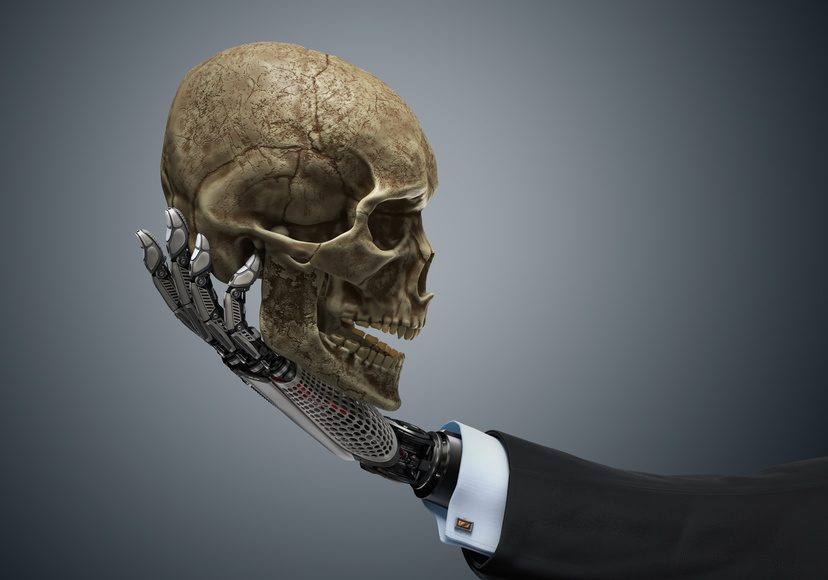
On the other hand, we have been very aware of the impact of technology on all of our lives over the last 100 years. It has changed the way we live together. It has constantly challenged our idea of how we communicate, work and even love each other, and we have therefore had to and must constantly find new answers to the question of how we deal with it. While these technologies bring enormous advantages for us humans, we also perceive them as disruptive factors due to these permanent adaptation processes.
None of this is logical.
What feels intuitively right is not really logical when we take off our social glasses. Because the development we see is a different one: Ever since technology has existed, we have been using it to improve ourselves. This is a process that has been going on for centuries.
If you like, even banal tools are nothing more than a technological improvement of ourselves. Think of knights’ armor. With the relatively newly acquired skill of forging iron so delicately, wouldn’t there have been more skillful and better ways of protecting vulnerable people? I think so.
But, and I think this is what people are primarily concerned with, they used the most obvious way and improved people themselves. The use of the smartphone is another such improvement. It is, so to speak, today’s “standard augmentation” for knowledge and communication. The majority of people have an almost symbiotic relationship with their smartphone. Whether you perceive it that way or not is irrelevant. We have been a man-machine complex for a very long time.
Physical fusion of people and technology
I think that the development we will see is not technologies that become independent, but people who, through technology and direct networking with each other, gain abilities that are still unimaginable today. We can see a small and admittedly banal foretaste of this, for example, in so-called exoskeletons, which make it possible to release special physical forces, e.g. to carry out storage and assembly work more efficiently and gently. All this technology is still in its infancy. However, there is an intuitive path for adapting it.
Prostheses pave the way
Paradoxically, this development, i.e. the physical connection between technology and the human body, is paving the way for what is now considered a human trait: we care for the sick, disabled and injured. It is precisely this attitude that allows us to question our physical integrity in favor of technology that is foreign to us. The inhibition threshold is low for people with disabilities of any kind. They will do anything to improve their own situation.
The technology for artificial limb replacement, for example, is still in its infancy and is extremely expensive. However, it is much more advanced than is publicly perceived. As soon as we have people in our circle of acquaintances who are fully functional again with artificial limbs after accidents or illness, we will accept this as something natural. Just like a pacemaker today, for example.
Once this has happened, the path to non-medical, artificial and greatly improved technological, non-biological changes to the human body is not far away.
We have seen a very similar development with operations in recent years. Initially an act of blasphemy, later an adventurous tightrope walk, today in many areas a standard procedure that is completely harmless. And non-medical cosmetic surgery operations are now accepted and perceived as a valid option.
Now, the benefits of cosmetic surgery do not justify the cost and effort for the vast majority of people. Imagine, however, that the benefits of the procedure were not a straight nose but, for example, a 5x better memory. The majority of people would make such changes in the short and long term. And as soon as the generations change, standards will be set in this respect. In other words, it’s no longer a question of whether you have such improvements made, but rather that you don’t have them.
“Superhumans”
Depending on technological progress, this direct adaptation of technology to strengthen ourselves will sooner or later create what futurists call “superhumans”. People who, through technological “augmentation”, acquire abilities that are fundamentally superior to those of their (unchanged) fellow human beings. I think this poses the greatest danger to us as humanity. At the same time, it is also a great opportunity. This is, by the way, an almost tried and tested human pattern.
Technology vs. humanity
One of the biggest advocates of the “Technology vs Humanity” idea is Gerd Leonhard. He has written a book with the same title and tours the world giving talks on the subject. His main point, greatly reduced, is that a tipping point will be reached when the “technological singularity” is reached, at which point technology will supplant humanity and humanity. I do him an injustice with this simplification – of course he deals with various aspects of this – but in the end it is about the question of whether technology will displace us. And, the author’s message is that we need to look at how we can defend our position as humans on different levels.
I can recommend reading the book, even if I found it highly repetitive and the underlying “apocalypse pathos” seemed out of place. The book is valuable, however, as it provides a lot of inspiration and indirectly raises the question of the definition of human beings. What are the core values and characteristics that define human beings?
A purely biological human future is an obsolete model
What many people don’t realize is that the definition of what constitutes a human being is constantly in flux. When we approach the topic of “technology vs. humanity”, we always base “humanity” on our snapshot. This makes one part of the discussion unsound. And we have no idea either way about the nature and speed of technological development, and I say this after years of working on the subject. It is too complex to grasp at the moment.
The more philosophical discussion about what constitutes humanity once we move away from the purely biologically associated definition seems much more exciting to me. I am convinced that sooner or later we will mix so much with non-biological technology – and I mean physically – that the biological part will become irrelevant.
What remains if we leave out all the things we do today out of biological constraints?
The urge to explore
I think that if there is one thing that defines us as a species, it is an irrepressible urge to explore. We can’t help but constantly develop new possibilities and try out these possibilities according to all logic and reason. If necessary, we subordinate everything to this urge.
All the great things we have created on this planet stem from this urge to explore. All the terrible things, too.
In my opinion, this urge for exploration also gives rise to the will for self-improvement. And we will continue on this path with technology. For better or for worse.
“Humanity 2017” will disappear and that’s a good thing
So the question is not whether “humanity” will prevail over technology. Technology will remain the means to the end of further developing humanity. The fact that we will constantly redefine humanity along the way is in the interests of our cause.
Our idea of humanity will be completely different in 100 years’ time. But it was the same 100 years ago. Because although we perceive ourselves as being driven by developments, we don’t realize that we are in fact the drivers of these developments. And that is the most difficult point in the whole discussion.
Artikel auf Social Media teilen: